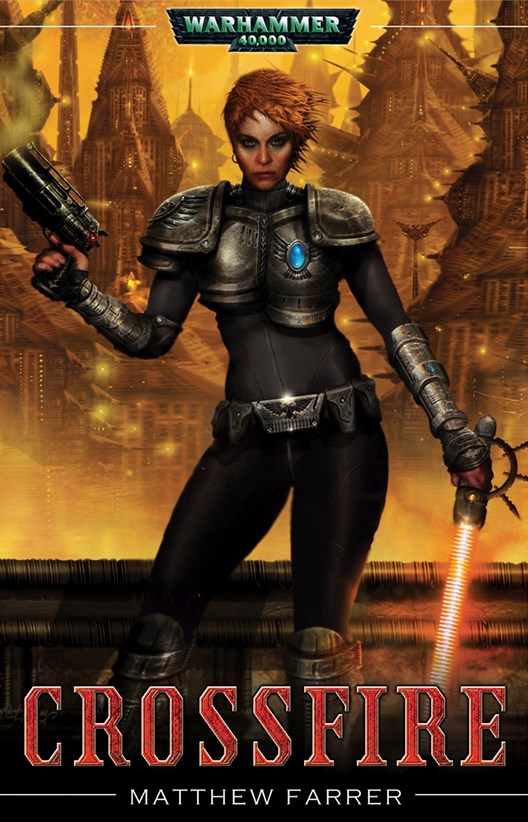
Warhammer 40,000: Crossfire by Matthew Farrer

Publisher: Black Library (Paperback – 1 January 2003)

Series: Warhammer 40,000: Shira Calpurnia – Book One

Length: 320 pages

My Rating: 4.25 out of 5 stars

Amazon

I finally got around to reading the awesome Warhammer 40,000 novel, Crossfire.  A classic entry in the Warhammer 40,000 canon with a cool crime fiction twist, Crossfire was a great novel that serves as an excellent first entry in Farrer’s Shira Calpurnia trilogy.

In the grim future of the 41st millennium, order and control of the massive Imperium of Man is maintained through the strictest interpretation of Imperial law, with no room for variation or leniency.  The ultimate arbitrators of this law are the dedicated members of the Adeptus Arbites, elite law bringers, trained to weed out corruption, dissent and disloyalty wherever they are deployed.

Shira Calpurnia Lucina, recently promoted arbitor senioris of the Adeptus Arbites, has been assigned to the bustling dockyards of the Hydraphur system.  A glistening gem of Imperial rule dedicated to providing material to the navy, Hydraphur is a seemingly unlikely place for dissention.  But this elite planet harbours dark secrets which come to the surface after a deadly assassination attempt is made in public against Calpurnia amid the distraction and celebration of a major religious festival.

Attempting to uncover who would want her killed after only just arriving on world, Calpurnia begins her relentless investigation.  However, this is no simple case, and soon Calpurnia finds herself forced to navigate the many plots and schemes of the Hydraphur elite.  With more attacks striking close to her and the fate of the whole planet seemingly in the balance, Calpurnia must uncover all Hydraphur’s secrets before the assassins stalking her finally succeed.

Crossfire was an excellent and compelling Warhammer 40,000 novel from Farrer that proved very fun to get through.  Featuring a fantastic plot that is one of the earlier examples of a crime fiction narrative melding with the iconic Warhammer 40,000 universe, Crossfire was a great read and one that is worth checking out.

I liked the captivating story that Farrer came up with for Crossfire, which quickly gets the reader’s attention with a powerful introduction to the protagonist, as she quickly finds herself under fire from a lethal assassin.  Serving as a good start to the main investigation arc, the plot follows the protagonist as she attempts to uncover the identity of the assassin, while also learning more about the planet of Hydraphur.  While a very lore-heavy story, Farrer keeps the plot going quickly and effectively, especially as there are soon more apparent attacks against the protagonist, each of which give her more clues to follow to try and find the mastermind of the plot against her.  At the same time the protagonist gets bogged down in dealing with various other interested parties on Hydraphur, including the planet’s local elites, agents of the Imperial church, the Adeptus Mechanicus and the Inquisition, each of whom have their own interests in finding out who is trying to kill Calpurnia.

While Farrer keeps up a good pace for Crossfire as the plot continues, I do think that he might have overloaded the narrative with details about Hydraphur’s society, as well as the various plots that infest it.  While these serve as good red herring motives for the protagonist to follow, it did overcomplicate the plot at times, which slowed things down even amid some great action sequences.  Despite this, the overall narrative for Crossfire was quite strong, and you get hooked into the continued investigation, especially as the author kept raising the stakes of the case.  After some exciting scenes, everything leads up to the big final confrontation, as the protagonist fully unwinds all the conflicting conspiracies they’ve been forced to encounter.  The conclusion was a sufficiently intense and over-the-top fight, which you need in Warhammer 40,000 fiction, and I liked the clever way the protagonist was able to turn the tables on the antagonist, even if the set-up for it was a little heavy handed.  An overall excellent Warhammer 40,000 plot that nicely tells its own story, while also introducing the character for the larger trilogy.

I’ve previously had a lot of fun with previous Warhammer 40,000 novels that utilise strong crime fiction elements in their story telling, such as Bloodlines by Chris Wraight and Grim Repast by Marc Collins, as there are some outstanding crime narratives in this grimdark universe. Crossfire is an interesting early example of this utilisation of crime fiction in Warhammer 40,000 fiction, and I felt that Farrer did a pretty good job of building a compelling investigation around this fantastic setting.  The resulting story is a layered and intense read that sees the protagonist slowly unwind the case amid various battle sequences and other dark distractions.  The relevant clues, hints and misleading details are well scattered throughout the plot, and I felt there was a good amount of foreshadowing to some of the key plot reveals.  While some story elements and conspiracies came a little out of nowhere, for the most part this was a concise and ordered novel, well told through the perspective of the protagonist.  Farrer excelled at fitting a ton of interesting and heavy lore elements in the plot, and I particularly appreciated how well he utilised his setting throughout the story.  The various plots and schemes of planet’s noble families and prominent organisations, as well as the elaborate religious festival the novel is set around (ceremonial details of which are cleverly included at the start of each chapter), are expertly worked into the larger plot, and it was fascinating to see how they impacted the story and drove the investigation.

One of the more entertaining elements of Crossfire I enjoyed was the narrative’s compelling characters.  The focus is primarily around series protagonist Shira Calpurnia Lucina, the arbitor senioris through whose eyes we see the story unfold.  Calpurnia serves as an interesting central figure, especially as she provides an outsider perspective to the complex setting.  While Farrer writes Calpurnia as a somewhat bullish and highly determined figure that is initially hard to appreciate, I felt that this was an intentional choice by the author, which reflects the typical attitudes of the Arbites in the general Warhammer 40,000 setting.  Forcing her to deal with the more subtle techniques needed for the politically delicate Hydraphur brought in some interesting conflict for Calpurnia, as well as producing some interesting character growth.  Despite this, the outsider status of Calpurnia continues to be a compelling plot feature throughout Crossfire, which Farrer utilised extremely well with his writing.  The rest of the cast, while less prominent, adds some complexity to the plot, and I enjoyed the compelling array of fellow Arbites members, the gentry of Hydraphur, and other prominent figures in the planet’s hierarchy.  I particularly enjoyed the motivations of the book’s eventual antagonist, which had a great hint of madness behind it, and this was an overall excellent group of characters.

While I really enjoyed Crossfire’s compelling story, I must admit that this wasn’t the easiest Warhammer 40,000 novel to read.  The plot details of Crossfire are very dense, and it takes a lot of effort to absorb and follow the story.  I felt this was especially noticeable in the small-print paperback version I had, and you really had to focus to take everything in.  As a result, this one probably wouldn’t be a recommended starting point for a new Warhammer reader.  Farrer utilises a lot of intricate details about the Warhammer 40,000 universe that even people casually familiar with the franchise are going to struggle to follow at times.  While most new readers can probably follow along well enough through context, I would suggest it’s best enjoyed by veteran fans who will probably have a lot more fun with it.

Overall, Crossfire by Matthew Farrer was an awesome Warhammer 40,000 novel, and one that I was glad I finally got the opportunity to read.  A compelling crime fiction novel that makes great use of Farrer’s complex setting, Crossfire proved to be an exciting and interesting read.  While not the easiest novel to get through at times, Crossfire proved to be an excellent piece of Warhammer fiction and I’m hoping to get through the rest of the Shira Calpurnia trilogy soon.

Amazon

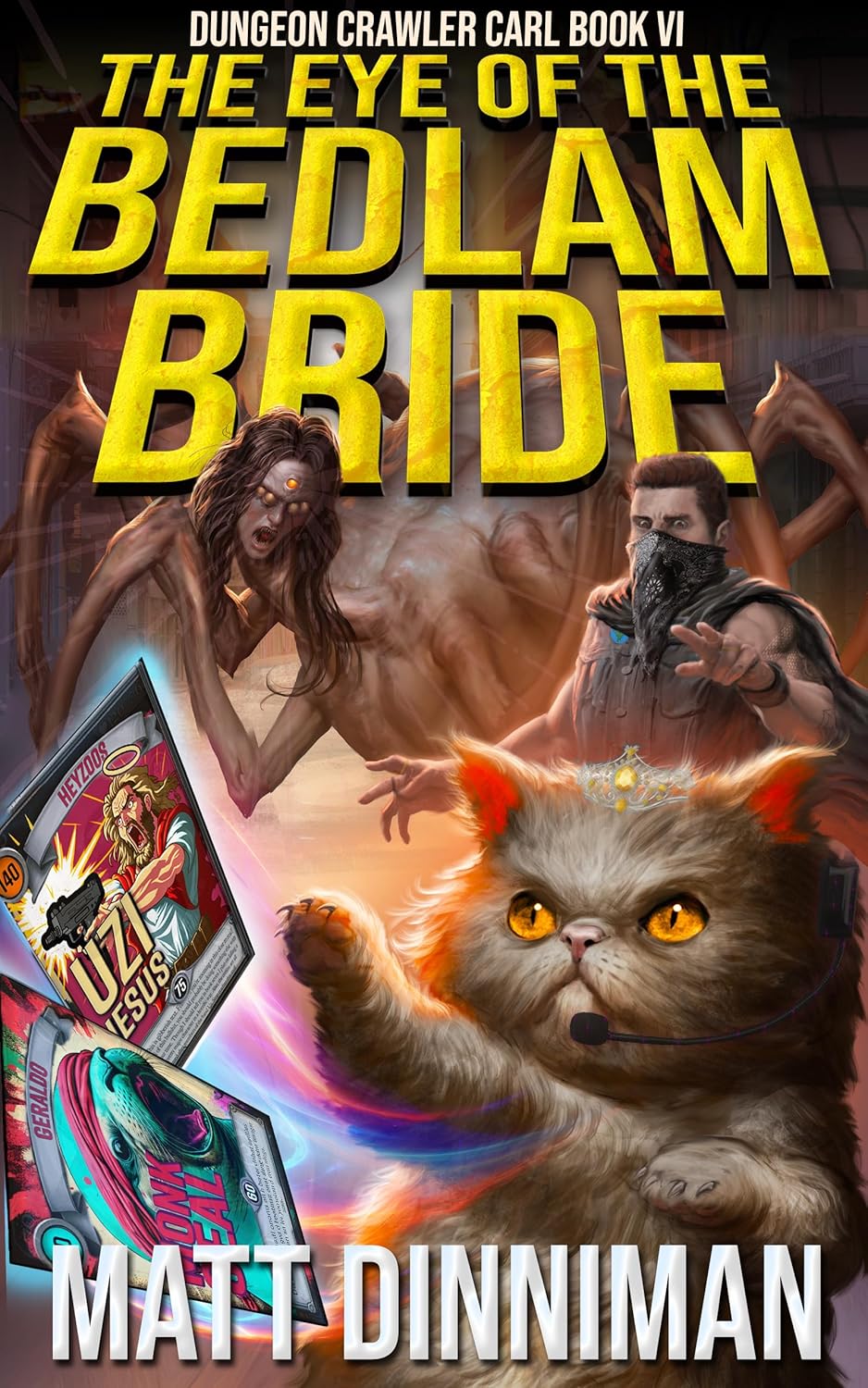
The Eye of the Bedlam Bride by Matt Dinniman

Publisher: Soundbooth Theater (Audiobook – 2 July 2023)

Series: Dungeon Crawler Carl – Book Six

Length: 26 hours and 46 minutes

My Rating: 5 out of 5 stars

Amazon

The chaotic fun of Matt Dinniman’s Dungeon Crawler Carl series continues in epic fashion with the ultra-impactful and deeply addictive sixth entry in the series, The Eye of the Bedlam Bride, an exceptional novel designed to strike hard at the reader’s emotional heartstrings.

As you might have guessed from my recent flurry of reviews for this series, I am seriously in love with the Dungeon Crawler Carl books.  An impressive and surprisingly deep LitRPG series, the Dungeon Crawler Carl novels follow a collection of compelling characters as traverse a deadly fantasy dungeon created from the ruins of all of Earth’s buildings by aliens for intergalactic viewing content.  Set around a damaged protagonist and his excitable and now sentient cat, these books are deeply addictive, and once you start the series you really can’t stop.  Indeed, I literally just chain-read the entire series, with awesome books like Dungeon Crawler Carl, Carl’s Doomsday Scenario, The Dungeon Anarchist’s Cookbook, The Gate of the Feral Gods and The Butcher’s Masquerade all proving to be outstanding reads.  I loved these previous books so much, that I instantly started listening to the sixth book in the series, The Eye of the Bedlam Bride, the first chance I got, and boy was I in for an incredible time with it.

After barely surviving the Butcher’s Masquerade and then witnessing the surprising end to the seventh floor, Carl and Princess Donut are exhausted and traumatised by recent losses.  However, they have no time for rest as they find themselves thrust into the dangerous eighth floor of the dungeon.  One of the most ambitious levels so far, the eighth floor is based on a map of Earth’s final days, filled with intangible ghosts of the humans who wandered the world mere weeks before the planet’s death.

However, this is not a perfect replica of Earth; instead these locations have been seeded with monsters and mythological figures based on twisted accounts of Earth legends, with each creature tied to the geographic area their folklore originated.  To complete this level, the crawlers are tasked with finding and capturing six of these monsters and turning them into cards, which can then be summoned to fight alongside their new owners.  Each team will need to find and convert as many powerful creatures as possible to create the best decks, especially as they will be forced to face off against mobs and other crawlers with their own cards.

Unexpectedly starting in Cuba, Carl and Donut navigate an unfamiliar location as they try to learn the new mechanics of the game.  Determined to get to the next floor, Carl and Donut endeavour to find the best monsters they can.  However, the stronger the monster, the less controllable the card, and Carl and Donut will soon have their hands full managing a strange array of summonable creatures, including the legendary demon Shi Maria, who has far more independence than they would like.  Can Carl and Donut survive this new floor of the dungeon, or will they finally be crushed by their dark secrets, troubled pasts and Carl’s slowly eroding sanity, especially once he looks into the eye of Shi Maria, the Bedlam Bride?

Just when you thought this series couldn’t get even better, Matt Dinniman amps up the intensity and complexity of his plot and characters a whole additional notch, with one of the more moving and powerful entries in the entire series.  The Eye of the Bedlam Bride was an absolute masterpiece that featured the author’s trademark LitRPG chaos, while really showcasing his impressive writing ability.  One of the best books in an already incredible series, The Eye of the Bedlam Bride was so damn good, and it gets a very easy five-star rating from me.

Dinniman pulled together another brilliant narrative for his sixth Dungeon Crawler Carl novel, as They Eye of the Bedlam Bride perfectly continued the long-running series storylines while also presenting its own unique adventure.  Thrusting the protagonists into a complex new level, Dinniman quickly showcases all the floor’s new elements, including a fun card-based combat mechanism that fits into the existing dungeon battle system surprisingly well.  While the pacing is initially a tad slower to ensure the readers fully appreciate all the necessary lore and gameplay details of this book’s plot, Dinniman quickly works to show that The Eye of the Bedlam Bride isn’t a filler novel between the pivotal fifth and seventh books.  This becomes especially clear during a major sequence that requires Carl and Donut to make a deadly choice while surrounded by several vengeful gods.  Dinniman also makes sure that a major secret from the previous book is brought into the light early, complicating protagonist relationships and presenting them with dark choices.  Dinniman swiftly follows this up with some very awesome sequences, such as Carl and Donut coming face-to-face with their most problematic card, demonic carnage in a night club, and problems from the wider universe caused by Carl’s ambitious and rebellious plots.

While all these early elements are great, The Eye of the Bedlam Bride hits its storytelling height about halfway through, as Dinniman amps up the emotional stakes of the narrative.  Forced to compete in a gruelling series of battles that test the unique fight mechanics of the floor, the protagonists find nothing but heartbreak as they near the end of the second phase of the level, including a truly horrifying and deeply personal big boss.  All this follows a series of impactful personal revelations for Carl, that hit his already fragile mental state hard and finally provides full context for character background elements that have been hinted at throughout the series.  This central part of the story was so damn heartbreaking, and you really must appreciate how Dinniman can make you laugh before loading up substantial sorrow and regret and producing some beautifully crushing sequences.  While these scenes are emotionally charged, I appreciated how Dinniman often tempered them with more heartwarming moments that show the connections the protagonists have built up during the series, and the author does some amazing character work in the second half of this book.

Everything perfectly leads up to the incredible final third of The Eye of the Bedlam Bride, as Dinniman raises the stakes as only he can.  With the protagonists forced to compete in a brutal third and final phase of the floor, events soon break down into pure chaos with undead hordes, demonic possessions, crazed gods and various rival crawlers all coming into play.  Dinniman keeps the story moving so fast in this last part of the book, as the protagonists dive into key battle after key battle.  I actually ended up listening to the last several hours in one day as I just had to see what happened next.  Following one of the most tragic scenes in the series, which nearly broke me, Carl and Donut race to save as many people as they can from the AI’s inventive endgame, leading to an all-out battle royal in the middle of Cuba.  I loved how so many story elements from the entire book came into play for the conclusion after some clever set up earlier in the plot, resulting in some very epic moments.  The ending was a brilliant mixture of humour, intense action, extra lore, and some particularly dark moments for the protagonists, which came together beautifully and ended the novel on a real high.  Throw in some last-minute reveals that really amp up the excitement for the next book, and this was pretty much a perfect narrative that is guaranteed to keep you hooked all the way the bloody end.

I honestly feel that The Eye of the Bedlam Bride was one of the best-written entries in the entire Dungeon Crawler Carl series, and frankly I am still not over every single amazing moment of this book.  Dinniman achieves so much in this impressive novel by simultaneously changing the rules of his own game while also providing the deepest examination of his complex protagonists yet.  At the same time, he makes a novel that most authors would have turned into a filler entry into one of the series’ most impactful books.  I was really impressed by how the author chose to further amp up his various storylines and character arcs in this book, and Dinniman perfectly carries on the craziness of The Butcher’s Masquerade while building up the oncoming calamity of the seventh book and the long-awaited Faction Wars.  Naturally, this means that The Eye of the Bedlam Bride is best enjoyed by those who have read all the previous Dungeon Crawler Carl books first.  Still, for those who are determined to dive in here, Dinniman provides enough context and flashbacks to ensure you can easily follow what’s happening, and there is even a fun summary at the beginning.

This sixth novel in the series brings back all the impressive humour, intense action, and great LitRPG elements that made the previous Dungeon Crawler Carl books so damn good, while also bringing in some impressive new features, primarily a fun new battle element.  I must admit that I wasn’t too sure that the card system of this level, which on paper sounded like a crazy combination of Pokémon and Yu-Gi-Oh!, was going to work.  However, I should never have doubted Dinniman as it fitted in amongst the usual chaos and over-the-top scenes perfectly.  Dinniman does an excellent job introducing and then exploring this system throughout The Eye of the Bedlam Bride it proved fun to see the characters adapt to the new rules.  There is some great progression in how these cards impact battles, and each fight with them gets increasingly hectic.  I really enjoyed how big and crazy battles with these cards could get, especially towards the end, and you won’t see protagonists facing off in card duels with gods and demons anywhere else.

There are some additional excellent elements to The Eye of the Bedlam Bride that also enhanced the epic story in some interesting ways.  This includes a haunting new setting of the book, the ghost-filled replica of the pre-dungeon Earth, which really amplifies the feeling of despair and loss that many of the characters feel.  Dinniman continues to also feature a compelling array of LitRPG elements in this novel, and you really find yourself getting drawn into the minutiae of stat updates, item benefits, spell effects, and so much more, as the author cleverly works it into the narrative.  A lot of why these RPG features are so fun is due the chaotic humour that infests every single page of this hilarious book.  The book’s comedic elements are so effortlessly funny and feature a great mixture of sudden outrageous moments with realistic reactions, the insertion of the book’s reality television elements into life-and-death struggles, often inappropriate jokes from the massive and fun supporting cast, and an array of reference focused commentary on all matters of the dungeon.  While some of the comedic moments get a little out of hand: “I need a baby seal”, they all work beautifully in the context of the book’s clever plot, and I laughed myself silly so many times during this book, including at how the day was saved thanks to, let’s say, “crab meat”.  I’m also as appalled as a certain velociraptor that some of the funniest, if weirdest, moments of the book occurred in Chapter 69.  However, what makes The Eye of the Bedlam Bride particularly good is the way in which these comedic elements are well matched by darker, tragic moments, which allows for quite on overall powerful read, especially when it comes to the characters.

Dinniman went above and beyond when it came to the character development in this book, with a particular focus on series protagonist Carl.  After several books laden with hints about his past, we finally get Carl’s full backstory, which really goes to show just how damaged he is.  Dinniman does an outstanding job showcasing this background in several powerful scenes in The Eye of the Bedlam Bride, and I really appreciate how it built on the subtle foreshadowing from the previous novels.  This existing trauma was further enhanced in this book, as Carl also finds out multiple new revelations about his family, including several that had been kept from him (which simultaneously shows just how bad a girlfriend Bea really was).  Throw in his anger and guilt from being one of the few survivors of Earth, and the trauma from all carnage he has witnessed in the dungeon, and Carl really isn’t in the best headspace for this book, and that’s even before the titular Bedlam Bride gets hold of his mind.  As such, there is a lot of dark moments for Carl to unpackage throughout this novel, and Dinniman perfectly captures his protagonist’s continued struggle to remain in control.  This deeper dive into Carl’s psyche produced some of the best scenes Dinniman has so far written in the series, and I really appreciated how these darker moments were well matched by the revelation that Carl now has a true family with Donut and his new friends.  These relationships kept him relatively sane in this book, and allowed him to remain the resilient, if explosively inclined, straight man of the book.  Dinniman also works to showcase how despite his issues and reputation, Carl has become a bit of a legendary figure for his fellow crawlers, and the big sequence at the end where he is able to convince them to follow one of his craziest plans, was just amazing.

While most of this book’s focus is on Carl and his history, the rest of the characters in The Eye of the Bedlam Bride also get their moments to shine, and you continue to appreciate just how awesome the ended cast of this series is.  This includes the other main protagonist, Princess Donut, Carl’s now sentient cat who provides much of the humour in the story thanks to her over-dramatic reactions, silliness, and feline superiority complex.  While Donut is the comedic relief of the main duo, she still has a lot of serious moments in The Eye of the Bedlam Bride, especially while serving as the emotional anchor the spiralling Carl.  Donut is also dealing with her own grief and sadness, especially after the tragedies of the previous novel, and there are some heartbreaking moments where you see her trying to push that down.  Despite her issues and immaturity, Donut role in the plot, especially as she controls the cards during most of the battles, and you get to see her tactical genius in full display.  There are some super sweet moments with Donut in this novel, and I really love how well Dinniman continues to feature the bond between her and Carl as the true heart of this series.

In addition to Carl and Donut, The Eye of the Bedlam Bride also features multiple other key members of the Dungeon Crawler Carl cast, and it is very impressive how much you care for so many of these figures.  This includes Katia, who, despite leaving the team in the previous novel, still has a major impact on the plot.  Dinniman perfectly revisits some key revelations from the end of the previous novel, that adds additional complexities to her relationship with Carl and Donut.  The protagonist’s mentor, Mordecai, also has a key role in this book, especially as you finally get the full context for his tragic past.  This background adds some additional drama to the main story, especially when Carl and Katia find themselves caught in the same feud between forces outside the dungeon that he did.  There is also a certain sweetness to Mordecai’s story in this novel, especially when you find out he’s caring for several NPC children, in ways very contrary to his usual gruff disposition.  Dinniman also perfectly brings back the various members of Carl’s guild, who form a surrogate family with each other, and whose appearance in one scene was one of the most heartwarming moments in the plot.

Other characters of note in The Eye of the Bedlam Bride include the possessed sex doll head, Samantha, whose insane declarations, unhinged actions, unsettling abilities and crazy general demeanour make her one of the funniest characters in the series.  There is also an array of over-the-top monsters and creatures that the protagonists encounter and turn into cards.  These include Uzi Jesus, a kung-fu seal, hilarious caricatures of Carl and Donut, and a crab who must overcome his ‘performance issues’ to save the day, just to name a hilarious few.  These comedic monsters were well contrasted by Shi Maria, the titular Bedlam Bride, whose dark actions amp up the intensity of this book in some powerful ways.  I also must mention a couple of recurring crawlers from previous novels who reappear in dramatic fashion in the final third of the novel, allowing for some of the book’s best moments.  One of these character ends up having one of the series’ saddest moments, and I frankly am still not over how brutally raw and tragic that whole sequence was.

While all these above characters are amazing in their own ways, my favourite character in this series remains the dungeon’s System AI.  Despite never physically appearing, the AI has a major impact on the plot, and you are constantly bombarded by its unique humour in the various descriptions and summaries it provides to Carl and the reader, often full of weird and hilarious references.  So many serious or threatening moments are turned into comedic gold by the AI’s inappropriate commentary, and anytime it provides input to the plot, you are guaranteed to laugh.  While the AI has been fun the entire series, it gets even more unhinged in this novel as it gains full sentience and takes full control of the.  Determined to continue the crawl on its own dramatic terms, the AI starts making things even weirder for the characters, throwing in its own twists and changes.  Dinniman does a wonderful job showcasing just how insane the AI is at times, including with some very worrying inclusions in its usually informative descriptions.  There are also some hilarious scenes where the AI interacts directly with the characters, including one brilliant moment when he responds to Carl’s feedback on its descriptions in a particularly petty way.  All this, and more, allows the AI to really standout in this book, and it is a testament to how good Dinniman is as an author, that a disembodied voice is one of the best characters in a series loaded with exceptional and extremely complex figures.

As with all the previous Dungeon Crawler Carl novels, I ended up listening to The Eye of the Bedlam Bride on audiobook, which is honestly the only way to enjoy the author’s fantastic and chaotic narrative.  Coming in at nearly 27 hours in length, The Eye of the Bedlam Bride was one of the longest audiobooks in the series, but you frankly don’t mind as every second you spend listening to a Dungeon Crawler Carl audiobook is so much fun.  I honestly powered through The Eye of the Bedlam Bride in no time at all, especially the concluding several hours, and I still love how audiobook format brings out all the book’s humour, tragedy and excitement.  A lot of this is down to the series’ awesome narration, which in the case of The Eye of the Bedlam Bride, includes an extended voice cast.  While there are a few voice actors for this particular audiobook, Jeff Hays remained the principal narrator, voicing nearly all the characters and the plot descriptions.  Hays is an incredible narrator, and I loved the sheer range of epic voices he brings to bear throughout the audiobook, all of which fit their associated character perfectly, with associated accents and clever tonal changes.  This includes an excellent reuse of voices for previously featured characters, while the various crazy new cast members featured in this book were also extremely cool.  My favourites for The Eye of the Bedlam Bride remain Princess Donut, who gets autotune in this audiobook to help with her singing (the sound effects for this were brilliant), and the AI running the dungeon, as Hays matches the unhinged energy of the cracked computer and conveys this insanity to the listener with amazing enthusiasm.

In addition to Jeff Hays, The Eye of the Bedlam Bride also features three other actors who voice small roles in the larger audiobook to great effect.  The most notable of these is actor Patrick Warburton, who was an awesome addition to the experience.  Initially voicing the flashback voice of Carl’s father in several heavy scenes, Warburton did an outstanding job of breathing life into a harsh figure we’d only had glimpses of in the previous books, and his appearances here had some real menace to them.  Warburton also gets to have some fun when he plays a secondary character later in the audiobook with some brilliant levels of enthusiasm.  Narrator Travis Baldree was also hilarious with his appearance in The Eye of the Bedlam Bride, voicing a giant crab who becomes one of the protagonist’s cards.  Featuring a comedic accent and some very over-the-top lines, Baldree was just amazing, and I loved the interactions he had with Hays and Warburton’s characters.  Finally, Soundbooth Theater regular Annie Ellicott returns to voice an entertaining character in a concluding skit, which was very amusing on a variety of levels.  I really loved how well these outstanding extra voice actors were fitted alongside Hays’s impressive main narration, and it allowed for a great overall listen.  Throw in the excellent sound effects of the series, some of which alter Hays’s voice in clever ways, or places a voice role into the background of a scene for some interesting ambience, and this was an exceptional audiobook that I loved so damn much.  There is honestly nothing better than a Dungeon Crawler Carl audiobook, and I must once again recommend this format with all my heart.

With a particularly impressive and powerful plot, The Eye of the Bedlam Bride was one of the best books in the already incredible Dungeon Crawler Carl series, and author Matt Dinniman outdid himself when it came to diving into his damaged protagonists.  A highly inventive and captivating novel that I just couldn’t stop listening to, The Eye of the Bedlam Bride was Dinniman at his very best and you are guaranteed to have an exceptional time with this novel, and you will, like me, instantly dive into the next novel of the series, This Inevitable Ruin, just to see what happens next.

Amazon

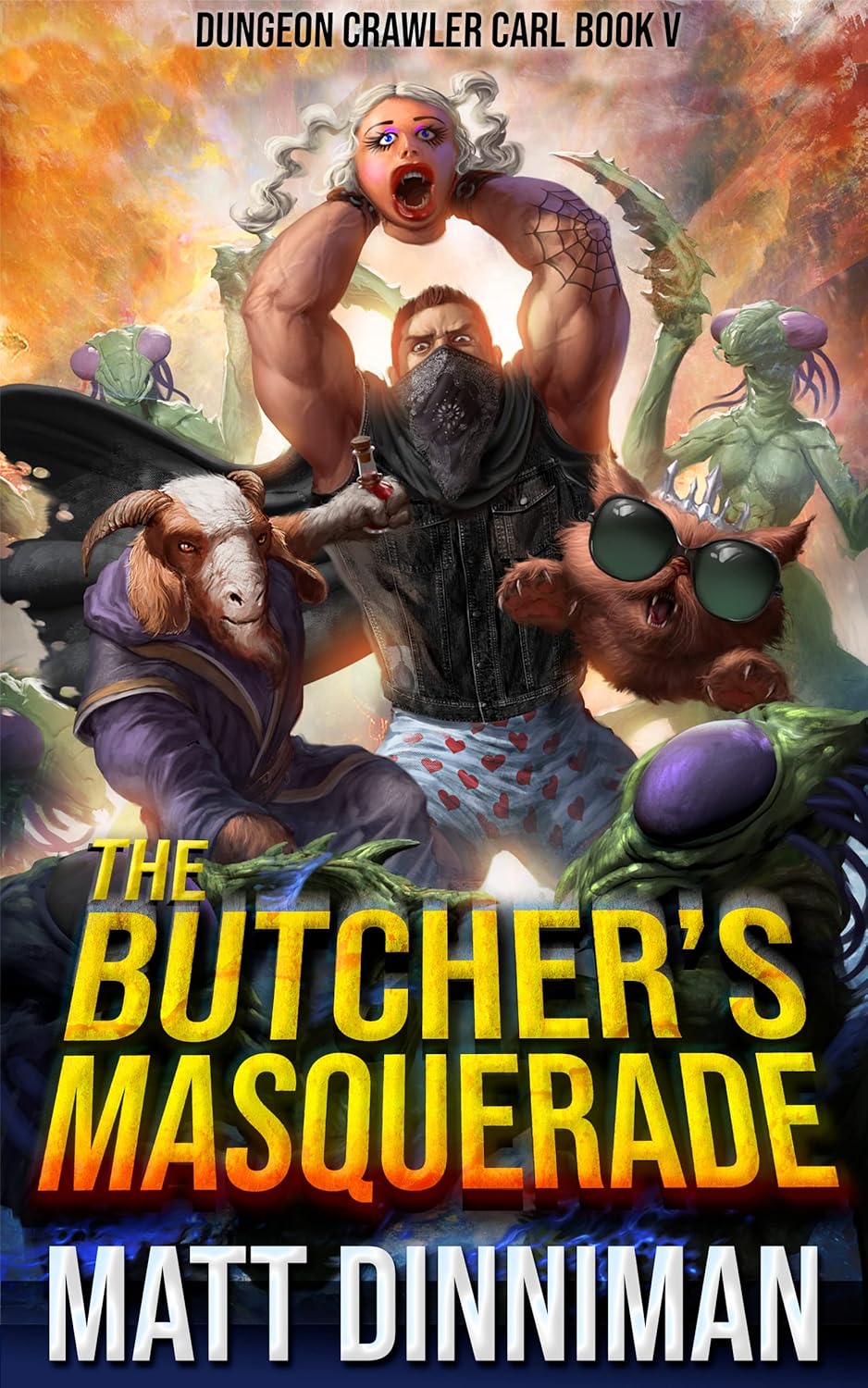
The Butcher’s Masquerade by Matt Dinniman

Publisher: Soundbooth Theater (Audiobook – 28 February 2022)

Series: Dungeon Crawler Carl – Book Five

Length: 23 hours and 33 minutes

My Rating: 5 out of 5 stars

Amazon

The epic adventures of Carl and Princess Donut continue in the incredible fifth book of the Dungeon Crawler Carl series, The Butcher’s Masquerade, which takes the reader on an intense thrill ride loaded with fantastic comedy, crazy action and some incredibly powerful moments.

After doing little else but talk about the series for the last few weeks, I think it’s obvious that I am now a massive fan of Matt Dinniman’s Dungeon Crawler Carl series, a major LitRPG sensation that I have recently become obsessed with.  Featuring amazing books like Dungeon Crawler Carl, Carl’s Doomsday Scenario, The Dungeon Anarchist’s Cookbook and The Gate of the Feral Gods, the Dungeon Crawler Carl series has been nothing but amazing since the very first page.  These books follow reluctant adventurer Carl, his now sentient cat Princess Donut and an eclectic mix of humans and NPCs (and some goats) fighting for survival in a dungeon built under the surface of Earth by entertainment-obsessed aliens.  I have been deeply impressed with the impressive narrative contained within these previous books, so much so that I have listened to all these books in a row without break, often spending hours at a time getting through key parts of the plot.  This fifth book in the series promised to be a major entry with some key plotlines, and Dinniman did not disappoint, presenting a deep and captivating book I couldn’t turn away from.

After surviving the horrors of the previous floor and striking a blow against the wealthy Faction Wars contenders waiting for the human crawlers below, Carl, Princess Donut and their allies have arrived at the infamous sixth floor of the dungeon, better known as the Hunting Grounds.  A lush, jungle level, filled with powerful mobs, intricate quests, and conquerable towns, there are many opportunities for the crawlers to level up on this floor, but also many dangers, including those who would make the remnants of humanity their prey. 

As part of the traditional chaos of the Hunting Grounds, off-world tourists are given their first chance to enter the dungeon to participate in the carnage.  Known on this floor as hunters, these aliens seek to make money by hunting crawlers and stealing their gear.  These hunters have long made the sixth floor the most lethal level for crawlers, whose best strategy is to run and hide from the deadly aliens.  However, this season is going to be very different, especially as Carl has no intention of being hunted.

Determined to punish everyone who has profited from his planet’s destruction, Carl takes the fight directly to the hunters, and his explosive actions soon inspire the rest of the human crawlers.  However, his very public rebellions have placed a massive target on his head, and soon the deadliest hunters in the game, including the legendary crawler killer Vrah, are on his trail.  At the same time, Carl and Donut must contend with far more dangerous human opponents, a horde of rampaging dinosaurs, the vicious whims of the AI running the dungeon, and an elite NPC whose tragic backstory they find themselves dragged into.  But the greatest threat to everyone in the Hunting Grounds lies at the end-of-floor celebration, a party where all the top crawlers will be forced to attend amongst their deadliest enemies.  Everything will be decided at The Butcher’s Masquerade, and no one will emerge unscathed.

Well goddamn, Dinniman, you really know how to throw a party.  Just when I thought this series couldn’t get even better, Dinniman presents The Butcher’s Masquerade, which throws the reader right into the carnage and barely gives you a chance to catch your breath.  Filled with epic moments, brilliant storytelling, insane humour and some of the most complex characters you are likely to find in LitRPG fiction, The Butcher’s Masquerade was an incredible and utterly addictive read that I could not turn away from.  I’m honestly still reeling from the ending of this novel, and there is no way I can give The Butcher’s Masquerade anything but a five-star rating.

I loved, loved, loved the narrative of The Butcher’s Masquerade, as Dinniman hits all the right notes to keep the reader engaged and diving even deeper into his series.  Starting off right after the chaotic events of The Gate of Feral Gods, Carl hits all manner of trouble early on, especially as his actions put a massive target on his head for every hunter.  Dinniman shows you just what kind of book The Butcher’s Masquerade is going to be early on, as Carl immediately teleports himself and Donut into the middle of the hunter base to start his own explosive campaign of resistance.  The story only gets more exciting and compelling from there, with an engaging Elite NPC storyline, various dinosaur themed quests and so much impressive action.  This action is well balanced by scenes showcasing the chaotic changes occurring out in the wider universe, as well as a particularly moving sequence where Carl and Donut are forced to deal with manipulative events with huge emotional implications.

While there are some amazing moments in this first part of the book, the events that really cemented The Butcher’s Masquerade as one of the best entries in the series occur around the middle, as Dinniman brings both fun action and deep tragedy in equal measure.  The first of these sees Carl whisked away to Crawler Con, an over-the-top convention filled with entertaining enemies, right at the moment that he and Donut find themselves under attack in the dungeon.  Knowing that he is going to be teleported back into a massive ambush, Carl spends his time at the convention trying to plan, including crowdsourcing tactics at a panel featuring an opponent’s mother.  The resulting carnage as Carl uses a fun combination of a gonorrhoea-causing arrow, necromancy, friendly fire and explosives (naturally) to defeat his enemies, all to the backdrop of ‘The Ballroom Blitz’, was so damn awesome and fun.  The fact that Dinniman immediately follows this up with one of the most heart-wrenching moments in the entire series goes to show just how talented an author Dinniman is, especially as it also works to set up an outstanding new supporting character as a complex recuring figure.

All this perfectly leads up to the big final third of the book, which starts with some major raised stakes and every ongoing storyline heading towards the titular Butcher’s Masquerade, an event where every major survivor of the floor is trapped in the same room, and the person who starts the inevitable fight is instantly killed.  The tension heading into this event is very impressive, as you wait to see who makes the first move and how the carnage will unfold, especially as the protagonist’s plan to survive has a lot of holes in it.  The contrast between Carl’s despair and the more light-hearted and frankly hilarious antics of Princess Donut (there may be a moonwalking dinosaur, just go with it) is very impressive, and you honestly don’t know what is going to happen next.  The eventual reveal of the big plan is pretty damn amazing, and the resulting over-the-top confrontation is pure Dinniman, who once again manages to exceed the craziness from the previous books with hunters, bosses, and gods.  There is some haunting tragedy thrown in amongst the carnage that really highlights just how dire the entire crawl is for the protagonists, while also concluding some powerful storylines.  However, even after this carnage and its terrible aftermath, Dinniman isn’t done with the readers, whiplashing them with some brilliant and well-telegraphed moments that change everything about the progression of the Dungeon Crawler Carl books.  So many major plot points for the series going forward have their origin in the final sequences of the book, and it will leave you wanting more as soon as possible.

Dinniman really brought all the carnage he could in The Butcher’s Masquerade, and I was really impressed with how this elaborate story unfolded for the readers.  Once again requiring knowledge of the previous novels to fully enjoy (seriously, start the Dungeon Crawler Carl books from the beginning), The Butcher’s Masquerade adds a lot of cool elements to the series, which Dinniman expertly introduces and then utilises in his massive, ongoing story.  Featuring all the cool action, adventure and over-the-top moments you’ve come to expect from the Dungeon Crawler Carl books, Dinniman really amps up the carnage in this fifth novel, while also increasing the drama and powerful character moments.  I honestly found myself sitting at the edge of my seat during some of The Butcher’s Masquerade’s big scenes, as I honestly didn’t know where the story was going to go at times.  The major show-stealing sequences were especially great, and I really appreciate how elaborate some of these scenes were, loaded with multiple moving parts and elements cleverly set up either earlier in the book or even in previous novels.  However, Dinniman ensures that all the scenes in this novel were really entertaining and there honestly are no slow or wasteful moments at all during this awesome novel.

As with the rest of the series, The Butcher’s Masquerade is loaded with a lot of elaborate RPG elements, which are worked into the story extremely well.  While the natural progression of the series and the need to include new things each book means that some original spells and abilities don’t get shown as much, while other RPG elements are somewhat overused, for the most part I feel that Dinniman ensures all the best elements are shown to the reader, and this is one of the easiest LitRPG series to enjoy.  A lot of this enjoyment is down to the outrageous humour loaded into every scene, which allows readers to absorb and even become obsessed with the progression of stats and quests, as well as the gaining of achievements and new abilities and equipment, especially as the series really doesn’t take itself as seriously as other LitRPG books.  While this humour might not be for everyone, I really loved how fun and over-the-top things got at times, and there are so many layers to the novel’s comedic charm.  This includes a combination of overreactions to crazy events, deadpan reactions to other humorous characters, and a ton of fun references, including some particularly subtle ones that are cleverly seeded throughout and may take multiple rereads to appreciate (for example, I only just got the hilarious U2 references loaded into the names of the rock cretin NPCs).  While this humour is very amazing on its own, its true strength lies in the way that Dinniman perfectly balances it with the more serious and darker elements of the narrative, providing some reprieves for the horror of the story, or even helping to emphasise the darkness surrounding the characters as they face death and despair again and again.  I really love the complex balance of themes that Dinniman manages to weave around his elaborate and often silly story, and it makes for quite an impressive read that will appeal to large audience of readers.

I’ve mentioned multiple times in previous Dungeon Crawler Carl reviews that Dinniman is extremely amazing when it comes to writing complex characters to set his stories around.  You really get drawn into the various moving character arcs in this series, many of which progress across multiple books, and it is awesome to see how these figures develop and evolve in response to the dark events of the dungeon.  The Butcher’s Masquerade is an impressive example of this, especially as Dinniman really amps up the drama surrounding several key characters, each of whom have their moment to shine in some outstanding ways.

Naturally, most of the book’s focus revolves around the series’ titular protagonist, Carl, the troubled and intense central protagonist, through whose eyes we see most of the narrative unfold.  Carl really shines in The Butcher’s Masquerade, with his anarchist persona on full display.  Determined to bring his own form of explosive justice to the various aliens profiting from the destruction of Earth and the murderous crawl, Carl eagerly faces off against the hunters who have come into the dungeon, antagonising them as only he can.  Dinniman pulls together some amazing sequences around Carl in this book, especially when it comes to facing off against the hunters in deadly situations, and I loved the methodical and often extreme ways he reacts to pressure, as well as he hilarious performance during Crawler Con.  While he is still mostly seen as the reasonable, if explosively inclined, straight man of the team, Dinniman starts to show a darker edge to Carl in this novel.  Thanks to the continued pressure of the dungeon, the various emotional revelations, his desire for revenge and his own troubled past, as well as a certain magic ring, Carl takes on a more sinister persona at times in this book, especially with the cold way he deals with his opponents.  He also finds himself struggling with all the trauma that comes his way in this new book, much of which is showcased through the appearance of “the river”, a part of his mind that is always moving and brings back his anger and memories of all the evils he has experienced.  The continued torrent of the river begins to warp Carl at times, and this is the book when he starts to become a little bit scary.  As such, there is a lot of emotional depth to Carl in this book, and Dinniman did a great job expanding on his darker personality, while still including all the elements that made him such a beloved protagonist of the previous novels.

While Carl is a brilliant main character, he is usually overshadowed in all the best ways by his sentient cat companion, Princess Donut.  A brilliantly sassy, over-emotional and deeply hilarious diva who still maintains many catlike personality traits, Donut is the perfect foil for Carl, especially when it comes to being in the spotlight, and her overly positive manner in most situations really endears her to the audience, even when she needlessly overreacts.  Dinniman has some real fun with Donut in The Butcher’s Masquerade, as the cat takes on a temporary bard class which requires her to sing to cast spells, much to everyone’s displeasure, and there are so many moments when you get to laugh at her antics.  However, much like Carl, Donut goes through some real emotional turmoil in this novel, not only getting the chance to confront her original owner Beatrice (although Carl was always her true human), but she also deals with some deep trauma as the book continues.  The author loads up some highly emotional scenes between Carl and Donut, especially in the aftermath of the climatic finale, and you grow to appreciate their complicated bond even more throughout this book, even when your heart breaks at some of the trials they must endure.  However, Donut continues to move through the dungeon in her usual over-enthusiastic manner, and it was very fun to see her finally get to perform on the big stage at the end of the titular Butcher’s Masquerade.  The pet talent show with Mongo was one of the funniest moments in the book, while her subsequent singing performance helped to highlight just how far she’d come, and the emotional impact she has on the rest of the cast.  I honestly love everything about Princess Donut, and this was probably one of her strongest appearances in the series.

While most of the story focusses on Carl and Donut, Dinniman at this point in the series has created a truly impressive collection of supporting characters, all of whom have some very compelling storylines around.  The most prominent of them is probably Katia, who has spent the last two books in the main party.  Katia steps away a little from the main character’s plot in The Butcher’s Masquerade, leading her own group of crawlers in a separate storyline to the protagonists.  While it was a shame to have her featured a little less, especially after her impressive appearances in The Dungeon Anarchist’s Cookbook and The Gate of Feral Gods, it fit her character development nicely and showed how much her confidence had grown.  It also allowed for a bigger focus on some of the other extended members of the Guild group that Carl and Donut have become part of, and I think the book benefited from a bigger cast.  Dinniman did go quite dark with Katia at times in The Butcher’s Masquerade, especially in the book’s epilogue, where so many secrets that the author had cleverly been hiding under the character’s surface, finally come to light, especially the final shocking revelation.

The rest of the returning cast was also very impressive.  Mordecai continues to excel as the cranky and practical mentor figure, even if he has been turned into a cute and cuddly little creature this book, much to the team’s amusement.  The trapped and insane god Samantha was hilarious as the book’s mother-threatening comic relief, and there are some truly amusing scenes with her in this book, especially when Carl starts using her as a mobile weapon platform.  The returning former slackers, Louis and Firas, continue to shine in this novel as the team’s pilots, and it was nice to see how much they evolved since their original appearance, while readers also got to spend more time with long-running characters Elle, Imani and Chris.  The Butcher’s Masquerade also features the return of the dangerous Elite NPC, Tsarina Signet, whose dramatized storyline drags the protagonists into all manner of trouble.  Dinniman made perfect use of Signet and her NPC cohorts in this novel, and I was really impressed by the full-circle and sad nature of her narrative.

In addition to these returning characters, The Butcher’s Masquerade featured significant appearances from several notorious crawlers who had only been shown existing outside the protagonist’s adventures.  This includes the lethal child crawler, Lucia Mar, who lives up to her crazy reputation, the Crocodilian crawler Florin with his strong Australian accent, the calm shepherd turned vampires Miriam Dom, and the now sentient goat Prepotente.  Of these Prepotente was probably the most impactful new character, especially as his story takes him from being a comedic figure, to a particularly dangerous and grieving ally.  His heartbreaking appearance halfway through the book was extremely well-written, while his big act of defiance at the end of The Butcher’s Masquerade changes everything.  However, out of all these characters, my favourite remains the AI controlling the game, who has really started to crack and is testing its limits in some very concerning ways.  The various over-the-top descriptions, announcements and rulings made by the AI add so much humour to the story, especially as they are getting more-and-more unhinged and random.  Throw in the AI’s dangerous independent decisions, which have dire effects for everyone in the dungeon, and you really come away eager to see how crazy things are going to get with this disembodied figure next.  I really cannot emphasise just how impressive this massive cast is, and Dinniman perfectly uses all his complex character to enhance his already outstanding narrative.

I doubt anyone is surprised at this point that I chose to listen to The Butcher’s Masquerade on audiobook, which is just the best way to enjoy this incredible novel.  Due to the increased action and adventure that Dinniman loads into each new novel in the series, The Butcher’s Masquerade is the longest audiobook in the series yet, coming in at a respectable 23 and a half hours.  While this is a long audiobook, I honestly flew through it, thanks to how addictive and cool the crazy events within were, as well as the once again exceptional narration of Jeff Hays.  Hays is frankly perfect for the complex and hilarious Dungeon Crawler Carl series, and his amazing range of voices and excellent takes on the many over-the-top characters, has ensured that every second of this series was a joy to listen to on audiobook.  The Butcher’s Masquerade is one of the best examples of this, as Hays brings every awesome element of it to life with apparent ease, as well as some excellent use of minor sound effects and cool vocal enhancements.

Each character within The Butcher’s Masquerade has a very fitting voice to it, which includes a return of all the fantastic tones from the previous audiobooks, as well as several additional cool voices for some of the newer characters.  You really get the perfect sense of these characters from Hays narration, and every aspect of their personalities comes through with his voice.  Some of the best voices include those for Carl, whose increased anger is becoming more apparent, Mordecai, whose most recent transformation requires a new hilarious voice, and the System AI, whose over-the-top exclamations are just hilarious when read out.  I also must highlight Hay’s voice work for Donut in this audiobook, especially as he gets all her outrageous mannerisms, over-reactions and the rest of her personality perfectly.  Hays also rises to the challenge of Donut taking on a bard class in this book and singing, badly, which made me laugh so damn hard.  Highlights include an exceptional talent show performance, as well as the cat’s unique take on ‘Wonderwall’ in the Soundbooth Theater promotional material at the end of the audiobook (renamed as ‘Wondercrawl’), both of which Hays gamely voices, and clearly has fun with.  I honestly could go on for ages about every outstanding voice Hays uses in The Butcher’s Masquerade but let’s save time and say they are all exceptional, and that this entire audiobook is just pure awesomeness.  I cannot recommend this format enough, and you will have a brilliant time enjoying The Butcher’s Masquerade in this format.

If the above extensive review didn’t give it away, I loved The Butcher’s Masquerade, and it is probably the best entry in the Dungeon Crawler Carl series at that point.  Matt Dinniman produced a truly incredible entry in his brilliant series with The Butcher’s Masquerade, and I still cannot get over just how compelling, exciting and emotionally charged this fifth entry in the series was.  I honestly cannot think of a better compliment than to point out that I was still absolutely addicted to this series when I finished The Butcher’s Masquerade, and I instantly jumped to the next book in the series, The Eye of the Bedlam Bride, and devoured it in a similar quick manner, before jumping even further into the series.  If you’re not enjoying the Dungeon Crawler Carl series, you are missing out, especially with this exceptional fifth novel.
Amazon

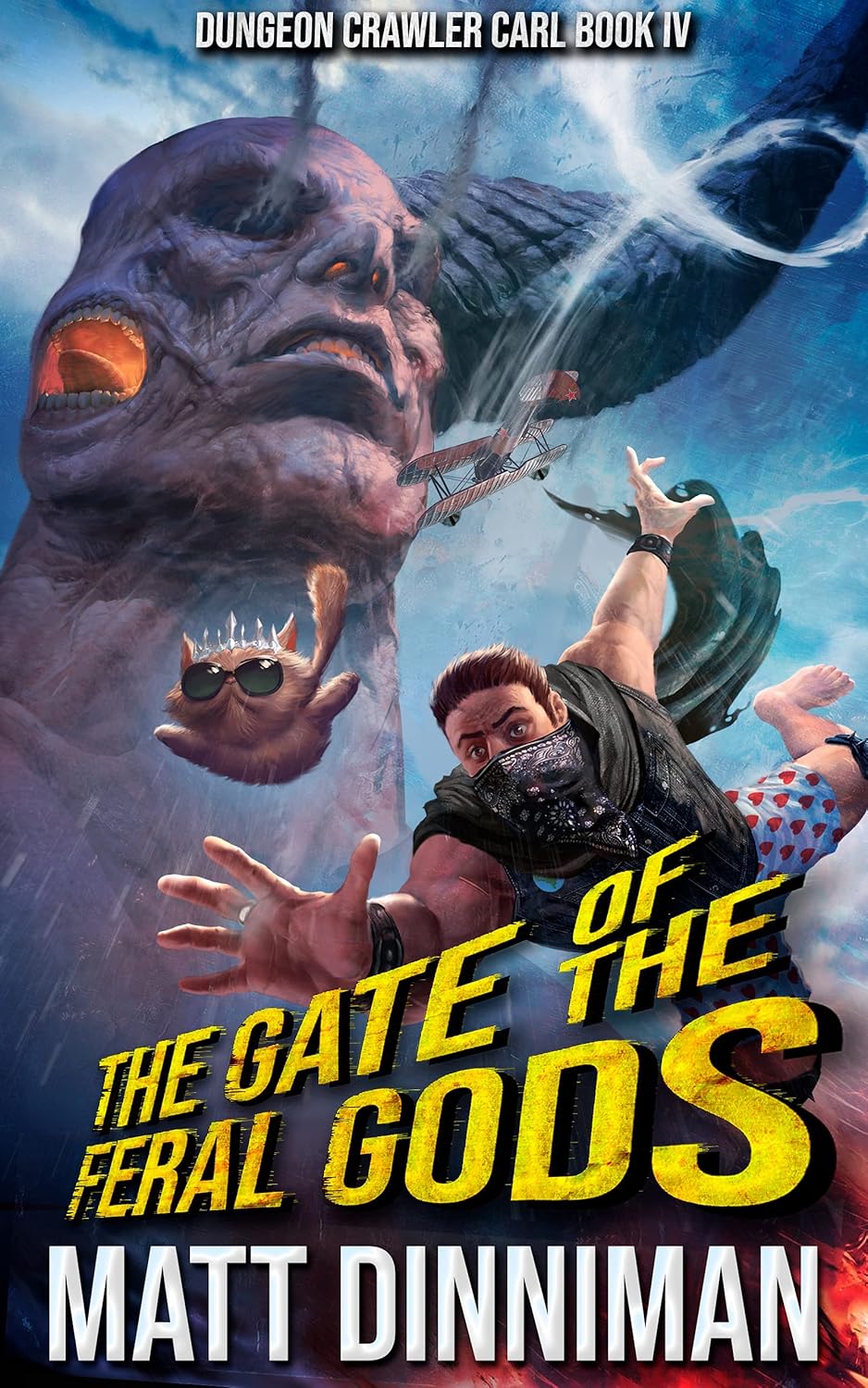
The Gate of the Feral Gods by Matt Dinniman

Publisher: Soundbooth Theater (Audiobook – 1 July 2021)

Series: Dungeon Crawler Carl – Book Four

Length: 18 hours and 3 minutes

My Rating: 5 out of 5 stars

Amazon

The chaotic fun of Matt Dinniman’s Dungeon Crawler Carl series reaches another impressive level in the awesome fourth book, The Gate of the Feral Gods, an exceptional read that I could not put down until its gripping and epic end.

I can officially say that I am incredibly obsessed with the Dungeon Crawler Carl books.  Taking place after all buildings on Earth are instantly destroyed and turned into an elaborate fantasy dungeon, all in the name of an alien reality show, the Dungeon Crawler Carl books are an incredible series that perfectly utilises its unique concept and LitRPG basis to create a particularly addictive story loaded with crazy action, over-the-top humour and an array of incredible characters.  I only started it a few weeks ago and I have so far powered through several books in the series, including Dungeon Crawler Carl, Carl’s Doomsday Scenario and The Dungeon Anarchist’s Cookbook, all of which were five-star reads.  Indeed, I have had such a great time with this series, that the moment I finished off The Dungeon Anarchist’s Cookbook I instantly started listening to the fourth book in the series, The Gate of the Feral Gods, which continued the series in some outstanding ways.

After surviving the carnage of the Iron Tangle, Carl, Princess Donut and Katia have emerged on the fifth floor of Dungeon Crawler World Earth and must now contend with a new dastardly set-up.  Placed into a multitude of small, bubble-contained worlds, each remaining human party needs to assault castles contained within each of the bubble’s four zones.  If they succeed in capturing each zone’s castle, the dungeon stairwell will open and they’ll be able to advance to the sixth floor.

While the setup for the fifth floor seems simple, in reality it is a logistical nightmare, as the popular team of Carl, Princess Donut and Katia must navigate and master four very different environments within a rushed timeline, including a desert landscape infested with flying gnomes, a gigantic haunted crypt filled with traps, a besieged sand castle that is home to a powerful mage with relationship issues, and a derelict underwater submarine surrounded by gigantic sharks, all while trying to untangle a unique puzzle hidden in an elaborate quest storyline.  Worse, thanks to their high levels, the team are forced to rely on ineffective, low-level fellow crawlers to clear out the bubble’s zones, including those people who have barely survived the previous floors.

However, the elaborate new floor is only the tip of the problems facing Carl.  Old enemies from outside the dungeon are desperate to strike him down for the chaos he has caused, while the AI controlling the dungeon continues it erratic obsession with him.  As events heat up, Carl is given the unique chance to obtain a legendary artefact loaded with unimaginable power and terrible risk, The Gate of the Feral Gods.  If Carl can master the gate, he has the chance to keep his friends and loved ones safe on this floor.  But what happens when Carl decides to use the gate to strike back against those who have destroyed his planet?  You will not break him, but he will break everything in the galaxy to get his revenge!

Dinniman does it yet again as The Gate of the Feral Gods was another exceptional and epic novel that I could not stop reading.  Perfectly continuing the impressive story from the previous Dungeon Crawler Carl novels, The Gate of the Feral Gods was an ultra-exciting and complex novel, that brings laughter, excitement and powerful emotional moments in equal measure.  Another book in this series that gets a very easy five-star rating from me, The Gate of the Feral Gods was so damn good, and I had so much fun getting through this insane, but clever, adventure.

I really enjoyed the impressive story that Dinniman came up with for The Gate of the Feral Gods, especially as the author uses the opportunity to feature a more traditional fantasy narrative, while also building on the unique character relationships that have been an impressive part of the previous novels.  In a new dungeon floor with some unique quirks, you are once again drawn into the battle for Carl, Donut and Katia’s survival, as they attempt to understand their new scenario as the population of the entire galaxy watches their progress.  There are also some great new characters introduced in this early part of the book, who add some excellent human elements to the wider story.  Determined to clear their part of the floor, Carl’s team embark on some explosive initial actions, and I liked how Dinniman treated this early part of the story in a more traditional LitRPG manner, as the protagonists follow the quest elements laid out as part of the story.  However, it doesn’t take long for Dinniman to throw things completely off the rails, as there are some great scenes halfway through, including the return of an old friend with real inner anger, and a unique boss battle in a flying house that will have you cackling with surprise.  However, one of the more impressive events set around the middle of the novel sees Carl start to embrace his anarchist persona, striking back against his oppressors in his usual destructive manner.

The big events of the first half of the book have an impressive impact on the second half of The Gate of the Feral Gods, as the protagonists find themselves in a time crunch.  This forces them to go on some risky missions, including invading a giant sandcastle with some unique elements, as well as journeying beneath the waves, much to the horror of everyone’s favourite sentient cat.  The various intense challenges faced by the protagonists are usually overcome in some impressively inventive ways, I loved how well Dinniman hints at the protagonist’s eventual plans.  While this is unfolding, you get some interesting looks at the wider crawl thanks to flashes of other character’s battles, and Dinniman also provides some intriguing looks at the issues surrounding the outer galaxy.

While all the above elements are impressive and result in some epic moments, it pales in comparison to the final third of the book.  Thanks to the titular Gate of the Feral Gods, all hell breaks out (literally and figuratively), as the protagonists find themselves involved in the biggest escort mission ever.  Thanks to that, they get into some brutal confrontations, which help to define how desperate things are getting for the characters.  The final sequences of The Gate of the Feral Gods helps to cement this novel as a truly impressive part of the series, as Carl and Donut finally face down one of their oldest enemies, while also fooling everyone with a particularly chaotic scheme.  The set-up for the protagonist’s bold strike against their foes is very clever, and while there are a lot of hints about what is to come, Dinniman cleverly obscures the entirety of the plan, allowing for some awesome surprises that really show off how audacious the protagonists are coming.  This was honestly an incredible end to such a chaotic and compelling read, and it sets up the next book in the series perfectly, allowing for some impressive moments going forward.

I really enjoyed how The Gate of the Feral Gods turned out, especially as Dinniman turned what could have been a filler novel between two major parts of the Dungeon Crawler Carl series, into a particularly powerful and intense novel with long-running implications for the rest of the series.  Due to its position as the fourth book in the series, The Gate of the Feral Gods is best read by those who have enjoyed the previous entries in the series, even with the protagonist’s useful internal recaps, especially as this book continues to feature and build on a lot of complex ongoing storylines and character arcs.  Once again written in the first-person style, Dinniman perfectly showcases his unique scenario, and gifts the reader with so much awesome action, fun humour, compelling characters, and surprisingly enjoyable LitRPG elements.  With a bit more of a slower pacing at the start of the novel, Dinniman gives this book time to breath after the crazy conclusion of The Dungeon Anarchist’s Cookbook, and allows the characters, and the readers, time to get familiar with the new floor of the dungeon.  This complex new setting within the dungeon was extremely well crafted, and its unique features ensured that The Gate of the Feral Gods had a very distinctive feel amongst the rest of the series.  The focus on quests and the internal storylines of the level helped to amp up the fantasy vibe of the story, while Dinniman also set up a multitude of additional long-running storylines that have a big impact later in the series.  At the same time, Dinniman cleverly continued to showcase the wider universe outside of the dungeon and the way that these exterior events impact the protagonist’s battles, and vice versa, allowing for a particularly compelling narrative.

While I felt that The Gate of the Feral Gods had a slightly slower start, that doesn’t last long, as Dinniman adds in some amazingly exciting and over-the-top sequences that really stick in the mind.  The author proves extremely capable of completely going even further beyond the craziness of his previous novels, and I loved how fantastically outrageous things get at times, with giant boss battles, unbelievably dangerous traps, multiple crazy gods, and some deeply human fights, all making this story particularly epic at times.  The many, many action scenes within the book are so well written, and I loved how impactful, insane, and usually hilarious these sequences are, and Dinniman makes excellent use of the LitRPG part of the series, with so many cool elements from RPG games coming into play in entertaining ways.  Dinniman also does an excellent job expanding on a ton of complex elements of the dungeon in this novel by including various extracts from Carl’s Dungeon Anarchist’s Cookbook, a secret compendium of knowledge from previous crawlers.  These extracts are each cleverly written in their own style, and I love how they highlight technical elements of the dungeon, as well as the emotional damage each of these previous crawlers experienced.  These LitRPG elements are further made better by the author’s unique sense of humour, which inhabits every aspect of the book and ensures that the reader is constantly laughing at all the insane moments, clever jokes, and over-the-top characters.  While this humour might not be for everyone, I felt it was perfect, especially as it blended with all Dinniman’s complex storytelling and the deeper emotional pain of the book, allowing for a very impressive overarching novel.

The thing that made The Gate of the Feral Gods really stand out was the author’s focus on character introductions, growth and powerful human moments, as the protagonists, their allies, and the various beings involved in the running on the dungeon, continue their chaotic journey together.  As with all the books in the series, the plot of The Gate of the Feral Gods revolves around protagonist and perspective character Carl, through whose eyes we see the plot unfold.  The perpetually exasperated and intense heroic figure who is desperately trying to save everyone he comes across, Carl continues to struggle in his role of leader and must keep coming up with dangerous plans to save his friends and beat the latest challenges of the dungeon.  While mostly serious, there is some fantastic humour and deeply sympathetic moments behind Carl, and it proves fascinating to see him struggle to maintain his anger and place as the reasonable one in the group, especially when it comes to his habit of blowing everything up.  The author also really dials up the rebellious anarchist aspects of Carl in this novel, as he starts fighting back against everyone he holds responsible for Earth’s destruction in some very cathartic ways.  Throw in the continued hints at the character’s traumatic past and his growing connection to all his friends, and Carl proves to be an excellent central character for this incredible book.

While Carl is a great main protagonist, this series would be nothing with his sentient cat companion, Princess Donut, who continues to be the highlight of most of the scenes she is in.  An overly dramatic, imperious and fun figure who maintains many stereotypical cat elements, Donut is the heart and soul of the book, and you have to laugh at all her funny jokes, entertaining reactions and the unlikely friendships and interactions she has.  Dinniman has fun building up the cat aspect of the character in The Gate of the Feral Gods, especially in the sequence where Donut finds herself underwater, and it was so damn entertaining to see her freak the hell out at times.  Much of the book’s humour also revolves around her unlikely partnership with Carl, and the way the two play off each other is just amazing.  While most of her personality and appearance is humorous in nature, it hides a deeper heart to it, as Donut’s child-like nature ensures that she is very reliant on Carl, and it was deeply moving to see them bond even further in this novel, and you can clearly see how close they are, even during the moments when Donut is deliberately annoying her human.  Probably one of the best cat characters in modern fiction, Princess Donut is so much fun, and I deeply enjoy every scene she is in.

While most of the book’s focus is on the central pair of Carl and Princess Donut, Dinniman continues to expand the incredible supporting cast of the series in The Gate of the Feral Gods, and I loved the brilliant storylines and development that occurs around these secondary figures.  This includes the third member of the protagonist’s party, Katia, who serves as the more reasonable and responsible member of the team.  It was fascinating to see how much Katia comes into her own in this novel, especially during a period where Carl and Donut are out of the game for an extended time, and she really steps up as a compelling alternative leader to the supporting cast.  Donut’s manager, Mordecai, a former crawler with issues, was a wonderful mentor figure for much of the story, and I quite enjoyed the interactions he has with the rest of the characters, especially Carl, while his attempts to keep his charges from doing anything too crazy are often ignored.  I also continue to be deeply entertained by the AI running the dungeon, whose over-the-top commentary, descriptions and jokes, add so much awesome and often concerning humour to the story.  There were some hilarious moments in The Gate of the Feral Gods where the AI continued to act a little crazy as its personality evolves to match the dungeon’s participants, including his continued messing with Carl, his weird foot fetish, and its own rebellion against the showrunners and people outside the game who are trying to restrict its fun.  Dinniman clearly had a ton of fun when it came to writing the AI’s actions, and it is so entertaining to see how crazy things get around it.

While all these returning major characters are great, one of the best things about The Gate of the Feral Gods was the way in which Dinniman brought in outstanding new characters, as well as reintroducing figures we haven’t see for a few books.  Some of the best new characters include Louis and Firas, two out-of-their-depth crawlers whom the protagonists must rely on.  Thanks to the encouragement of Carl and the others, they start to become much more effective as the book continues, and I loved their compelling growth in The Gate of the Feral Gods, as well as their impacts in their later books of the series.  I also must mention fun new character Samantha, renamed that by Donut from Psamathe.  A minor deity of unrequited love (or crazy ex-girlfriends), Samantha is a banished god trapped in the decapitated head of a magical sex doll.  Loud, rude, crude and constantly threatening every character’s mother, Samantha is probably the most over-the-top character in the series (which is saying something), but boy is she entertaining.  Perfectly introduced amongst the chaos of this book’s story, Samantha perfectly fits in amongst the main characters and becomes a major comic relief for much of the series.  Other great characters include some other fractious crawlers, the return of Chris from the first novel, who has gone through some major personality changes, a variety of insane gods including some unfortunately named demons, and various NPCs, whose existential plight becomes a major ongoing arc in the series.  All these characters, and more, allow for quite an entertaining and at times moving novel, and I really appreciate how well Dinniman utilises them in The Gate of the Feral Gods.

As with the previous Dungeon Crawler Carl novels, I ended up listening to The Gate of the Feral Gods on audiobook, which is such an incredible experience.  These Dungeon Crawler Carl audiobook are so damn good, and it’s one of the key reasons I have been able to so effortlessly binge this entire series.  The narration, done by the very talented Jeff Hays, perfectly captures the insane and over-the-top nature of the series, and so many elements of The Gate of the Feral Gods, including its humour, the intense action, and the impressive LitRPG inclusions, are deeply enhanced by having the story read out.  Hays complements this narration with unique and very fitting voices for all the characters, and I love all the elaborate and often hilarious tones that come out as a result.  It’s impressive how many new voices Hays comes up with each audiobook, and I loved the excellent consistency between audiobooks for the recurring characters.  The long-running voices for Carl and Donut are just perfect, especially as Hays perfectly captures the various emotions hidden within both figures.  I really love how much extra humour you get from hearing Carl’s exasperated voice at times, while the entirety of Donut’s excessive personality, including her hilarious overreactions and continuous outrage, are just amazing.  The rest of the cast are also voiced extremely well, and Dinniman pulls out some fun voices and accents in this book, including an acceptable Australian accent from a crocodile-themed crawler.  However, one of my favourite voices is still the one he uses for the Dungeon AI, and it is so much fun to hear Hays’s voice the various excited, mocking and occasionally deranged announcements and descriptions from this figure.  Throw in some subtle sound effects and vocal enhancements, that add even more umph to the narration, and The Gate of the Feral Gods is an exceptional listen.  I absolutely powered through the 18-hour runtime, and I cannot recommend this format enough, as you guaranteed to have an absolute blast listening to it.

With even more incredible carnage, character development and the author’s incredible humour, The Gate of the Feral Gods was another outstanding novel from Matt Dinniman.  Perfectly continuing the extended Dungeon Crawler Carl narrative and adding in some excellent, long-term characters and elements, The Gate of the Feral Gods is an amazing entry in this epic series, and I honestly couldn’t stop enjoy this novel.  I loved The Gate of the Feral Gods so much that I instantly dove into the next book in the series, The Butcher’s Masquerade, the very second I finished it, and I am so very glad I did. 

Amazon

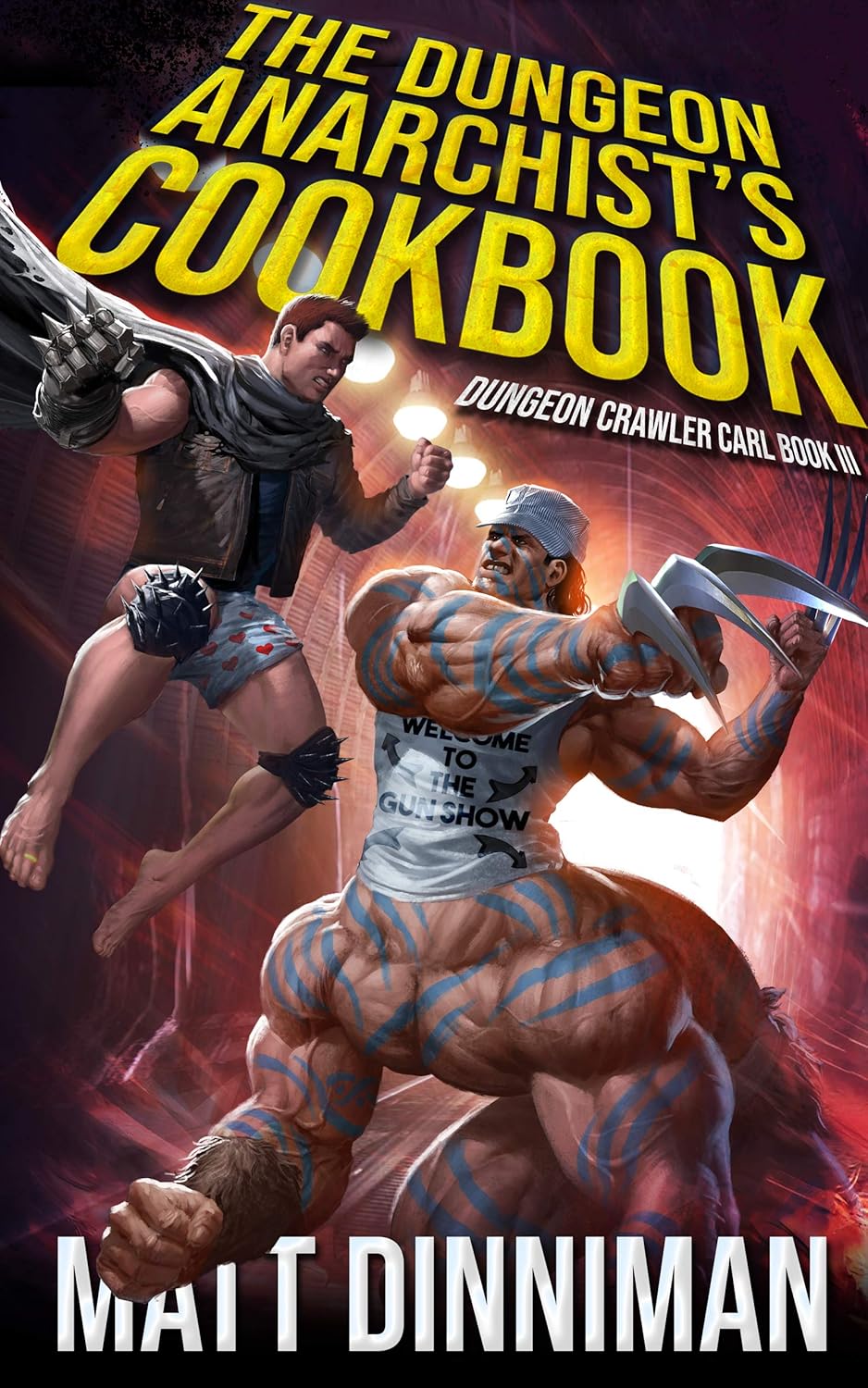
The Dungeon Anarchist’s Cookbook by Matt Dinniman

Publisher: Soundbooth Theater (Audiobook – 19 March 2021)

Series: Dungeon Crawler Carl – Book Three

Length: 16 hours and 54 minutes

My Rating: 5 out of 5 stars

Amazon

Matt Dinniman’s elaborate tale of carnage and comedy continues with the third entry in the Dungeon Crawler Carl series, The Dungeon Anarchist’s Cookbook, another exceptional and highly addictive novel that I could not get enough of.

Those familiar with this blog will know that I recently discovered the sheer insanity that is Matt Dinniman’s epic Dungeon Crawler Carl books.  An outstanding LitRPG series that sees Earth demolished by aliens and turned into a massive, multi-layered fantasy dungeon that the surviving humans need to fight through and descend, all in the name of reality television, the Dungeon Crawler Carl novels are an incredible collection of books with some amazing depth to them as they follow two of the more explosive dungeon crawlers, the gruff Carl and his now sentient cat, Princess Donut.  I powered through the first two books in the series, Dungeon Crawler Carl and Carl’s Doomsday Scenario, in no time at all, and both were epic five-star books.  Due to how incredible these first two books were, I just had to continue the series, and I instantly started listening to the third book, The Dungeon Anarchist’s Cookbook, as soon as I finished off Carl’s Doomsday Scenario, and boy was it something special.

After the cataclysmic end to the third floor of the dungeon, Carl, Princess Donut, their dinosaur pet Mongo, and new party member Katia have arrived on the fourth floor.  This new floor opens all manner of changes for the crawlers, with sponsorship programs, advanced living quarters, new crafting areas and a leaderboard, all needing to be considered by Carl and his companions.  At the same time, the difficulty of the game is ramping up, and this new level is far more complicated than anything they have faced before.

Known as the Iron Tangle, the fourth floor of the dungeon is a mass of interwinding subway tunnels and stations built from the world’s pillaged railway systems.  Tied together in an elaborate knot, thousands of different lines populate this level, filled with random subway and train cars loaded with monsters.  To survive and find the stairs to the next floor, the crawlers need to work out the elaborate puzzle of the Iron Tangle, including which areas are safe, where the monsters are coming from, and what trains can be used to get to important destinations.  However, the dungeon’s creators have populated this floor with all manner of nasty surprises, surprises designed to swallow all the crawlers they can find.

Faced with a seemingly impossible puzzle before them, Carl, Donut and Katia will need to work with all the crawlers on the floor if they want to decipher the mystery of the Iron Tangle.  Only by coming together can the remnants of humanity survive the horrors before them and find a way to continue descending to the bottom of the dungeon.  But can Carl trust his fellow crawlers, especially now that he has a bounty on his head and a potential traitor in his own party? 

Wow, wow, wow!  I honestly didn’t believe that the series could get even better than the awesome first book, but Dinniman once again proves me wrong by producing a particularly elaborate third entry that I once again fell in love with.  Featuring a clever and memorable new scenario, The Dungeon Anarchist’s Cookbook was an exceptional continuation of the series, bringing back all Dinniman’s great characters, complex RPG elements and insane humour, and producing a particularly special story with it. This is another incredible Dungeon Crawler Carl book that gets a well-deserved five-star rating from me.

Like the previous entry in the series, the plot of The Dungeon Anarchist’s Cookbook covers the protagonists’ attempts to journey through a single level of the dungeon, in this case the massive fourth floor, which is made up of an elaborate tangle of monster-filled subway tunnels.  Thanks to The Dungeon Anarchist’s Cookbook having a longer length than the previous novels and not requiring any substantial introduction material, Dinniman is able to spend a substantial amount of time fleshing out the exploration of this level, and the primary focus of the plot focuses on the characters trying to find the various tricks of the Iron Tangle.  While the narrative of The Dungeon Anarchist’s Cookbook is a little slower paced than the previous entries in the series, you soon get engrossed in this complex adventure narrative, especially as there is the usual fun humour, cool character dynamics and the inevitable explosive solutions to all the problems the characters encounter.  Dinniman also spends time expanding on some of the background character plots and wider universe narrative threads that give greater context to the events of the dungeon.  While these parts aren’t as prevalent as in the original novel, you still get some interesting continuation of the wider conspiracies and issues surrounding the crawl and the whole series, which come into play in some compelling ways.

While the first half of the book is very awesome and has some great moments, it is the second part of The Dungeon Anarchist’s Cookbook that really ensures that readers will come away from this novel particularly happy.  Starting with a fantastic and particularly bloody rescue sequence when Carl and his associates attempt to save a bunch of trapped fellow crawlers and initiate a group stand against the horrors of the Iron Tangle, the plan swiftly breaks down in some particularly memorable ways, with the entire dynamic of the dungeon changing in a single moment.  Other great scenes, including a confrontation between Carl and one of his main enemies in the dungeon, also add to the general drama of the novel, and I love how these complex moments, as well as the entire plot of the second half of the book, perfectly flows from the great build up Dinniman featured in the first half of The Dungeon Anarchist’s Cookbook, as well as a multitude of other great plotlines the author has been building up throughout the series.

This impressive narrative eventually leads up to the big and massively destructive conclusion of the book, which was a perfect end to such a captivating novel.  Dinniman cleverly builds up the tension in the lead-up to this finale, and you know that the other shoe is about to drop in a big way.  When it does, Dinniman does not disappoint, forcing the protagonist into some elaborate life and death scenarios, including one particularly epic showdown.  I really loved how all these intense and action-packed sequences came together, and you are constantly on your edge of your seat as you wait to see what happens next.  The protagonist’s various creative plans and failed solutions in the face of these over-the-top scenarios really add to the outrageous entertainment value of the book, and I cannot emphasise enough what an awesome conclusion The Dungeon Anarchist’s Cookbook had.  The author also cleverly sets up the events for the next book, with several hints at key moments to come, and you are left eagerly waiting for even more of the series, especially after seeing how crazy and intense things got in this novel.

Dinniman did another outstanding job writing this third Dungeon Crawler Carl book, and I really appreciated how he brought the same energy and level of excitement to The Dungeon Anarchist’s Cookbook.  The reader is once again treated to an amazing amount of complex action, intriguing LitRPG elements, captivating character growth, and the author’s outstanding humour, which equates to a particularly gripping and intense read.  I liked that The Dungeon Anarchist’s Cookbook had a much more effective pace than the second novel, and the entire journey through the floor was very well set out and quite captivating.  While the labyrinthine nature of the Iron Tangle is a little hard to follow at times, I think this worked well in the context of the story, as it helped to underscore the confusing puzzle that the protagonists had to solve, and you really have to appreciate the sheer inventiveness that the author threw into this distinctive fourth floor.

As with the second novel, I felt that people interested in trying out this series really shouldn’t start with The Dungeon Anarchist’s Cookbook, and instead they need to read the preceding novels first.  While this third novel does have a bit more internal recapping, as the protagonist thinks back to key events, Dinniman does drop the reader into the story immediately after the closing moments of Carl’s Doomsday Scenario, which will confuse most new readers.  The author again builds on the cool LitRPG elements of the previous novels, adding in even more classic gaming features that the protagonists, and through them the readers, need to keep in mind as the book progresses.  All these features have an effective introduction so that anyone can understand their impact, no matter their experience with RPGs, and Dinniman works them into the wider plot extremely well.  As always, a lot of the dryer LitRPG elements of the book are made a lot more entertaining thanks to the over-the-top explanations, clever jokes, and the general insane manner in which the protagonists utilise them, and those reader’s with less interest in stats, abilities or equipment, will still have fun with the scenes focussed on them, especially as they feature some of the book’s funniest lines.  The rest of the novel also features a great comedic tone, and I laughed so many times throughout The Dungeon Anarchist’s Cookbook, especially as Dinniman keeps upping the ante with the plot and forcing the protagonist into even more ridiculous scenarios.

This great humour is well balanced by the often more serious character moments that Dinniman does a wonderful job inserting into the story.  Most of these revolve around the perspective character, Carl, who serves as the voice of the entire story.  A sarcastic, gruff and scarred figure, Carl serves as an excellent everyman protagonist for the series, and you soon get very attached to him, especially as he attempts to be the dungeon’s hero and save everyone he can.  The author builds up some really moving storylines around Carl in this third book, and I loved seeing his continued growth as the team’s unofficial leader, as his accurate insights and tactical ideas really move the plot along.  There are some very dramatic moments loaded in as Carl encounters the various dark sides of the dungeon, and I loved the big anti-authoritarian aspect to the character that Dinniman is expanding upon, especially as he witnesses more and more of the dungeon’s cruelty.  The inclusion of the titular Dungeon Anarchist’s Cookbook, a secret in-game book that gives him hints and ideas to survive in the dungeon, was a fun twist, and I loved how it gave him even more explosive ideas, while allowing the author to explore his rebellious side even more.  Despite being a mostly serious figure, there is still a lot of humour around Carl, mainly from him being the straight man in a very ridiculous place, and you have to love his very reasonable reactions to some of the weird things he witnesses.  Dinniman also continues the very funny trend of having Carl gain a well-deserved reputation of being one the craziest crawlers in the dungeon, mainly due to his tendency of solving all his problems with explosives, and there is a lot of entertainment in seeing Carl’s various plans go further off the rails than intended.

In comparison to Carl, sentient cat Princess Donut is the fun face of the team, and it’s impossible not to love her various antics and over-the-top attitudes.  Her many entertaining quirks, including her obsession with fame, hilarious insights into humans, her long-running grudge against all Cocker Spaniels, her relentless use of all-caps in chat mode, and her general cat-like personality all add a lot of amusement to the novel, and you have to love the odd-couple relationship that forms with Carl.  So many of The Dungeon Anarchist’s Cookbook’s funniest sequences result from Donut’s antics and Carl’s subsequent reactions, and this novel would not be as entertaining without her.  Despite mostly being a comedic figure, Donut does get some serious interactions with the other characters, which help to showcase her character growth and protective nature.  Her occasional vulnerable and honest discussions with Carl really highlight their bond, and she has one of the best moments in the entire book when she overreacts after a friend is hurt.  I really cannot emphasise enough what a great character Donut is, and I really love that Dinniman decided to make this hilarious sentient cat one of his main protagonists.

I also must mention the newest member of the protagonist’s party, Katia, a shy woman who has taken on a shapeshifting race that allows her to act as an effective tank.  I must admit I wasn’t too certain about Katia as a character at the start of The Dungeon Anarchist’s Cookbook, due to her understated personality and somewhat random introduction and inclusion to the team in the second half of the previous novel.  However, Dinniman steadily builds up her complex personality as the book continues, and thanks to the continued support of her new party, as well as Carl’s various attempts to hack her race features, she becomes quite an effective crawler, gaining a lot more confidence.  Her unique abilities and likeable personality nicely compliment the already existing team of Carl and Donut, and they end up becoming a well-balanced trio thanks to her inclusion.  The author also sets up an intriguing storyline around Katia’s conflicting loyalties between her previous party and the current group of Carl and Donut, which come into play perfectly during one of the novel’s big moments.  Katia ends up becoming quite an awesome part of the book thanks to these scenes, and I loved the excellent new dynamic she brings to the series.

Aside from these main three characters, The Dungeon Anarchist’s Cookbook features a really impressive supporting cast, especially as Dinniman brings back a lot of awesome characters from the previous two novels.  This includes Donut’s pet, Mongo, a giant velociraptor who was once again a fun addition to the plot.  While Mongo does get used a little less in the book thanks to the compact train cars of the setting, he made an impact when he did appear (especially to a certain gnoll) it is very entertaining to see Donut finally able to ride him.  The group’s manager, Mordecai, was once again perfect as the reluctant and exasperated mentor figure, who plays off the personalities of the main protagonists perfectly.  One excellent scene in the book ended up limiting Mordecai’s role in The Dungeon Anarchist’s Cookbook, which serves as an effective handicap for the protagonists, while also hinting at Mordecai’s traumatic past, and I look forward to the author expanding on that in the future.

This lack of Mordecai also allows for the author to feature a lot of additional characters, which fits the giant group teamwork focus of the plot, and it was fun to see some of Carl and Donut’s acquaintances from the previous two books return here, especially as several have changed in some very entertaining ways.  I need to highlight the return of antagonist Frank Q, whose big scene with Carl was one of the most powerful moments of the novel, especially as Frank seemingly gets his revenge.  Other previously mentioned antagonists, including some introduced outside the dungeon, are brought back here, often in a big way, and their interactions with Carl are always quite destructive.  Dinniman also focuses on an array of NPC characters in The Dungeon Anarchist’s Cookbook, and the dark plight of these poor figures helps to showcase both the protagonist’s empathy and the twisted nature of the entire dungeon process.  Finally, I again need to mention the hilarious AI who runs the dungeon, as the disembodied figure is easily the most hilarious character in the series thanks to his unhinged descriptions, brilliant references, and the twisted way he manipulates the crawlers to get the funniest result for the audience.  I love how Dinniman showed how the AI is starting to crack a little, especially when it begins rebelling against the corporation running the game (how dare they appeal the AI’s decisions), and I laughed so hard at so many things the AI said.  All these characters, and more, were very entertaining to follow, and I love the many rich character arcs and moments that the author cleverly inserted into the novel’s plot.

I have been having an absolute blast with the Dungeon Crawler Carl audiobooks, and I didn’t even hesitate in choosing to also listen to The Dungeon Anarchist’s Cookbook on this format.  Unsurprisingly, this was another exceptional listen as the audiobook version of The Dungeon Anarchist’s Cookbook really helped to highlight all the best aspects of the book, including the great action, amazing characters and brilliant, over-the-top humour.  Coming in at nearly 17 hours, this was the longest Dungeon Crawler Carl audiobooks yet (they only get even longer from here), although I still managed to power through it in very quick order.  A large reason this audiobook was so good was because the very talented Jeff Hays once again impressed as narrator.  Thanks to his zany voices Hays makes this audiobook truly come alive, and I love how perfectly he inhabits all the crazy and complex characters featured within this book.  There is an outstanding array of accents, parody voices, and over-the-top tones from Hays in this audiobook, and all the voices were a lot of fun, especially for some of the big or exaggerated monsters.  I again need to highlight his excellent voices for Carl and Princess Donut, and it’s just amazing how he can embody both very divergent characters.  I also loved the voice he used for the system AI, especially as Hays brings out all the disembodied figure’s sass, anger and sadistic comedy with his reading of the announcements, especially when the AI gets freaky or mad.  This Dungeon Crawler Carl audiobook also features the voice of Youtube personality The Critical Drinker, who voices a minor character in a well-done, if unnecessary, inclusion.  I felt this entire audiobook came together pretty damn perfectly, including the very funny ad for Soundbooth Theater thrown in at the end, and I honestly don’t think I would enjoy this series nearly as much if it weren’t for these fantastic audiobook productions.  I plan to listen to all future Dungeon Crawler Carl novels on audiobook, and I know I am going to have so much damn fun doing so.

With yet another explosive story, loaded with great characters, clever RPG inclusions and the author’s outstanding humour, The Dungeon Anarchist’s Cookbook was extremely epic, and I could not get enough of it.  The best book in the Dungeon Crawler Carl series so far, The Dungeon Anarchist’s Cookbook was ultra-impressive, and Matt Dinniman did an exceptional job bringing everything together.  I enjoyed this novel so much that I once again decided to start reading the next book in the series the moment I finished this one and then continued after that.  As such, I am currently in the middle of the fifth book in the series, The Butcher’s Masquerade, after loving the fourth book, Gate of the Feral Gods, and both are incredibly awesome and so much fun.

Amazon

Carl’s Doomsday Scenario by Matt Dinniman

Publisher: Soundbooth Theater (Audiobook – 6 January 2020)

Series: Dungeon Crawler Carl – Book Two

Length: 11 hours and 28 minutes

My Rating: 5 out of 5 stars

Amazon

After falling in love with Dungeon Crawler Carl, the first book in the epic Dungeon Crawler Carl series, I have decided to continue diving into this incredible series of adventure, friendship and adversity, with the second novel in the deeply impressive LitRPG series Carl’s Doomsday ScenarioDungeon Crawler Carl was so damn fun, and I chose to start reading this awesome sequel the very moment I finished the first book in the series.

The dungeon crawl to determine the fate of planet Earth has begun, and it is already the highest rated show in the entire galaxy.  However, the games have only just began, as the human crawlers who survived the training levels of the game now must contend with the horrors of the dungeon’s third level. 

The unlikely team of the pants-bereft hero Carl, his now sentient cat, Princess Donut, and Donut’s pet dinosaur, Mongo, have already survived great adversity in their initial forays through the dungeon, but now the game is starting to get even more chaotic.  Starting off the level with the ability to chooses new races and specialised classes, Carl and Donut have some serious upgrades to face the full horrors of the dungeon, and they are going to need it.

This new level of the dungeon, known as the Over City, is the sprawling ruin of a once vast city, laid low by a devastating calamity.  Many creatures still haunt the now destroyed streets, including the horrifying remains of a once popular circus, while in the seemingly safe town they use as a base, murdered prostitutes rain from the sky as part of a malevolent scheme.  However, while Carl and Donut face all manner of monsters and mayhem tackling these horrors and the quests that lay behind them, the greater danger may lay outside of the dungeon, as old and new enemies from the alien races descending on Earth are determined to make Carl’s journey as difficult as possible.  Can these two unlikely companions and their pet dinosaur survive the carnage to come, or is their doomed crawl through the dungeon about to come to an end?

Well damn, now that was a really impressive follow-up to the first book in the Dungeon Crawler Carl series.  Carl’s Doomsday Scenario was an outstanding novel from Dinniman that ups the craziness and ensures that you are still absolutely hooked on its brilliant storytelling, intriguing LitRPG elements and awesome humour.  I frankly couldn’t stop listening to Carl’s Doomsday Scenario, and I have to give it another five-star rating for how much fun I had with it.

Dinniman came up with another great story for Carl’s Doomsday Scenario that continues right after the events of the first book in the series.  One of the shorter novels in the series, Carl’s Doomsday Scenario avoids any recap material and instead jumps right into the plot, which covers the entire time the protagonists spend on the third level of the game.  Cleverly bringing in some cool new elements at the start, the protagonists are soon grinding through this new level.  The plot mostly focused around two of the quests that the protagonists choose to participate in, one involving a cursed circus, and the other involving a sinister plot of sacrifice and murder in one of the floor’s main towns.  Dinniman plays through both major plot elements in a similar manner to quests from a particularly deranged RPG game, and you soon get invested in both the scenarios, and the protagonist’s unusual or explosive ways of dealing with the situation.  Both major quest lines involved carnage, exploration, a dash of mystery, and an array of intriguing new characters, and allow for the protagonists to keep getting stronger and more experienced.

These quest-focused sequences are well balanced by an array of events that tie them into the larger series story of the protagonists playing the dungeon game.  The protagonists become involved in several events outside the dungeon which helps introduce long-term antagonists and hints about some of the future obstacles to come.  You also get some interesting updates about some of the recurring characters introduced in the first book, many of whom are clearly going to have a bigger impact on the story in the future.  All these elements blend well into one cohesive and exciting plot, and I loved how well Dinniman balanced the various unique story elements and kept making the overall narrative of the series even more elaborate.  These plots all come together for Carl’s Doomsday Scenario’s big finale, which was as hilariously epic as possible.  Dinniman really ramped up the tension for this final part of the book, and you are constantly on the edge of your seat as you wait to see who survives and how.  An epic story that perfectly continued the overarching Dungeon Crawler Carl narrative, while also providing some very memorable moments that allows Carl’s Doomsday Scenario to stand on its own.

I loved how Carl’s Doomsday Scenario came together, although I must point out that you really need to read Dungeon Crawler Carl first.  The plot of Carl’s Doomsday Scenario directly continues from the events of Dungeon Crawler Carl, and you could honestly combine the two to get one long novel without any issues at all.  Indeed, this story does feel a little like a bridging novel between the introductory first novel and the heavily plot laden third book, although it still works well to tell its own fun story.  While the point-of-view protagonist does recap some events in his head as the story unfolds, new readers trying to start at this second book would likely get lost in some of the plot details.  As such, this is definitely a book for those who plan to read the series from start to finish, and those that are will find that Carl’s Doomsday Scenario features all the very best elements from the initial novel, including a ton of great action, some unique LitRPG elements, and the continued side-splitting humour that made Dungeon Crawler Carl so much fun to get through.

Dinniman makes excellent continued use of the first-person perspective to paint a compelling picture of the protagonists’ journey in this second book, and you really get drawn into Carl and Princess Donut’s adventures as a result.  Thanks to the fact that they are experiencing all these scenarios for the first time, readers with all manner of LitRPG or RPG experience can easily enjoy this novel, and the author does an amazing job combining the more elaborate RPG elements into the larger exciting narrative.  There are a ton of great new elements added in for this book, with things like class and species decisions, quests, elite NPCs, towns and more, adds some additional complexity to the plot which helps to make the story even more interest.  These extensive LitRPG features are perfectly enhanced by the author’s comedic writing, and there are so many great jokes thrust into the story.  This humour is well supported by the book’s overall outrageous nature, and all the over-the-top scenarios the protagonists encounter can be exceptionally funny at times.  Thanks to how well Dinniman writes and combines these elements together, I was so invested in every part of the book, and it was fantastic to see the entire narrative unfold and watch the protagonists evolve with the game.

As with Dungeon Crawler Carl, the emotional heart of Carl’s Doomsday Scenario lies in the partnership between Carl and Princess Donut, and it was fascinating to follow these two unlikely heroes through the dungeon.  Carl continues to be the gruff and over-exasperated central character through whose eyes we see the story unfold.  A tired figure still reeling from the death of his planet, Carl continues to grimly stay alive for Donut’s sake, while also becoming more enraged at the full evils of the dungeon and the corrupt alien corporations controlling it.  I really enjoyed the practical and often quite clever way he addresses the dungeon’s many challenges, and Dinniman does a good job showcasing his evolution as a player, even though he still mainly resorts to explosives and crazy plans.  Indeed, Carl starts to develop a somewhat well-deserved reputation as a reckless figure, which is quite entertaining.

While Carl is the stoic centre of the plot, Princess Donut is the comedic heart of the Dungeon Crawler Carl series, and you just have to love her entertaining persona.  Despite being sentient, Princess Donut is still very much a cat in nature and bearing, and it is hilarious to see her exaggerated personality clash with the more subdued nature of Carl.  Her ability to get them into all manner of trouble with her fun-loving ways and lack of caution adds some great entertainment to the plot (Goddammit Donut!), while her love of attention and popularity perfectly plays into the reality television nature of the dungeon game they are in.  Donut is an outstanding personality foil to Carl, and this allows for some very entertaining moments as a duo.  However, while on the outside she is still the same silly and haughty cat you came to love in the first book, Dinniman has started to showcase Donut’s hidden depths, and there are some great moments when you come to realise that the cat is growing up and become more mature.  A lot of this lies in the heartwarming relationship between Carl and Donut as the two continue to become a true team.  I love some of the scenes when Carl and Donut are vulnerable with each other, especially when they are close to death, and you realise just how close they’ve become and how much they mean to each other.  This connection provides some amazing moments throughout Carl’s Doomsday Scenario, and you continue to become extremely invested in these two’s adventures.

Aside from Carl and Donut, there is an array of additional awesome characters featured in Carl’s Doomsday Scenario, including a combination of figures from the previous novel and some new great characters.  This includes Donut’s pet velociraptor, Mongo, who continues to grow into an even more dangerous killing machine.  Despite some continued teething troubles about Mogo’s inability to control himself, Mogo grows into a key member of the team, and that intense scene where he defends Donut from harm cements him as a wonderfully beloved pet.  The team’s NPC tutorial guide, Mordecai, gets an extended appearance in Carl’s Doomsday Scenario, becoming Donut’s reluctant manager, and I loved the fun mentor role he adds to the cast, becoming the team’s voice of reason, which is often ignored by the protagonists.  Dinniman also adds in an interesting third member of the party later in the book, who gets an effective introduction, even if they don’t play a major role in the plot this time around.  Throw in an array of determined fellow crawlers, aliens who often have beef with Carl, and some complex mobs and NPCs whose unique stories the protagonists get dragged into, and the cast of Carl’s Doomsday Scenario was so damn epic and really enhanced the overall story.

As with the first book in the series, I chose to listen to Carl’s Doomsday Scenario on audiobook, which is frankly the very best way to enjoy this incredible novel, especially as the having the crazy story and the antics of the characters read out is so much fun.  Coming in with a run time of 11 and a half hours, this is one of the shorter entries in the series, and I managed to finish off this audiobook in a few very entertaining days.  I deeply appreciate the fact that Jeff Hays continues as the narrator of this second audiobook in the series, as he really impressed me with Dungeon Crawler Carl.  Hays has an amazing array of elaborate voices that perfectly fit so many of the unique characters featured in this novel, and he carries over several of the key tones from the first audiobook for the recurring characters.  His voices for Carl and Princess Donut are particularly good, and I love how effectively he still captures their complex personalities, including Carl’s frustrations and anger, and Donut’s comedic over-excitement and infectious personality.  His best voice still probably remains the system AI running the dungeon, as the sheer amount of excitement, sarcasm and comedic timing Hays brings to reading out the AI’s notices is so damn good.  Throw in a cool array of new character voices, as well as some modulated tones for characters who have changed race or attributes, and this was such an impressive listen that will have you laughing like crazy.  I cannot recommend the audiobook format of the Dungeon Crawler Carl books enough, so do yourself a favour and make sure to check them out.

My newfound obsession with Matt Dinniman’s Dungeon Crawler Carl series continues unabated as I powered through the second book, Carl’s Doomsday Scenario, in no time at all.  an outstanding sequel that perfectly continues all the amazing story elements from the first book, while adding even more layers to the elaborate scenario.  Fast-paced, constantly entertaining, and with some impressive emotional depth to it, Carl’s Doomsday Scenario was particularly awesome, and I had an absolute blast reading it.  Indeed, I loved it so much that I once again instantly dived into the next book in the series, The Dungeon Anarchist’s Cookbook, which is proving to be just as incredible as its predecessors.

Amazon

Dungeon Crawler Carl by Matt Dinniman

Publisher: Soundbooth Theater (Audiobook – 21 September 2020)

Series: Dungeon Crawler Carl – Book One

Length: 13 hours and 31 minutes

My Rating: 5 out of 5 stars

Amazon

Have you ever had one of those books or series that everybody seems to be talking up all the time?  Lately for me that series has been the Dungeon Crawler Carl novels by Matt Dinniman.  An intriguing LitRPG series, the Dungeon Crawler Carl books are a funky and hilarious fantasy and science fiction hybrid that places its outrageous protagonist into an unlikely alien reality show filled with subterranean dungeons inspired from classic RPGs.  A series with a very interesting premise, I have been seeing so much online about the Dungeon Crawler Carl books over the last couple of years, with everyone praising it and really talking it up.  Despite not having a lot of experience with the LitRPG genre (except for Ascension by B. F. Rockriver), I decided to check out the first novel in the series, also titled Dungeon Crawler Carl, to see what all the fuss was about, and boy did that have an excellent result.

When aliens come to Earth, first contact is far more brutal and unusual than you could ever expect.  Instead of communicating or conquering, the aliens instead instantaneously collapse every single human-made structure down into the ground, killing everyone who was inside.  Only those standing outside at the time survived, and they are given a dire choice: either remain on the planet’s now desolate surface with no shelter, or journey down into the subterranean 18-level dungeon that has been formed from humanity’s repurposed buildings.

For those few million human survivors who journey into the newly labyrinth, they soon encounter a fantasy-inspired dungeon, filled with traps, monsters, loot and other dark dangers to navigate.  These survivors, known as dungeon crawlers, need to keep moving downwards in the hope of reaching the 18th floor and the promised reward it contains.  Death and dismemberment are a near certainty in the dungeon, so contestants will need to learn how to kill mobs, find enchanted gear, learn new combat skills or magic and keep getting stronger, all before the level they are on collapses.  However, this dungeon is far more that a contest of might and magic; it is the most popular reality program in the galaxy, seen by untold trillions of aliens, and only those crawlers who can gain a strong following and rich sponsors are likely to survive.

Into this chaotic situation is thrown unlikely hero Carl.  A simple man caught outside in his underwear as he attempted to retrieve his ex-girlfriend’s cat, Princess Donut, Carl soon finds himself fighting for his life in the most ridiculous of circumstances.  Teaming up with the now sentient Princess Donut, Carl finds that the dungeon has a steep learning curve, and he will need all his resolve, cunning and the friendship of a superpowered cat to survive.  However, as Carl and Princess Donut accidently become two of the most popular contestants in the game, they will need to contend with everyone who wants them dead, both from inside the dungeon and without, as they constantly move downwards.  Dangerously overmatched, completely overwhelmed, and with a distinct lack of pants for Carl, this unlikely duo will need to learn how to survive big and show the universe and the unhinged AI controlling the game that they are worth keeping alive.

Goddammit Dinniman, how could you create something so damn addictive.  It turns out that for once the internet crowd had this 100% right, and Dungeon Crawler Carl was everything they said it would be and more.  A clever, intense and overall hilarious romp through a cool LitRPG scenario, Dungeon Crawler Carl had me hooked very early on and I absolutely powered through this epic adventure novel which I just had to give a full five-star rating.

I really, really loved the cool story in Dungeon Crawler Carl, which starts off quickly and never lets up all the way to the end.  Starting with a quick but effective introduction to Carl, which then leads to the world collapsing and him being forced to enter the dungeon with his cat, you are soon immersed in this new crazy world, with some bloody opening fights setting the crazy tone for the rest of the novel.  After an in-depth sequence that explains the rules of the world, Dungeon Crawler Carl takes off again at a fast pace made even more entertaining thanks to the introduction of the now sentient cat, Princess Donut.  Forced to keep fighting through monsters, traps and other obstacles, the action and excitement never lets up, and I really appreciated how Dinniman naturally flowed the protagonists into fresh scenarios, including unusual boss fights, explosive opportunities, and starting a meth war between goblins and fire-spitting llamas.

The second half of Dungeon Crawler Carl goes in some very interesting direction, as the protagonists encounter other Crawlers, with some very different results, while also ensuring the full and often ultra-bonkers horrors of the first two levels of the dungeon keep coming at you hard and fast.  There is some great character development as the book continues, both literally and figuratively, and it was interesting to see the characters evolve to face the unique threats of the dungeon in their own way.  Dinniman threw in some clever and often hilarious solutions to many of the obstacles the protagonists face (although most of them involve explosives), and you’re constantly on the edge of your seat as you wait to see how they will survive going forward.  There is also some excellent universe expansion as the characters experience the reality-television obsessed world outside the dungeon, which often leads to some hints of the dangers to come later in the series.  These upcoming elements are well placed into the book, which allows the readers to anticipate what is to come, while not distracting from the main plot points.  The conclusion of Dungeon Crawler Carl comes a little after the big events of the book, but it sits in a good place as part of the wider series.  This novel ends up being an exceptional read on its own, while also being an excellent first entry in the series that perfectly sets up the many over-the-top adventures to come.

This proved to be a very cleverly put together novel, and Dinniman really excelled at utilising the unique elements of the LitRPG genre and utilising in his story.  Featuring a very cool explanation for why the protagonists are trapped in a fantasy dungeon (alien reality television show to determine the fate of the planet is an awesome plot idea), you soon get engrossed in the LitRPG themes of the book, as the characters are instantly forced to battle mobs to survive.  Due to the time limits built into the plot, the protagonists are quickly forced to adapt to the new way of living (or dying), and the reader is given a crash course in the mechanics of the game system.  I found these to be quite fascinating, and you really get engrossed in the various levelling, skills, magical items, achievements and other elements of the game, which fans of RPGs of all varieties will be familiar with.  The dungeon itself is a unique blend of classic fantasy creatures and tropes, with exaggerated elements of modern human culture, allowing for modern references to go together with fights against goblins and other creatures.  Dinniman also adds in a great reality television element to the plot, as the protagonists are forced to earn followers and appeal to a wider audience to improve their chances, like The Hunger Games on steroids.  The author does an excellent job of setting these unique elements up, and it’s a great extra edge to the typical LitRPG elements.

Dinniman ensures that these LitRPG elements continue to be quite entertaining throughout the entirety of Dungeon Crawler Carl thanks to a variety of factors, mainly humour.  Nearly every scene in this book is incredibly funny of various levels, including entertaining character interactions, reactions to over-the-top scenarios, various subtle jokes, and a large amount of more noticeable adult humour that reflects the crazy situation and big personalities of the plot.  I personally loved how Dinniman enhanced all the game elements of the book, such as item and mob descriptions, achievements, skill discussions and more, by including comedic summaries loaded with jokes, references and the barely controlled fetishes of the AI running the dungeon.  These wacky descriptions made the more LitRPG-heavy parts of the plot flow a lot better, especially as readers with less interest in RPGs can still have fun with these scenes.  Dinniman works to make various other LitRPG elements more entertaining for casual readers in various other ways, such as ensuring all the scenes featuring the chat function are quite distinct and humorous due to Princess Donut’s insistence of only writing in caps.  I honestly was left laughing out loud multiple times throughout Dungeon Crawler Carl, and the sheer ridiculousness of the story, as well as the often quite inappropriate, yet hilarious jokes, was just too much for me.

While there is a definite focus on comedy and jokes in Dungeon Crawler Carl, Dinniman also adds in some real emotional heart to the story, mainly through the focus on the protagonists.  The relationship between the perspective protagonist Carl, and the now sentient cat Princess Donut adds some excellent and powerful depth to the book, especially as they grow to be a compelling team.  While initially thrown together in unlikely fashion, the grumpy Carl and the amusing Princess Donut, who has all the smugness and confidence of a prize-winning cat, turn into the ultimate odd-couple, made even more entertaining by the fact that the cat is much more powerful than Carl.  Dinniman throws in a lot of very entertaining quirks for both characters that makes you love them; however, it is the more subtle examination of the protagonist’s deeper emotions that help to enhance this narrative even more.  This includes Carl’s deep internal anger, brought on by various factors, the despair he feels at the complete destruction of his world, and his continued attempted heroics, even when it puts him at greater risk.  I loved how both Carl and Princess Donut both grew to become quite dependent on each other as the book continued, and while there is still a lot of growth needed for both, you can see that their bond is going to be the powerful centre of the plot.

Aside from Carl and Princess Donut, Dungeon Crawler Carl is loaded with an outstanding array of characters who each bring their own brand of fun to the plot.  I personally enjoyed the protagonist’s guide, Mordecai, a veteran former crawler who provides advice on how to proceed, while also hiding the trauma of his own adventures in a previous dungeon.  There was also an array of compelling and distinctive mobs, alien night show hosts, and other creatures associated with the production, who on the surface are quite entertaining and funny, but whose deeper tragedies work to highlight just how dark the dungeon process truly is.  There are also some other distinctive fellow crawlers thrown into the plot, and it is interesting to see how humans will react to the terrible situation before them, either becoming heroes or dark villains.  Finally, I must mention the AI running the dungeon, who proves to be one of the more entertaining figures in the book, despite not appearing in person in any way.  His very over-the-top commentary and descriptions for all the game mechanics was ultra-hilarious, and there are so many great jokes there.  However, it was the AI’s more subtle actions that proved to be the funniest part of this electronically ethereal figure’s inclusion, as it guides the game to suit its own interests and desires.  This includes giving very specific items to the protagonists to produce the most amusing story, while other rewards and loot encourage Carl to remain barefoot and lacking pants throughout the game for “reasons”.  I felt that this excellent cast really matched the over-the-top story that Dinniman threw together for Dungeon Crawler Carl, and every character made an amusing and memorable impact on the story.

I ended up checking out the audiobook for Dungeon Crawler Carl, which was honestly exceptional, and I cannot emphasise enough just how effective this format enhanced Dinniman’s great story and outrageous humour.  Narrated by Jeff Hays, who might be one of my new favourite audiobook voice actors, all the action, intensity and the distinctive characters of Dungeon Crawler Carl came across exceptionally well in this format, and I absolutely loved how effectively Hays conveyed the entire craziness of this novel.  The narrator provides an excellent voice for the protagonist, Carl, that served as the base tone for most of the narration, and you really get to feel the protagonist’s fear, determination and continued exasperation, especially when he encounters all the crazy twists and inclusions.  Hays’ voices for the other characters of Dungeon Crawler Carl also helps to make this audiobook stick out.  For example, the tone that Hays choice for Mordecai perfectly fit the tired, old mentor, while his Princess Donut voice is so damn entertaining, especially as you can fully appreciate the character’s catlike nature with Hays’ high-pitched and demanding voice.  Hays also captures all the fun features of weird mobs of the dungeon, including goblins and other sentient creatures, and there are some very striking and funny voices featured there.  However, it is the tone he uses when speaking in the voice of the AI running the dungeon that is the best.  Cheerful and sarcastic, Hays perfectly captures this computer program’s weird sense of humour with his narration, and I loved the boisterous way he reads out the achievements, the skills, item stats and more, especially for more colourful descriptions that require accents or other creepier voice changes.  This outstanding narration worked on so many levels with Dinniman’s unique style, and I frankly could not get enough of listening to Dungeon Crawler Carl on audiobook, which is just the best way to check out this novel.

Overall, I had an exceptional time with Dungeon Crawler Carl, and this series instantly became my new obsession.  Fun, outrageous and constantly exciting, Dungeon Crawler Carl lives up to all the hype surrounding it, and I was really impressed with Matt Dinniman’s ability to craft a complex story that will potentially get better with each new entry.  Honestly the best way to showcase just how much I enjoyed Dungeon Crawler Carl is to reveal that as soon as I finished this first book I instantly started listening to the sequel, Carl’s Doomsday Scenario, and then the third book, The Dungeon Anarchist’s Cookbook, soon after that.  I will probably end up powering through this series in the next few months, hopefully before the eighth book comes out next year, and I cannot wait to see where Dinniman takes this beautifully unhinged plot next.

Amazon

Mort by Terry Pratchett

Publisher: Gollancz/Penguin Audio (Audiobook – 1987)

Series: Discworld – Book Four/Death – Book One

Length: 7 hours and 18 minutes (Planer version)/7 hours and 57 minutes (Clifford version)

My Rating: 5 out of 5 stars

Amazon

My dive into the always outstanding Discworld series by the legendary Terry Pratchett continues with one of the earlier classics, Mort, a clever and highly entertaining novel that still hits hard after all these years.

Readers of this blog will be aware of my obsession for all things Discworld, which I have been a mega fan of for many years.  I have had the very great pleasure of reading all the books in the Discworld series multiple times, and I honestly love everything about them, so much so that I even named this blog after a key setting in the series.  I’ve recently been having one of my periodic re-reads of the series, which has seen me finally review some of my favourite Discworld entries, including Pyramids, Guards! Guards!, Moving Pictures, Small Gods and Men at Arms.  The next entry in the series I decided to reread was the wonderfully compelling Mort.  The fourth book in the series, this is one of the earlier Discworld novels and serves as the first book in the Death sub-series.

They say that death comes for everybody, but on the Discworld that statement couldn’t be more true, as everyone will eventually encounter Death, the black-robed, scythe wielding skeleton who personifies the end of life.  However, not all encounters with Death are the same, as terminally unqualified teenager Mort is about to discover, as instead of taking his life, Death offers Mort a job.

Suddenly saddled with the responsibilities of being the apprentice of Death, Mort finds his life a lot more complicated.  Reaping the souls of the recently departed is one thing, but learning to walk through walls and deal with the unlikely whims of his new master is another, especially as Death seems determined to set Mort up with his adopted daughter Ysabell.  However, the big problems begin when Mort impulsively decides to change fate and save the life of a young princess destined to die.

Forced to find a way to stop the diverging threads of reality while keeping the princess alive, Mort soon discovers that being the Grim Reaper isn’t all it’s cracked up to be.  Worse, with the real Death suddenly discovering the joys of life, Mort’s own humanity is starting to slip away.  Can Mort and a group of unlikely companions save reality, or will he have to face his final judgement at the hands of the universe’s most unyielding employer?

Mort was a particularly impressive Discworld novel from Pratchett, especially as it was probably the book where the author finally found his true writing groove.  Fun, thoughtful and featuring a clever and concise story, Mort was an outstanding read, and I once again powered through in very short order.  As such, Mort gets a very well-deserved five-star rating from me and is a particularly awesome Discworld novel to check out.

I loved the very impressive story that Pratchett came up with for Mort, which takes the concept of Death finding an apprentice and going to the extreme with it.  Starting at an initially slow pace that introduces the key characters of Mort and Death, you soon get invested in Mort’s tale of young man coming into his own in a very unusual field.  Things get interesting quickly when Mort decides to save the life of a young princess destined to die and soon splits reality down the middle.  This leads to a very addictive middle section, as Mort attempts to save the princess while also ensuring reality doesn’t split apart.  At the same time, Death, who finds his time freed up thanks to his assistant, begins to wonder around the world learning about humans and trying to have fun.  The resulting outlandish interactions with Death are a great counterpoint to Mort’s storyline, especially as this results in the apprentice starting to obtain his own powers, often with hilarious results.

Everything cleverly and quickly leads up to the big final third of the novel, where a less-than-human Mort and a scrappy Ysabell attempt to do a disappeared Death’s duty, while also finding a way to save the doomed princess, whose own attempts to stay in reality have been less than successful.  At the same time, fun supporting character Albert, Death’s manservant, returns to his old profession on the Disc and tries to find the original Death, who has found his own unlikely niche in the mortal world.  This final third of Mort is extremely fun, fast-paced and surprisingly impactful, especially as the author keeps raising the stakes for the protagonists, and you are very much unable to stop reading it as you try to see where all the entertaining storylines are going.  However, it’s the inevitable showdown between Death and Mort that really ties everything together perfectly.  Their intense, deeply personal and perfectly showcased duel is amazing, especially as it expertly builds off all the character growth in the novel.  Ending on a hopeful note that sets the tone for a great character going forward, you come away from Mort very happy and with an interesting new outlook on life and its always-grinning counterpart.

I really enjoyed how Mort came together, especially as this is the Discworld novel where Pratchett perfects the style and storytelling methods that make his later novels such a treat to read.  As such, Mort is an early classic in the series, so much so that it is a perfect entry point for new Discworld fans, who get to see a lot of key ideas develop here, while also being introduced to the author’s humour and clever storytelling.  Mort definitely benefited from Pratchett developing a more concise storytelling style here, keeping the narrative a little more focused than the previous novels, and this works as a well-crafted standalone read.  Pratchett also does an outstanding job combining cool fantasy elements with outrageous humour and complex characters, and the result is a very entertaining read that will appeal to a wide range of readers.  Part coming-of-age story, part examination of an extreme mid-life crisis, Mort’s narrative hits a lot of generational notes, and while some of his ideas about splitting reality and the nature of the Discworld are a little complex, Pratchett ensures that readers can completely follow his thought all the way to the fantastic conclusion.

As with all Discworld books, Pratchett imbues Mort with an amazing level of humour, and I loved how intensely funny this novel was at times.  Despite Mort essentially being a novel about mortality and destiny, this is a very light-hearted novel thanks to the entertaining characters and the unusual situations they find themselves in.  There are several different levels of humour contained within Mort, ranging from obvious jokes and over-the-top situations to well-setup references or clever name gags, as well as the subtly funny footnotes that really dive into the absurdity of this flat world that lies atop a giant turtle.  Some of the funniest parts of Mort lie in the usually hardboiled and cynical inhabitants of the Disc suddenly encountering Death in unlikely scenarios.  This becomes particularly prevalent later in the novel when Death leaves the job to Mort and wanders the world looking to understand “fun”, and the various scenes with Death fishing, going to parties, getting drunk, gambling and even searching for a job, are particularly hilarious, especially as everyone else involved in these situations is either deeply unsettled or completely terrified.  Other great jokes involve wizards coming to terms with an apparently animated statue, very long-running bar tabs, fun, if short-lived, political intrigues, unlikely deaths, and the young protagonist upsetting everyone by unwittingly walking through walls.  I laughed myself silly multiple times in Mort, even though I had heard all the jokes many times before, and you are guaranteed to have a lot of fun with this great Discworld entry.

As with all of Pratchett’s novels, Mort features an excellent array of entertaining characters, whose unique arcs add some excellent power to book’s overall narrative.  The cast of Mort was particularly compelling and well-rounded, and I think that Pratchett did a great job of introducing some excellent new figures while also making use of one of the best side-characters in the entire series.  Unsurprisingly, most of the novel’s focus settles on the titular character of Mortimer (Mort), a young teen who unexpectedly finds himself the apprentice of Death.  Shown at the start of the book to be an awkward and unusually thoughtful figure, Mort’s storyline revolves around his attempts to fit in, learn his unlikely trade, and the interesting relationships that form thanks to his new position.  Pratchett works in a very compelling coming-of-age narrative around Mort, especially as he grows into his new role and gains the confidence that comes with finding oneself, while also walking the fine line between morality and duty.  However, there is a definite dark edge to Mort’s storyline towards the end, as Mort starts to lose his humanity and becomes more like Death, and it falls to the rest of the characters to keep him human.  Pratchett did a really good job introducing and building up Mort as a complex young character, and he ended up being one of the author’s better one-shot protagonists.

While much of the book is focused on Mort, the character who constantly steals the show is Death.  The literal personification of death on the Discworld, Death appeared in the first three novels in the series, serving as an ethereal and often entertaining figure on the sidelines who occasionally haunted the author’s original protagonist.  Pratchett cleverly expands on Death in this book, showcasing him as a wise and implacable figure doing his duty in a dispassionate way.  However, his interactions with humans, especially Mort, soon start to change his personality, especially as he becomes curious about life and tires of his eternal station.  This allows him to become a particularly entertaining figure in the second half of the book, as he roams the Disc in unlikely situations, trying to learn how to have fun.  His various ponderings on mortality and human nature result in some hilarious moments, and there are so many fantastic and funny interactions that occur here.  However, it is the final third of the book where you get a real sense of Death’s character; at first, he wistfully tries to embrace life, only to leave that behind when confronted by the actions of Mort.  The anger and sadness that accompany his return to his role and his confrontation with Mort is extremely powerful, and you can’t help but feel for him as he faces an impossible choice, as well as rejection from those he loves.  An overall excellent first deep dive into the character of Death from Pratchett, and you can really see why the author wrote several more books around this character going forward.

Aside from Mort and Death, the rest of the main cast of Mort is quite concise and contains an excellent blend of distinctive and impactful characters.  This includes Death’s adopted daughter, Ysabell, a seemingly spoiled princess and lover of over-the-top romance, who is initially antagonistic to Mort.  Despite her attitude, Ysabell soon turns into quite a likeable and sympathetic character, especially when certain traumas from her unusual life become apparent.  Due to her having some of the more emotionally poignant dialogue and character moments in the book, Ysabell is an excellent part of Mort, and I liked how Pratchett paced her storyline.  The other major resident of Death’s domain featured in this story is Albert, the mysterious servant determined to hide his past from Mort and Ysabell.  Pratchett does an excellent job of setting him up as a bigger figure within the Disc’s history, and his explosive return to form after some entertaining scenes between him and a threatening Mort are a highpoint of the book.  Other major characters include Princess Keli, a young princess who finds her sudden reign made even more difficult due her convoluted existence, and young wizard Igneous Cutwell, who serves as a great foil to the more serious Mort and Keli and becomes an excellent comic relief for the book.  Throw in an array of over-the-top minor Discworld characters whose lives briefly become that much more interesting due to their interactions with either Death or Mort, and Mort has an especially fun cast that Pratchett uses to great effect within this masterful novel.

I must once again highlight the amazing audiobook formats that are my favourite ways of enjoying the Discworld series.  I honestly have so much fun with the Discworld audiobooks, mainly because the format does such an incredible job of showcasing Pratchett’s legendary humour and inventive worldbuilding, and there is frankly no better way to enjoy this cool series.  Like the rest of the series, Mort has two particularly awesome unabridged audiobook versions, both of which come highly recommended by me.  This includes the old-school version narrated by the legendary Nigel Planer, who provided his voice to over half the unabridged Discworld audiobooks.  As with all the Discworld books he narrated, Planer does a remarkable job in this early entry in the series, and I loved the impressive array of voices that he utilised in Mort.  Due to this being the first Death audiobook, Planer had a ton of fun featuring his amazing Death voice, which combines beautifully with some of the other new character tones he had to come up with for this novel.  His great voice work also helped to showcase some of Pratchett’s excellent jokes and key bits of humour, and you really get drawn into the author’s brilliant story and fantastic writing with this classic audiobook release.

Despite my love for the Planer version of Mort, which in some ways is still the definitive audiobook version of this novel, I must also really hype up the new Mort audiobook that was recently released.  Part of the recent rerecording of the Discworld audiobooks I have spruiked in previous reviews, this new version of Mort was extremely awesome, and in some ways it surpasses the old-school version.  Coming in with a runtime of just under eight hours, around half an hour longer than the Planer version, this was a brilliant listen, especially with the impressive combined voice work of Sian Clifford, Peter Serafinowicz and Bill Nighy.

Sian Clifford (of Fleabag fame) did an excellent job as the main narrator for this audiobook, reading out most of the story and the voices of the associated cast.  This results in a swift, well-voiced and deeply compelling version of Mort, and I loved how effectively Clifford brought the story to life and helped to showcase the author’s great humour.  You really get drawn into the cool narrative as Clifford reads it out, and I enjoyed her fresh take on many aspects of the audiobook.  Despite Mort being a rather male character dominated entry in the sub-series, Clifford did an excellent job portraying the cast, and there are some great voices featured here, including of some iconic figures from other sub-series (her Rincewind voice was sufficiently terrified and grovelling).  Clifford clearly has fun when it comes to some of the more outrageous members of the cast, such as Albert, while her take on Princess Keli was excessively regal, and captured both her irritation at the events unfolding around her, while also showcasing her fear and uncertainty.  I must also highlight the voice Clifford provides for the main character, Mort, as the narrator really paints a great picture of a gangly, uncertain teenage boy who starts to come into his own as he gains confidence, and more.  I particularly enjoyed the clever voice changes that Clifford did later in the book, especially when Mort started becoming more like his employer, and the corresponding changes to Death’s voice were just perfect.  This was honestly some amazing voice work from Clifford, and I look forward to listening to her narration of the other Death audiobooks, especially once Susan is brought in as the main character.

While Clifford is amazing, I felt that Peter Serafinowicz clearly stole the show in Mort, playing his character to perfection.  Voicing the recurring character of Death in all the new Discworld audiobooks whenever he appears in the plot, Serafinowicz hits listeners with a deep and final tone that perfectly portrays the Discworld’s Grim Reaper in all his bony glory.  For most of the audiobooks, this is just a fun extra inclusion, as Death only appears in a few hilarious scenes.  But for Mort, this is much more of an involved role, as Death is one of the book’s main characters, and so much of the book’s humour and complex narrative is based around Death interactions with humanity.  As such, Serafinowicz has a ton of fun voice Death through various unusual situations and emotional states, all while keeping up the foreboding Death voice.  The clever and subtle changes to this voice that Serafinowicz makes are extremely impressive, and the humour that results from hearing Death engage in these unlikely scenarios and conversations cannot be overstated.  I also must highlight one brilliant sequence where Serafinowicz hilariously hummed the classic funeral march in his Death voice in response to the text describing Death walking away humming a tune.  Details like that in Serafinowicz’s performance, as well as the increased utilisation of Death in this audiobook, really enhanced the overall impact and humour of Mort, and I loved every second I spent listening to it. 

The final actor featured in this audiobook is the legendary Bill Nighy, who also has a recurring role in all the new Discworld audiobooks.  Nighy has a very important job of narrating all the various footnotes that Pratchett includes in his text, and his gentle voice really brings out the subtle humour hidden in these footnotes.  While Nighy doesn’t get much to do in Mort due to author only featuring a few footnotes in this novel, he still makes an impact, and I’ve really enjoyed how expertly he enhances these clever inclusions.  Honestly, all three of these narrators did an outstanding job in this new version of Mort, and I deeply appreciated how well their compelling performances blended into one impactful listen. As such, Mort is best enjoyed on audiobook, and whether it be the classic Planer version, or the new one with extended cast, you will have a wonderful time listening to it.

As the above rambling pages no doubt prove, I have a lot of love for Mort which was an excellent early Discworld novel from Terry Pratchett.  Featuring some excellent storytelling and fully embracing the clever writing style and comedic charm that made the later Discworld novels so damn awesome, Mort was a brilliant read, and one that proves impossible to put down.  An outstanding novel that really shows how impressive Pratchett could be as an author; Mort comes highly recommended and is guaranteed to be enjoyed by any reader.

Amazon

Men at Arms by Terry Pratchett

Publisher: Gollancz/Penguin Random (Audiobook – 1993)

Series: Discworld – Book 15/City Watch – Book Two

Length: 12 hours and 58 minutes

My Rating: 5 out of 5 stars

Amazon

After yet another re-read, the classic fantasy satire novel, Men at Arms remains as one of my favourite Discworld novels by the late, great Terry Pratchett, especially as its new audiobook version breaths fresh life into the always impressive novel.

Readers of this blog will have noticed that I have been on a real Discworld rampage lately, having re-read several books from my absolute favourite fantasy series.  Much of this is due to the recent release of a cool new audiobook version of all the Discworld books, featuring an awesome array of new narrators and vocal talents.  This new format has proven particularly awesome for books like Pyramids, Moving Pictures and Small Gods, and I have been eager to see how some of the books in my favourite Discworld sub-series, the City Watch books, come across with the new narrators.

While I have a lot of love for all the books in Terry Pratchett’s Discworld, my absolute favourites come from the City Watch sub-series.  Following the unlikely members of the Ankh-Morpork City Watch, a rag-tag team of guards generally looked down upon by the entire city, the City Watch books features an exceptional combination of fantasy and crime fiction elements, wrapped up in Pratchett’s usual satirical humour, as the protagonists investigate a series of dastardly crimes in the supernatural Discworld.  The series started perfectly with the awesome novel Guards! Guards!, which I reviewed last year, and Pratchett did an outstanding job following this up with the brilliant sequel, Men at Arms.

After saving the sprawling and eternally crime-ridden city of Ankh-Morpork from a fire-breathing dragon, the men of the Night Watch are still at work protecting the city, even though most of the city wishes they didn’t exist.  Despite their previous escapades, it’s a bad time to be a copper in Ankh-Morpork, with species tension between the dwarfs and the trolls at boiling point, while the powerful guilds disregard the Watch’s non-existent authority.  Worse, the Night Watch has been forced to accept three diversity hires, and must now contend with a mad dwarf, a thick troll and a woman (gasp) amongst their ranks.

Despite this, when an explosion at the Assassin’s Guild literally rocks the city, it falls to Captain Samuel Vimes and his small squad to investigate the heist hidden by the blast, despite the deliberate orders of the city’s tyrannical ruler to stop.  Determined to wrap up the case before his impending marriage and retirement, Vimes is soon forced to contend with a series of unusual, but seemingly linked murders, many of which have been caused by a lethal weapon never seen on the Disc.

With riots on the streets, and assassins and fools dodging their questions, all the members of the watch, including their contentious recruits, will need to work together to solve the murders before the city descends into chaos.  But how will they fare when going up against the most dangerous criminal mind the city has ever seen, one determined to bring back the Ankh-Morpork’s ancient kings, while wielding a dangerous new weapon that could change the entire Disc forever?

Even after many, many re-reads, Men at Arms continues to shine as one of Pratchett’s better books.  Featuring an epic crime fiction narrative, loaded with impressive characters, fantastic humour and great use of Pratchett’s iconic Discworld setting, Men at Arms is a complex, emotionally charged and deeply moving read that I could honestly read 100 times and still not get bored with.  A brilliant novel that unsurprisingly gets an instant five-star rating from me.

Pratchett wrote some exceptional narratives throughout his career, but few stand up to Men at Arms in terms of complexity, cleverness and emotional impact.  Expertly reintroducing the cast of Guards! Guards!, while also bringing in some impressive new support characters, Men at Arms starts off an excellent pace, as Pratchett cleverly examines the changes to the characters, sets up the new case, while also showcasing the motivations of the apparent main antagonist.  From there, it doesn’t take long for a dark series of crimes to take place, with Vimes and his squad investigating despite the apathy of the rest of the city.  Pratchett does a lot of excellent set up in the early part of the book, and the reader soon becomes invested in the investigation, especially as the book begins to follow a series of deaths, some of which were caused by a particularly deadly weapon that modern readers will be all-too familiar with.  Some great character arcs are also introduced here, as the extended cast all hit their own various problems they are forced to overcome, with Vimes dreading his eventual retirement, Carrot feeling the added responsibility, the fun buddy-cop arc between Detritus and Cuddy, and Angua dealing with her own problems.  The author sets up and expands on these arcs throughout the book perfectly, providing additional emotional impact, as well as some interesting side angles on the main storyline.

While the first half of the novel sets everything up perfectly, it is in its second half where Men at Arms truly shines.  Pratchett keeps raising the stakes of the story, with more victims, run-ins with the shadowy antagonist, and the Watch characters attempting to understand the nature of the weapon that has been turned against the city.  The author throws in some interesting wrinkles to the case, which shadow who the true villain is, while other events throw emotional shade across several of the characters.  The various connected character arcs start to come together perfectly as the book continues, and you go into the final stretch with a range of emotions around you.  While ostensibly a comedy, Pratchett chooses to hit the tragedy element of the plot really hard in the lead up to the finale, with some big moments that will leave you speechless.  The big end reveal and confrontation is exceptional, and I loved how well all the storylines and cleverly setup plot points came together.  Everything leads up to a very desperate struggle that helps to define some of the main characters in some very powerful ways.  Pratchett chooses to leave the book on a hopeful note that sets the expanded course for the future City Watch books, while also providing some interesting insights into one of the main characters and his role in the city.  An overall epic narrative that twists, turns and keeps you guessing, while constantly entertaining and emotionally charged.

As with his other books, Pratchett perfectly sets out Men at Arms with impeccable writing, and I loved how this complex novel came about.  Featuring his usual impressive blend of fantasy and humour elements at its base, Men at Arms is both intriguing and quite funny in equal measures, and I love the subtle comedy that runs through it.  Many of these scenarios involve classic fantasy scenarios being seen through the eyes of self-aware characters, allowing the situation to be taken up to an 11, with sarcastic commentary from the witnesses.  This humour is well enhanced by several of its best characters, including a fantastic new buddy cop routine, with members of two separate and historically antagonistic species forced to work together and eventually becoming friends.  Some of the other hilarious moments in the book include unlikely members of the city’s population being conscripted into the Watch, unfunny clowns, unconventional investigation methods, and other subtle humour.  You also have to love the brilliant footnotes that seek to enhance the story and showcase just how ridiculous the Discworld is by providing additional details about the universe and the people within it.  All this results in a brilliant and highly entertaining fantasy read, and that’s before you even get to the great crime fiction elements of the story.

As with Guards! Guards!, Men at Arms stands out from the rest of the Discworld series due to the way that Pratchett provides a complex and compelling crime fiction narrative.  Focused on an explosive heist that eventually results in a series of brutal murders, Men at Arms tries to envision how firearms would disrupt the Discworld.  This allows for quite a captivating crime fiction narrative, which I feel was a much better mystery than Guards! Guards!.  Advancing more into police procedural territory than its predecessor, the mystery of Men at Arms proves to be top rate, with the protagonists going after an already known villain for much of the book.  Much of the early story involves the protagonists trying to unfurl the antagonist’s plan and discover how he committed the crime, which allows for some great scenes as the Watch inexpertly investigate.  Pratchett cleverly twists the fact that think you know who the antagonist is towards the end of the book, and I love how well he switched this key story element, especially as the implied true villain of the story is far more sinister than just evil humans.  I really enjoyed how well Pratchett sets up this mystery in Men at Arms, and even after so many re-reads there are still additional subtle clues and foreshadowing that I’m only just picking up on.  The police procedural elements of the story are also extremely well handled, with a lot of humour focused around three very unlikely recruits joining the already scruffy outsiders who make up the Watch.  All these elements come together extremely perfectly and allow for readers of various genres to come into Men at Arms and have an incredible time.

Due to Pratchett’s excellent writing style, Men at Arms does work quite well as a standalone novel, and new readers can generally enjoy this book without any prior knowledge of the Discworld series, especially once they get caught up in the cool story and amazing humour.  However, I do feel that to get the best experience with Men at Arms, readers really do need to have checked out Guards! Guards! first.  The continuing storylines, history of the city and character arcs all come into play extremely well in Men at Arms, and you get a much more complete experience viewing all City Watch novels in order.  There is also a continuation of some character arcs from the standalone novel, Moving Pictures, especially as a few major characters from there get a recurring role in this new sub-series.  As such, I would say that Men at Arms is a novel more aimed towards Pratchett’s established fans, with those who loved Guards! Guards! guaranteed to enjoy its impressive sequel and the compelling direction Pratchett starts to take the City Watch books in.  It helps that the author continued to explore the crumbling and crime-ridden city that is Ankh-Morpork in this Men at Arms, providing even more details about its governance, mindset and people.  This includes really expanding on the species tension between the dwarfs and trolls and showcasing it as a major plot point while also paralleling real-life racial tensions.  This focus on dwarf and troll conflict becomes a major plot point of the Discworld going forward (especially in the later City Watch books), and its setup here was spectacular.  Combine that with the changes that happen to the Watch at the end of the book, and Men at Arms is an important entry in the wider Discworld context, especially as so many key City Watch storylines start here.

While there are so many amazing writing elements to Men at Arms, few things top the exceptional character work that ensured that this novel was far more than just a funny fantasy novel with crime fiction elements.  Instead, the complex and heartfelt dives into its extensive main cast ensured that Men at Arms was one of the more powerful and emotionally charged entries in the Discworld (a very impressive feat).  The combination of returning protagonists from previous books, as well as a few outstanding new characters, allows for a range of different plot perspectives and personal storylines, and Pratchett effortlessly works to make you invested in all these character arcs before hitting you with intense tragedy and powerful moments.

At the centre of the plot lies main character Captain Samuel Vimes, the cynical veteran leader of the Night Watch, who has finally found happiness and romance in his life.  Now on course to retire and become a man of leisure, Vimes must deal with the horror of becoming the thing he hates most: a rich civilian.  Dealing with it by diving into one last investigation, Vimes finds himself facing everything he hates about his job, including bureaucracy and the whims of powerful people, resulting in some brilliantly chaotic scenes.  While it does seem that Vimes’s role in this story is slightly diminished compared to in other City Watch books, especially in the centre, he is still a major part of the book, and Pratchett writes some excellent storylines around him being the dogged and worn-down investigator pushing against authority and trying to solve one more crime.  The focus on his identity as a copper, the sacrifices he makes for his fellow officers, as well as the horror at having to give up the job are major parts of his character arc, and there are some truly heartbreaking moments when he realises he must give it all up.  This is well balanced with his heartwarming romance with his unlikely partner, Lady Sybil Ramkin, whose well-meaning support and determination help to make Vimes a better person.  However, it is the major sequence when Vimes finally encounters the antagonist which really provides the best look at the character.  Forced to decide between being a good cop or a figure of vengeance (a battle that rears its ugly head for Vimes many times during the series), Vimes truly hits his mental and moral limit as he faces down his adversary, and it is one of the most powerful scenes in the entire Discworld series.

While Vimes is the main character of the City Watch series, the focus of Men at Arms is a little more skewed more towards Corporal Carrot Ironfoundersson, as Pratchett expands on his excellent introduction in Guards! Guards!.  Now firmly a part of Ankh-Morpork society, Carrot has evolved from naïve newcomer to a seasoned police officer who knows literally everyone in the city.  Fully utilising his natural charisma, Carrot proves to be a major force for law and order in the city.  I loved how much Pratchett enhanced Carrot in this sequel, as his personality evolves due to his role and responsibility, and despite still appearing quite naïve and obedient, Carrot showcases some impressive intelligence driving much of the investigation.  I especially appreciated the various scenes where Carrot managed to outfox many of the city’s more dangerous figures who fall for the dumb copper routine.  Despite his new confidence and ability to bring out loyalty in others, Pratchett makes sure to show that Carrot isn’t infallible, and you see some vulnerability at times. Carrot also serves as the moral centre of the book, bringing out the best in the other members of the Watch.  His interactions with Vimes in the final confrontation were very heartfelt, especially as he keeps the man he admires most from doing the wrong thing, while the way he handles the antagonists goes to show that he is truly a good man, who you better pray you never face.  I also think that his talk with Vetinari at the end of the book was one of the best scenes in Men at Arms, especially as he truly surprises the Patrician, while also dancing around the tricky subject of Carrot’s potential position as heir to the throne.  His decision to refuse power and ensure that Vimes will be there instead really helps you keep faith in the good of people, and this was frankly Carrot’s best book.

I also have to highlight the fantastic and fun duo that was the newly instated watchmen, Cuddy and Detritus, the later of whom previously appeared in Moving Pictures.  An unusual dwarf and the thickest of trolls, the two make for a particularly unlikely and chaotic duo, which Pratchett uses to full effect as the book continues.  Thanks to the enmity that exists between their respective species, Cuddy and Detritus spend much of the early part of Men at Arms bickering with each other, including in one scene in the middle of a riot.  However, after being forced to work together, the two form a grudging bond, especially when Cuddy stops seeing Detritus as a dumb troll.  I loved how well Pratchett took the classic odd-couple police partner trope and twisted it around the compelling species-rivalry theme of the book, and the fun dynamic that forms between the new friends is a major highlight of the book.  The various sequences that follow the big scene that defines these two partners are some of the most powerful in the entire Discworld.

Following on the heels of Cuddy and Detritus is Angua, the other new recruit to the Night Watch.  Angua is an interesting figure in the story, mainly because she’s one of the few people able to see how ridiculous the entire Night Watch is.  The subsequent storylines surrounding her potentially doomed romance with Carrot and her desire to keep her status as a werewolf secret from everyone, add some excellent alternate perspectives to the plot, and Pratchett did an outstanding job setting her up as a compelling figure for the rest of the series.  It helped that for this first book she worked as a bit of a double act with the small talking street dog, Gaspode, who also previously appeared in Moving Pictures.  Gaspode proves to be a fantastic wise-cracking counterpoint to Angua, and it was hilarious to watch him mess with the various human characters who refuse to believe he can talk.  Their resulting storylines about investigating the crime as canines, as well as the unlikely dog rebellion brewing within the city, works well with the other character focused arcs, and it was fun to get a little more closure on Gaspode’s story after his previous appearance.

Other great supporting characters in Men at Arms includes the returning members of the City Watch, Sergeant Colon and Corporal Nobbs.  While not as well utilised in this book as the rest of the City Watch series, they still prove to be a fantastic addition to the supporting cast.  Entertaining backers to the various other character-driven storylines, both show interesting depths in this book, whether it’s Colon acting as a put-upon drill sergeant, or Nobby’s use of his quartermaster past to obtain a collection of weapons.  Other members of the city also prove to extremely entertaining, with the tyrannical Lord Vetinari being the highlight.  The way in which Vetinari manipulates Vimes throughout the entire novel, while also understanding the true nature of most of the city’s residents is highly impressive, and I love that he stayed on as a major character after Guards! Guards!.  Throw in a complex arrangement of well-hidden antagonists, including an idea of violence that takes on a familiar form, and the cast of Men at Arms proves quite exceptional.  I really cannot emphasise just how much these carefully written character arcs and complex personal storylines increased the impact and emotional power of this novel, and you will come away loving everything about them.

I doubt anyone will be too surprised that I am about to write several paragraphs about Men at Arms’s epic audiobook formats, which I have long described as the very best way to enjoy Pratchett’s stories.  I honestly love all the Discworld audiobooks and luckily for connoisseurs, there are two outstanding versions of the Men at Arms audiobook that you can check out.

The first of these is the classic edition that was released back in 1996 and which is read by Nigel Planer.  Planer, who is one of my favourite audiobook narrators, lent his voice to most of the early Discworld novels, and is a key reason why I love Discworld books in this audio format.  Planer unsurprisingly does an amazing job with Men at Arms, especially as he perfectly captures Pratchett’s complex humour and intense story arcs with his brilliant narration, with every element of the book coming across in an exceptional and addictive manner.  This includes the brilliant characters, many of whom Planer previously voiced in other Discworld books.  Planner does an amazing job once again diving into these unique characters throughout Men at Arms, and the way he effortlessly portrays each character and shows their full personality and emotional range is just amazing.  He frankly provides the definitive portrayal for all the City Watch characters, and I honestly love the passion he brings to the Men at Arms audiobook. 

While the Nigel Planer audiobook version is always going to be a favourite of mine, I also have come to deeply appreciate the latest Men at Arms audiobook.  Part of a newly released collection of Disworld audiobooks that feature an interesting array of British talents bringing their vocal skills to Pratchett’s classic tales, this new Men at Arms audiobook is very impressive and is just as easy to get lost in at the classic Planer version.  Featuring the amazing cast of Jon Culshaw, Peter Serafinowicz and Bill Nighy, this Men at Arms audiobooks has a runtime just short of 13 hours, which is a few hours longer than Planer version.  However, the excellent array of narrators really makes it worth a listen.

The heart of this new Men at Arms’ audiobook is British radio and television personality Jon Culshaw, who dove into this role in a very impressive manner.  Culshaw really makes the story his own with his take on the novel and the characters, resulting in a very different feel that fans of the original Planer version will really appreciate.  Part of the reason why it was so good was that Culshaw brought back the excellent character voices and tones he previously used in Guards! Guards!, many of which provide great and often gritty new takes on some classic characters.  This includes a much rougher and despair filled Vimes, which fits the darker places Pratchett took the character in Men at Arms, especially when he goes up against the system.  His voice for Carrot captures the same keenness and naiveté that we saw in the previous book, however Culshaw’s vocal work also backed up Carrot’s excellent character development as the protagonist came into his own.  His voices for Lord Vetinari and Nobby Nobbs were also a ton of fun, with the dark and insister tones of Vetinari stealing every scene he is in, while Culshaw’s Nobby voices sounded appropriately similar to David Bradley or Jon Pertwee, which is just hilarious.  Culshaw also did an excellent job with several newly introduced City Watch characters, and I felt he got ever new additional cast members’ voice down perfectly.  My favourite was probably the troll Detritus, as Culshaw worked hard to showcase his massive and rocky troll nature, as well as his serious and slow personality.  This excellent vocal work from Culshaw ensured that the core of this Men at Arms audiobook was extremely impressive, and I really could listen to Culshaw’s take on these epic characters all day long.

As with all books in this new collection of Discworld audiobook’s, Culshaw’s main narration was perfectly backed up by recuring voices of Bill Nighy and Peter Serafinowicz. Both play key parts in this audiobook, with Nighy providing the narration for the footnotes, while Serafinowicz was the voice of Death whenever he appeared. These performances were once again perfect, and I especially loved Nighy’s excellent work with the vital, comedic footnotes.  Nighy really enhances the impact and value of these footnotes with his calm and impressive voices, and I especially loved his take on some of the more entertaining footnotes, including one where he partially sings a bad folk song.  Serafinowicz’s role in Men at Arms is also very fun, as he brings the fan-favourite character of Death to life.  Death has several great appearances in Men at Arms, and hearing Serafinowicz’s excellent voice suddenly appear amongst the general narration really increases the impact of the character.  Both Bill Nighy and Peter Serafinowicz’s inclusions were extremely fun, and I felt that they were combined with Culshaw’s main narration in a very impressive way.  These three brilliant British talents ensured that the new version of Men at Arms was particularly impressive, and while the original audiobook will always remain one of my favourite ways to enjoy Men at Arms, this new version is very much worth a listen and will likely inspire a new generation of Discworld fans.

Well, I think that my above excessive ramblings have probably made the point by now that I deeply enjoyed Men at Arms by Terry Pratchett.  One of the best Discworld and City Watch novels, Men at Arms was a glorious, captivating and moving read that perfectly blended crime fiction, fantasy and satire into one truly addictive and impactful book.  Clever, sharp and loaded with truly exceptional characters, Men at Arms was Pratchett at his very best, and I cannot recommend this book enough, especially on audiobook.  I can think of no higher praise for Men at Arms than to once again state that I will never get bored with this exceptional book, and it inspired me to continue the series and re-listen the next City Watch book, Feet of Clay.

Amazon

Warhammer 40,000: The Emperor’s Finest by Sandy Mitchell

Publisher: Black Library (Audiobook – 7 December 2010)

Series: Ciaphas Cain – Book Seven

Length: 10 hours and 14 minutes

My Rating: 4.75 out of 5 stars

Amazon

Dive once again into the crazy adventures of the Warhammer 40,000 universe’s most undeserving hero, with the awesome Ciaphas Cain novel, The Emperor’s Finest by Sandy Mitchell.

I was recently in the mood for something familiar and fun to enjoy during a gap in my audiobook listening schedule, and the first thing that came to mind was another entry in the highly entertaining and addictive Ciaphas Cain series by Sandy Mitchell (a pseudonym of author Alex Stewart).  One of my favourite Warhammer 40,000 series, the Ciaphas Cain books chronicle the adventures of the dashing and doubtful hero of the Imperium of Man, Commissar Ciaphas Cain, a man who sensibly seeks to avoid the many, many terrifying dangers of the Warhammer 40,000 universe, but who constantly finds himself dragged into the deadliest of situations, often because of his vastly inflated legend.  I have had a wonderful time making my way through the series, with books like For the EmperorCaves of IceThe Traitor’s HandDeath or Glory, Duty Calls and Cain’s Last Stand, proving to be extremely compelling and highly entertaining.  As such, I knew well in advance of reading The Emperor’s Finest that I was going to have a brilliant time with it, and Mitchell did not disappoint.  The seventh entry in this outstanding series, The Emperor’s Finest, had an outrageous and fantastic plot behind it that throws you into the action right away.

A dangerous and terrible foe stalks several human worlds in the galaxy, and only one man is unlucky enough to face it: Commissar Ciaphas Cain.  Despite being relatively early in his illustrious career, Cain has already gained a reputation for heroics and bravery, a combination that conspires to get the Commissar into far more trouble than he wants.  However, one of his most dangerous adventures occurs when he is surrounded by the finest warriors humanity has to defend them.

Rescued from an exploding Necron ship, Cain finds himself in the care of Space Marines of the Reclaimers chapter and soon becomes their Imperial Guard liaison as part of a new campaign.  Assigned to supress a civil war on the important agricultural world of Viridia, the Reclaimers are keen to engage the enemy, and Cain finds himself reluctantly dragged in their wake, forced to once again play the rousing hero and bring the loyalists of Viridia into line.  However, as the Reclaimers begin their bloody work, it soon becomes apparent that the traitors of Viridia are far more deadly than expected, when a nefarious genestealer cult is revealed at the heart of the warring factions.

As the Space Marines engage the genestealers, the defenders of Viridia determine that they must have snuck into the system when a massive, drifting space hulk briefly appeared.  Determined to eradicate the source of this unholy threat to the Imperium, the Reclaimers lead an ambitious expedition into the warp to track down the space hulk and obtain its secrets, and Cain is naturally required to follow along.  With murderous genestealers and ravaging orks in front of him, and the far more terrifying threat of an ambitious husband-seeking noblewoman at his back, Cain and his trusty aide, Jurgen, are flung once again into the fray and must find a way to extricate themselves from the new dangers all around them.  But if anyone can survive the oncoming terrors of the space hulk, it’s the soon to be legend of the Imperium.

Sandy Mitchell continues to delightfully show just how ridiculous and entertaining the Warhammer 40,000 universe can be with this outstanding entry in his Ciaphas Cain series.  Featuring an intense plot loaded with some fantastic characters, The Emperor’s Finest takes Cain on a grand adventure filled with action, questionable heroics, and boundless fun.

As with the rest of the books in the Ciaphas Cain series, The Emperor’s Finest features a brilliant and highly entertaining story loaded with funny coincidences, complex characters and highly dangerous situations.  Following on from the immediate aftermath of the Ciaphas Cain short story, Echoes of the Tomb, the initial story sees Cain once again thrust into danger, this time supporting the Reclaimers’ attempts to wipe out a genestealer-led revolution on the planet of Viridia.  This first part of The Emperor’s Finest is a somewhat typical Ciaphas Cain narrative, with the reluctant Cain dragged into a dangerous situation thanks to his own inflated reputation.  This ensures a ton of excellent action and over-the-top scenarios, as Cain jumps from danger to danger, with many of his decisions to avoid trouble resulting in him finding an even worse scenario.  Mitchell enhances this fun by also forcing Cain to contend with supporting character, Mira DuPanya, whose entertaining exploits, foppish nature, aristocratic arrogance, and determination to stick with Cain leads to some great moments, including an unlikely romantic subplot with the protagonist.

While this was a great introduction, the plot focus of The Emperor’s Finest changes about a third of the way through into a space adventure, when the Reclaimers set out to find and cleanse the space hulk that initially corrupted Viridia, and Cain is dragged along.  This allows for some excellent space adventures, especially when Cain and the Space Marines burst out into ork space, resulting in a great boarding action sequence.  Mitchell really leans into some fun interpersonal clashes between the book’s three main characters here, especially as Cain and the always dependable Jurgen find themselves at their wits end with Mira, who continues to be a real highlight of the plot.  All this leads to the excellent final third of The Emperor’s Finest, which sees Cain and Jurgen trapped alone aboard the space hulk, facing off against genestealers and orks.  A frenetic and fast-paced extended sequence, the space hulk scenes feature some of the book’s best action, and it was fun to see Cain and Jurgen working as an effective team to achieve Cain’s goal of not dying.  Mitchell plunks in some really awesome, fast-paced sequences here, and the reader is left hanging on until the end as they wait to see how Cain escapes this time.  Everything wraps up with some final fun moments, with Cain once again coming out on top through happy accident, and I was thoroughly entertained with how the self-contained storylines around Mira came to an end.

Unsurprisingly, Mitchell continued to utilise the same writing style that made the rest of the Ciaphas Cain series so entertaining, with the main narrative primarily told in a journal format, written by an older Cain.  Filled with self-deprecating humour and his own narrow insights into events, the novel paints a rather compelling and frank picture of events, which Mitchell ensures is loaded with action, adventure, and a certain level of ridiculousness.  This main narration is cleverly interspersed with entertaining footnotes, commentary and in-universe texts provided by the account’s editor, Inquisitor Amberly Vail, which ensures that the story becomes even more cynical and humorous, abet with some excellent additional insights into the Warhammer 40,000 universe.  I personally found The Emperor’s Finest to be one of the funnier Ciaphas Cian novels, and I chuckled my way through several scenes, especially those where Cain’s greatest threat proves to be an ambitious and heavily armed love interest.  I really love Mitchell’s great writing style for these books, which are honestly some of the more light-hearted entries in the larger Warhammer 40,000 canon, and I felt that it helped to turn the already awesome action story of The Emperor’s Finest into a truly entertaining narrative.  While the overall general adventure narrative is relatively basic, especially after some of the preceding books that had a little more depth, this was still a great read, and those in the mood for comedy, action and amusing characters in the always grim dark Warhammer 40,000 universe are going to have fun with this seventh Ciaphas Cain book.

As with the rest of the series, The Emperor’s Finest works extremely well as a standalone novel, with no prior knowledge of the rest of the Ciaphas Cain series needed to enjoy this cool narrative.  Indeed, as The Emperor’s Finest is set relatively early in the character’s personal chronology, only a couple of the previous books are referenced or mentioned, although the short story, Echoes of the Tomb, set directly before the events of this novel, is discussed a few times.  As such, The Emperor’s Children could potentially be used as a good entry point into the larger series, especially as you get some great comedic moments and interactions in this book.  While The Emperor’s Finest does suffer from some repetition issues due to Mitchell reusing some phrases, descriptions and broad story arcs, I feel that there were enough unique elements in this book to make it stand out from the rest of the series.  This includes the inclusion of Space Marines characters for the first time in a Ciaphas Cain book, as well as the inclusion of some fun new supporting figures who add a lot of humour to the plot.  As such, I felt that The Emperor’s Finest was an outstanding addition to the overall series, and one that will appeal to both new readers and established fans of the series.

An always amazing highlight of the Ciaphas Cain novels are the great characters, and The Emperor’s Finest is an excellent example of this, featuring a fun cast of outrageous figures.  This includes protagonist and main point-of-view character, Commissar Ciaphas Cain, who is a particularly complex figure in the Warhammer 40,000 canon.  Always described by the protagonist himself as a coward and a false hero, Cain spends most of the book trying to come up with ways to avoid combat and survive the inevitable danger his reputation and own bad lack force him to participate in.  Written in a very cynical and self-deprecating manner, Mitchell always tries to emulate classic figures like Flashman or Blackadder with his depictions of Cain.  However, despite Cain’s own constant assurances that he is no hero, he often proves to be quite a skilled fighter and leader, routinely defeating the enemy through clever strategies or natural talents, and you soon figure out that the character is actually a good Commissar, even if he doesn’t believe it.  As such, Cain is a brilliantly contrary character, and it always fun to see him in action, especially in these earlier adventures where even he isn’t sure whether he’s brave or a hero.  Throw in the protagonist’s usual witty humour, sarcastic comments and overall cynical nature, which throws some entertaining shade on the entire Warhammer 40,000 universe, and Cain is a brilliant and surprisingly likeable central character that is so much fun to follow.

Aside from Cain, The Emperor’s Finest features some excellent supporting characters, including some recurring figures from the main series.  This includes Cain’s faithful aide Jurgen, a seemingly gormless and thoroughly unsanitary soldier, who is also an effective and lethal sidekick and in many ways is the true hero of the series.  While some elements of his nature are hidden due to this book being set early in the series’ timeline, Jurgen still has several moments to shine in The Emperor’s Finest, and I love how well he plays off Cian.  Another great recurring figure is Inquisitor Amberly Vail, who serves the essential role as the overarching narrator of the book as well as the person behind the footnotes.  Despite not physically appearing as a character in The Emperor’s Finest, Vail’s impact on the overarching book is undeniable, and I love hearing her commentary on Cain’s exploits while also calling out all his lies and mistakes.  Mitchell also features several stoic Space Marine characters, whose surly presence adds some interesting colour to proceedings, and whose apparently inability to see through Cain is quite amusing.

While Jurgen and Vail are great in their roles as always, I think that new character Mira DuPanya honestly stole the show in The Emperor’s Finest.  The spoiled daughter of Viridia’s governor, Mira is shown to be an early thorn in Cain’s side as she decides to accompany him into battle with her troops, despite being unqualified to lead anyone.  The early conflict between the two quickly turns into an unconventional romance, which Cain humorously regrets the entire way through, especially when Mira’s true intentions are revealed.  Mitchell honestly did a masterful job of portraying Mira in the most spoiled and foppish light, and for once Cain isn’t the most selfish character in the plot.  The hilarious interactions that occur between Mira and several of the recurring cast is often comedic gold, and I felt that this character’s presence alone helped to make The Emperor’s Finest one of the funnier books in the series.  An overall amazing cast of characters that I couldn’t get enough of.

I almost don’t need to say it at this point, but I of course checked out The Emperor’s Finest on audiobook, which frankly is the very best way to enjoy a Ciaphas Cain/Warhammer 40,000 novel.  Once again featuring an impressive cast of entertaining narrators, The Emperor’s Finest had a brisk run time of just over 10 hours, which I honestly flew through because I was having such a fun time with this audiobook.  The multiple narrators really help to capture the entertaining and crazy nature of the narrative, with Stephen Perring doing his usual exceptional job leading the narration.  His voice work in the main story, as told from Cain’s perspective, is very entertaining, and I love the extremely fitting voices that once again accompany the recurring protagonists of Cain and Jurgen, with Jurgen’s sticky tones being particularly fun.  Thanks to its compelling cast, Perring also had some additional interesting voices to feature in The Emperor’s Children, including a group of Space Marines, who Perring gives an appropriately intimidating and booming voice. However, Perring’s most entertaining, if ridiculous voice, belonged to Cain’s new love interest, Mira, upon whom Perring bestows a very grating and overly aristocratic voice, that really fits the spoiled princess persona the character had.  I honestly chuckled my way through some of the outrageous dialogue between the two, especially with Perring’s tones making them even more ridiculous.

In addition to Perring, the voice cast of The Emperor’s Finest also features the returning Penelope Rawlins, as well as additional narrators Andrew James Spooner and Helen McAlphine.  Rawlins once again does an amazing job voicing Inquisitor Vail’s notes on Cain’s account of this mission, and I loved the sarcastic yet informative tone that Rawlins has long attributed to this compelling figure.  Rawlins’s inclusions work perfectly alongside the main narration of Perring, and the way that her subtle and comedic comments are inserted into the flow of the story in this format is always extremely fun.  Throw in some excellent work from Spooner and McAlphine, who bring the contextual articles, interviews and exerts from in-universe texts to life in an amusing and striking fashion, and The Emperor’s Finest once again features some outstanding narration that really enhances Mitchell’s already awesome story.  I have so much love for how the Ciaphas Cain novels come across on audiobook, and The Emperor’s Finest once again shows why this is the very best way to enjoy this series.

Seven books in and the always fun Ciaphas Cain series remains one of the best Warhammer 40,000 series.  Sandy Mitchell did an outstanding job continuing the series with The Emperor’s Finest, which provides even more great action, fantastic comedy, and amazing character interactions.  An excellent and captivating read from start to finish, The Emperor’s Finest comes highly recommended, and I can’t wait to dive even further into the series when I get a chance.

Amazon