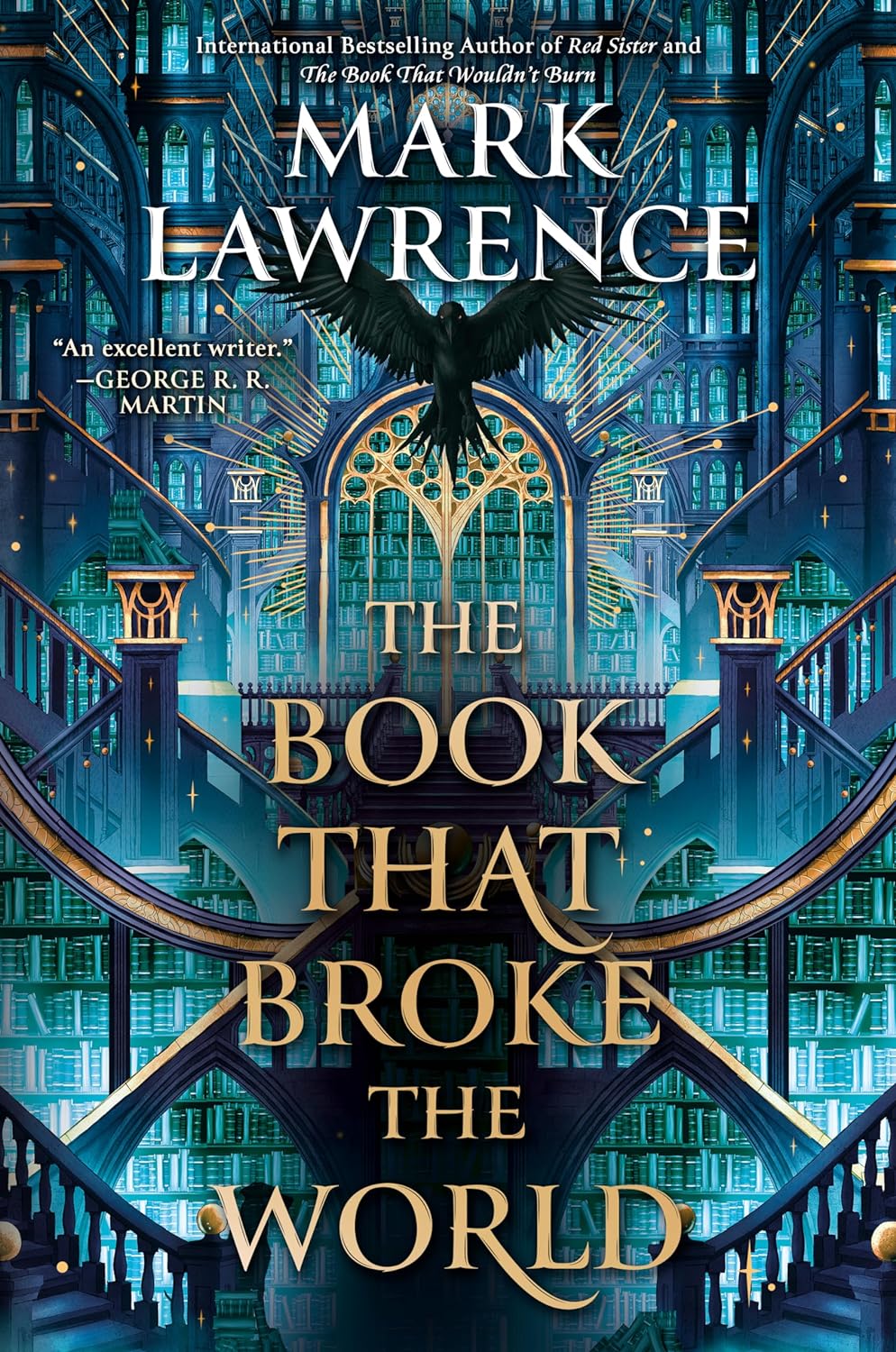
Quick Review – The Book That Broke the World by Mark Lawrence

Publisher: Harper Voyager (Trade Paperback – 9 April 2024)

Series: The Library Trilogy – Book Two

Length: 369 pages

My Rating: 4.5 out of 5 stars

Amazon

The master of elaborate fantasy fiction continues his outstanding and intricate Library trilogy with the captivating novel, The Book That Broke the World.

Mark Lawrence is an exceptional author who has been wowing fantasy and science fiction fans since 2011 with impressive reads that borrow heavily from both genres.  Some of his better-known series include the Broken Empire novels, the Book of the Ancestor trilogy and The Book of the Ice trilogy (which includes The Girl and the Stars and The Girl and the Mountain).  His current body of work, the Library trilogy, might be his most ambitious series yet as he envisions a complex and intense story of hope, discovery and secrets within an impossible library that bends time, reality and the lives of its many alien inhabitants.  The first book in the series, The Book That Wouldn’t Burn, was an epic read that told the story of Evar and Livira, two teenagers brought to the library in very different circumstances, who work to uncover its many mysteries.  This was such a great read, especially as Lawrence loaded in a particularly clever central twist that blew my mind, and The Book That Wouldn’t Burn ended up being one of my favourite books of 2023.  As such, the sequel, The Book That Broke the World, was one of my most anticipated reads for 2024, and it ended being a very interesting second entry in this amazing series.


Plot Synopsis:

We fight for the people we love. We fight for the ideas we want to be true.

Evar and Livira stand side by side and yet far beyond each other’s reach. Evar is forced to flee the library, driven before an implacable foe. Livira, trapped in a ghost world, has to recover her book if she’s to return to her life. While Evar’s journey leads him outside into the vastness of a world he’s never seen, Livira’s destination lies deep inside her own writing, where she must wrestle with her stories in order to reclaim the volume in which they were written.

And all the while, the library quietly weaves thread to thread, bringing the scattered elements of Livira’s old life – friends and foe alike – back together beneath new skies.

Long ago, a lie was told, and with the passing years it has grown and spread, a small push leading to a chain of desperate consequences. Now, as one edifice topples into the next with ever-growing violence, it threatens to break the world. The secret war that defines the library has chosen its champions and set them on the board. The time has come when they must fight for what they believe, or lose everything.

The Library Trilogy is about many things: adventure, discovery, and romance, but it’s also a love letter to books and the places where they live. The focus is on one vast and timeless library, but the love expands to encompass smaller more personal collections, and bookshops of all shades too.


Lawrence had to achieve a lot in this sequel, as he needed provided a compelling follow-up to his previous novel while also advancing the story in a clever and unique manner.  I felt that he succeeded on all fronts, as The Book That Broke the World proved to be just as complex, intense and addictive as the first book in the series.  Set in the immediate aftermath of the shocking events of The Book That Wouldn’t Burn, The Book That Broke the World continues to follow star-crossed lovers Evar and Livira as they to try and find each other despite the insurmountable odds of existing in different times and being born different species who are constantly at war with each other.  This new novel once again sees them parted, primarily due to one of the characters being a ghostly presence in the other protagonists’ time, and they soon end up discovering new periods of history within the library as war, strife and a new dangerous race upset the balance of events.  There is a certain feeling of tragedy and frustration for much of Evar and Livira’s narrative, as the two remain separated from each other, and you really get invested in their story, as well as the lives of their associated supporting characters, especially as the blending of timelines leads to some new interactions.

While it was great to continue to follow the adventure of the same main characters from the first book, the thing that made The Book That Broke the World’s narrative really stand out was the inclusion of new point-of-view protagonists whose additional narrative supported the unique story of Evar and Livira.  The first of these, Arpix, was a major secondary character in The Book That Wouldn’t Burn, and his use as a perspective protagonist here was very effective, especially as it allowed for a more measured view of some of the crazy events occurring throughout the book.  Arpix was a great character in this sequel, and I especially enjoyed seeing him interact with Evar and his family as Lawrence throws him into a delightful romance narrative with a very unlikely but entertaining figure.

However, it was the other additional point-of-view character who really turned The Book That Broke the World into something special, as Lawrence introduced a seemingly new protagonist, Celcha, a slave in the city surrounding the library, who finds herself drawn to its secrets thanks to the machinations of her unusual brother and the ghosts that visit him.  A member of an alien species who came from a different period than Evar and Livira, Celcha has an intriguing narrative within The Book That Broke the World, as she tries to escape the manipulations of other visitors from the library while also trying to learn more about her species.  Celcha’s narrative is at first separated from the rest of the storylines, and it is initially unclear what role it is going to play in the larger plot.  However, the way that Lawrence ends up tying it together with the rest of the plot is very clever, especially as he utilises the uncertainty of when Celcha’s story fits into the overarching timeframe of the narrative to tie up many mysteries from the first book while weaving in a complex new player.  These intriguing, character driven arcs come together extremely well by the end of the story, and you will be amazed at how well Lawrence’s many complex puzzle pieces fit together by the end for an addictive and memorable narrative.

As with most of Lawrence’s writing, The Book That Broke the World is a very complex and lore-heavy book that requires readers to really pay attention to the many, many details loaded into the overall text of the plot.  This results in a very elaborate narrative as Lawrence is constantly working in compelling details about his intriguing universe while also layering down constant hints and plot points that will become relevant later for twists and other reveals.  Readers really get caught up in the majesty of the massive setting of the Library trilogy, and I really appreciated how Lawrence was capable of blending fantasy elements with more science fiction focused occurrences, like advanced technology and time travel.  I also loved how well the author used the various character perspectives to further enhance the scope of the narrative and the setting, and you must appreciate the mystery and scope of his ambitious setting and the elaborate narrative around it, especially when it comes to the many fascinating side characters and protagonists he works in the plot.

While this proves to be a great book to read, it isn’t always the easiest novel to follow, as Lawrence throws in a lot of high-concept moments and plot points that sometimes seem a little too complicated for the narrative’s own good.  Readers are also required to remember a lot of key details from The Book That Wouldn’t Burn to fully appreciate the scope and cleverness of this second entry in the series.  While I was able to recall most of the details of the first book (the recap at the front was quite helpful), I can imagine some readers might have a little more difficulty, especially if there is a big gap between reads in the series.  Despite that, I think it would be possible to jump into the Library series from this second novel, but you really would be better off reading The Book That Wouldn’t Burn first as it allows you to become much more invested in the various compelling character arcs and emotionally laden storylines.

Mark Lawrence continues to showcase his inventive and unique fantasy style with The Book That Broke the World.  Providing readers with a complex and compelling sequel to his first Library novel, The Book That Broke the World continues the intense narrative in some fantastic directions, while constantly working to make the plot even more intricate and powerful.  An outstanding piece of fantasy fiction that will keep you guessing to the end, The Book That Broke the World comes highly recommended, and I look forward to the fast-approaching final entry in the series that is out in a few months’ time.

Amazon

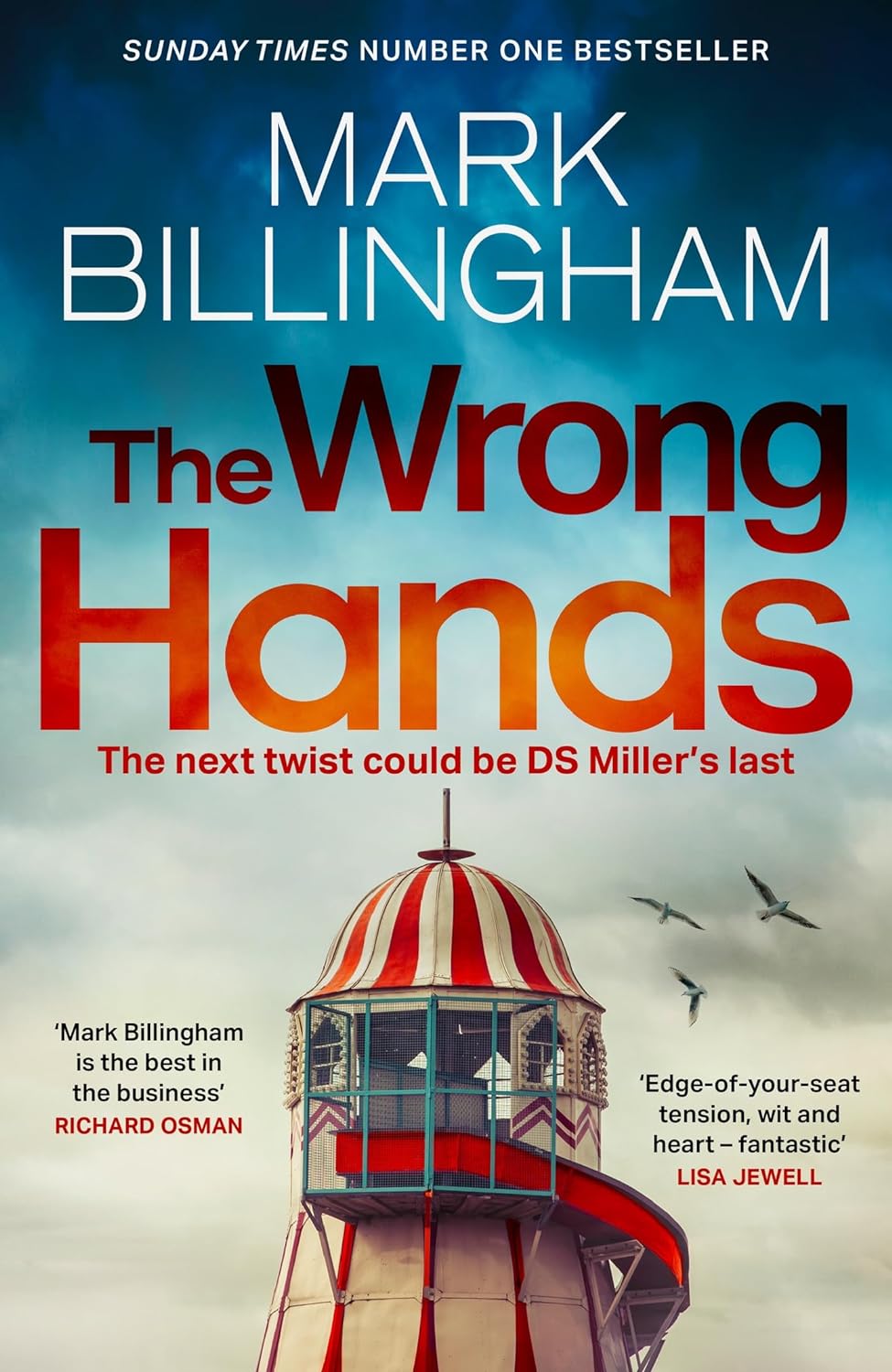
Quick Review – The Wrong Hands by Mark Billingham

Publisher: Sphere (Trade Paperback – 25 June 2024)

Series: DS Declan Miller – Book Two

Length: 405 pages

My Rating: 4.25 out of 5 stars

Amazon

Bestselling crime fiction author Mark Billingham continues his DS Declan Miller series with the highly entertaining read, The Wrong Hands.

Billingham is an intriguing British crime fiction author who has an impressive catalogue of books to his name.  Best known for his long running DI Tom Thorne series, Billingham has also written an array of compelling standalone novels and audiobook exclusives.  His latest body of work is his DS Declan Miller series, which is a light-hearted crime fiction series focusing on an array of over-the-top characters.  Starting with The Last Dance, the DS Declan Miller books follow an eccentric police detective as he investigates unusual crimes in Blackpool, including the murder of his own wife.  The Wrong Hands is the second book in the series, and it proved to be another cooky investigation with a highly entertaining plot behind it.

Plot Synopsis:

This is one case Detective Miller won’t want to open . . .

The second rip-roaring mystery from multi-award-winning number international bestseller Mark Billingham starring Detective Miller: unique, unconventional, and criminally underestimated…

Unconventional Detective Declan Miller has a problem. Well, two problems. First, there’s his dead wife and her yet-to-be-solved murder. He really should stop talking to her ghosts…

Second, and most pressing, a young man has just appeared on his doorstep with a briefcase . . . containing a pair of severed hands. Miller knows this case is proof of a contract killing commissioned by local ne’er do well Wayne Cutler—a man he suspects might also be responsible for his wife’s death. Now Miller has leverage, but unfortunately, he also has something that both Cutler and a villainous fast-food kingpin are desperate to get hold of.

Sprinkle in a Midsomer Murders-obsessed hitman, a psychotic welder, and a woman driven over the edge by a wayward Crème Egg, and Miller is in a mess that even he might not be able to dance his way out of.


The Wrong Hands
was a highly entertaining and slightly outrageous crime fiction read that sets the author’s distinctive police detective protagonist against an unlikely assortment of criminals in a wacky, fast-paced plot.  Starting off with a very entertaining opening sequence that sees a world-class assassin and a local crime boss severely embarrassed by two local youths who managed to steal vital evidence, the book only gets even more fun from there as DS Declan Miller comes into possession of a pair of hands that could prove the key to locking up his rival and solving the murder of his dead wife.  However, to get there, Miller must first catch a dangerous killer, determine who the hands belong to, and protect anyone associated with the thieves responsible for the whole debacle.

I had an amazing time with this story, as Billingham loaded his plot with a huge array of over-the-top characters, each of whom proved fun to follow.  The plot moves at a very fast pace, and the author loads up some interesting clues and set-ups that result in some fantastic twists.  Much of the plot turns into an unlikely game of cat and mouse as Miller and his colleagues try to find the assassin before he strikes down everyone involved with the case.  I liked the captivating tension and unique story moments that led up to the big confrontation and the eventual solution to the book’s main plot proves to be quite enjoyable, especially as the villains are brought down from an unexpected source.  However, I must admit that I felt the author’s solution to the big crime of the series, the murder of the protagonist’s wife, didn’t get the epic solution it deserves, especially as the culprit kind of comes out of nowhere.  Still, this was an overall fantastic read and you really get wrapped up in the clever story.

Billingham utilises a distinctive stye that combines humour with compelling crime fiction scenarios.  While slightly derivative of the current craze around comedic murder mystery novels, The Wrong Hands still proved to be extremely entertaining, and I found the entire oddball scenario to be very compelling.  The quick change in focus between the various memorable figures involved in the case helped to give the novel some additional depth and comedic power, and I loved seeing the different angles to this entertaining narrative.  In addition, I felt that Billingham did a great job making The Wrong Hands a very accessible and easy to read book.  While The Wrong Hands does serve as a sequel to The Last Dance, new readers can easily dive into this latest book from Billingham without any issue, and the author ensures all the key plot points are expertly rehashed, allowing anyone to come in and have a great time with this fantastic novel.

While I loved the plot of The Wrong Hands and the way it was presented, the real fun lies in the unique characters themselves, as Billingham brings together an amazing and varied cast of niche crooks, crazed killers and troubled cops.  While I did think that Billingham may have tried a little too hard to make his protagonist, the dance-loving, unusual fact-spouting, rat-owning DS Declan Miller seem as quirky as possible, he still proved to be a great character to follow, and I felt that the author perfectly captured his grief, guilt and obsession with finding his wife’s killer.  His partner, DS Sara Xiu, proved to be an excellent foil to Miller, and even with her issues she worked as an enjoyable straight figure to Miller’s eccentric persona.  However, it is Billingham’s villains that really make The Wrong Hands stand out, as the author utilises an excellent collection of outrageous rogues.  This includes two crime bosses with alternate product focuses, whose neglectful family life proves to be their downfall, an elite assassin with a less-than-perfect naming convention and a love for Midsomer Murders, and a psychotic welder with some major issues.  These fantastically dark characters added a lot of impact to The Wrong Hands, and I loved seeing how their entertaining and often ironic storylines came together.

Overall, The Wrong Hands was an awesome and very fun new book from Mark Billingham, who let his ridiculous side loose to produce a fantastic crime fiction read.  Fast, funny, and loaded with outrageously complicated characters, The Wrong Hands is an easy book to get lost in, and I am glad I decided to pick it up.

Amazon

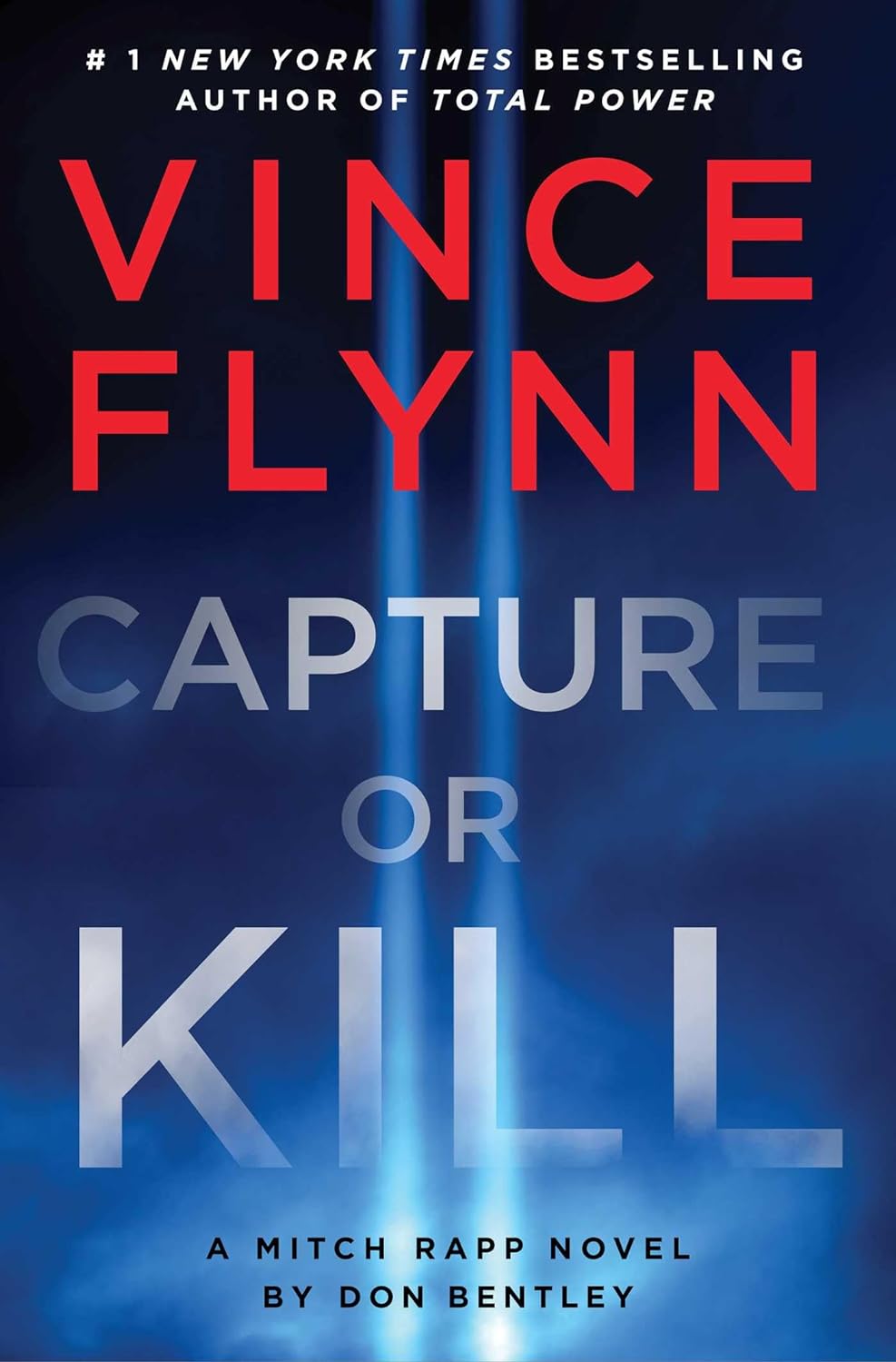
Quick Review – Capture or Kill by Don Bentley (based on the series by Vince Flynn)

Publisher: Simon & Schuster Australia (ebook – 4 September 2024)

Series: Mitch Rapp – Book 23

Length: 464 pages

My Rating: 4 out of 5 stars

Amazon

Those in the mood for an intense, action-packed spy thriller should check out the latest book in the long-running Mitch Rapp series, Capture or Kill, written by new author Don Bentley.

Over the last few years, I have become a massive fan of the classic Mitch Rapp thriller series.  Following a dark and deadly operative who specialises in killing America’s enemies, the Mitch Rapp books are an exciting and compelling series that always scratch my action itch each year.  Originally written by Vince Flynn, since his death, the series has been taken over by other talented authors continuing his story.  I personally have only read some of the books written by Kyle Mills, which includes Red WarLethal AgentTotal PowerEnemy at the GatesOath of Loyalty and Code Red, and I appreciated the cool scenarios that Mills pitted the protagonist against.  This year saw an interesting change to the series with the introduction of new author Don Bentley.  Bentley, an established thriller writer himself, is the third author to contribute to the Mitch Rapp series, and his new novel, Capture or Kill, was an excellent throwback to some of Flynn’s original storylines.

Plot Synopsis:

April 2011: On a remote mountaintop overlooking the remains of the Iranian nuclear weapons program, Azad Ashani witnesses a Quds Force demonstration of a capability meant to upend America’s war in the Middle East. Ashani, director of the Iranian Ministry of Intelligence and Security and Irene Kennedy’s former back channel to the Iranian government, recognizes the demonstration’s true significance, and the nation-ending conflict it will provoke. Alone, Ashani stands no chance of preventing this rush to madness.

But with the help of one man, he just might.

In Washington, DC, CIA director Irene Kennedy briefs the president that the operational window to kill or capture Osama bin Laden at his recently discovered compound in Abbottabad, Pakistan is rapidly closing. But before he’ll authorize a commando raid on Pakistani soil, the president demands irrefutable proof of bin Laden’s presence.

Proof he trusts just one man to provide.

Preventing a looming war in the Middle East while delivering justice for the nearly 3,000 Americans killed on 9/11 would be a big ask for anyone.

Mitch Rapp isn’t just anyone.


Capture or Kill
was an awesome and action-packed read that took the series protagonist back to basics by setting him against an array of Middle Eastern foes in a compelling thriller narrative.  Bentley weaves together an ambitious plot that seeks to continue storylines from the classic Vince Flynn novel, Protect and Defend, while the protagonist also gathers intel for the raid on bin Laden’s compound in Pakistan.  This results in a great array of intense scenes, as Rapp tries to counteract a dangerous collection of Iranian assets and plots, as well as help to recover a missing American soldier in Afghanistan.  There is some great back and forth as Rapp and the antagonists try to unravel their respective plans, and I loved the fantastic overarching plot of the book’s antagonists.  At the same time, Bentley cleverly works in real-life details of the events leading up to the bin Laden raid, which helped to give the story a much-needed sense of realism and higher stakes.  This proved to be a gripping Mitch Rapp narrative and readers will find themselves getting drawn into the compelling and fascinating plot.

I liked the writing in Capture or Kill, especially as Bentley did an amazing job of emulating the over-the-top style of the Mitch Rapp series.  The narrative is a lot more grounded than some of the Kyle Mills narratives I previously read, which I felt brought it back to Flynn’s original style a bit better (although I honestly loved some of Mills’s outrageous scenarios).  Moving the scenario back to the early 2010s was also a sensible move from Bentley, as it allowed him to fit his narrative amongst existing series story threads, while also putting the protagonist in a unique position to impact an historically important espionage event.  Bentley continues to set the tone perfectly by ensuring that the well-known excessive action and badassery of the protagonists is on full display, and those readers who love a ton of combat and exciting espionage escapades are in for a great time with Capture or Kill.  As such, there was a very classic feel to Capture or Kill that I think long-term fans of the series will appreciate, and I felt it captured the flow of some of the other Mitch Rapp books extremely well.

Aside from ensuring that Capture or Kill matched the typical tone of the series, Bentley also did a really good job of portraying many of the classic Mitch Rapp cast.  I felt that the author successfully captured the best parts of many of the protagonists in this new book, and I liked the fantastic storylines that he wove around them.  Series protagonist Mitch Rapp was his over-the-top self as always, and Bentley really ensured that the readers got the full blast of his intense aura and savagery.  It was a little jarring to see how intense Rapp got at times, mainly because I’m more familiar with the Mills version of the character, who is older and more family orientated, but I appreciated how Bentley was trying to get the rugged, active agent version of the protagonist down.  Other recurring characters came across in a similar manner, and I particularly enjoyed seeing more of CIA director Irene Kenedy, especially as much of this book deals with the aftermath of her kidnapping in Protect and Defend.  I also enjoyed seeing Mike Nash trying to fit into his new role as a CIA executive, especially when you consider where his character is going in the extended canon.  All this, and more, proved to be an awesome take on these established characters, and fans of the series will appreciate the care and attention Bentley took with them.

Don Bentley is off to a very strong start as the new author of the Mitch Rapp series.  Capture or Kill is an awesome addition to the series that presents readers with a dark and powerful action-packed narrative.  I look forward to seeing how the Bentley continues the Mitch Rapp books in the future, but it appears that this series is in safe hands going forward.

Amazon

Quick Review – Warhammer 40,000: Witchbringer by Steven B Fischer

Publisher: Black Library (Audiobook – 25 November 2022)

Series: Warhammer 40,000/Astra Militarum

Length: nine hours and 33 minutes

My Rating: 4.25 out of 5 Stars

Amazon

Fresh Warhammer 40,000 fiction author Steven B Fischer presents Witchbringer, a compelling and particularly intense novel that dives into the complex life of an Imperial sanctioned psyker.

I have been having a lot of fun with Warhammer 40,000 fiction this year, and one of the more interesting Warhammer books that I have recently enjoyed is the awesome debut novel from Steven B Fischer, Witchbringer.  I have been meaning to review Witchbringer for a while, especially as it had a fantastic plot synopsis behind it.  As I am currently in the middle of Fischer’s latest book, Broken Crusade, I thought that this was the perfect time to highlight Witchbringer on my blog, especially as it was a clever and memorable addition to the franchise.

Plot Synopsis:

An Astra Militarum Novel

Once a Cadian captain, Glavia Aerand’s psychic talents see her pressed into service in a new role, to fight and die as a sanctioned psyker.

READ IT BECAUSE
This story offers a rare glimpse into the mysterious process of becoming a sanctioned psyker in the service of the Golden Throne, and you’ll learn what that means for those who are found strong enough to serve.

THE STORY
Suffer not the witch to live, unless by their service they might earn redemption. This is the creed of the Scholastica Psykana, a brutal foundry in which those with psychic power might be taught to serve. On the eve of her sanctioning as a primaris psyker within these very halls, Glavia Aerand, former captain of the Cadian 900th Regiment, receives a startling premonition – one concerning her old unit, and a dangerous psychic artefact hidden on the planet where they are deployed.

After a reunion she never expected – or wanted – Aerand finds herself mired in a vicious campaign on the psychically active world of Visage, where the shallow seas and endless fogs are rumoured to swallow the souls of the dead. Haunted by growing suspicions of her new commander and the manifestations of the sinister relic, Aerand must trust in her new-found abilities to keep her former comrades alive, and confront an ancient threat that could consume Visage entirely.


Witchbringer
proved to be an outstanding and particularly powerful Warhammer 40,000 novel that combines compelling insights into a unique class of human soldier with a great plot centred around damaged characters.

This cool Warhammer 40,000 book primarily focuses on Glavia Aerand, former soldier and newly sanctioned primaris psyker.  A trained and authorised witch who uses her unnatural powers to fight for the Imperium of Man, Aerand is an outcast amongst her fellow humans, who view her gifts as tainted and borderline heretical.  Starting off with a dark sequence in the Scholastica Pyskana, a gothic school aimed at training and controlling powerful psykers, the story soon moves on to the main plot when the protagonist receives a vision warning that her old regiment is in danger.  Journeying to Visage, a war-torn swamp world, Aerand finds her regiment in shambles, her former friends no longer trust her, and nobody capable of remembering the previous pysker lord assigned to them.  What follows is an exciting and intense narrative as Aerand simultaneously fights against the rebels and their native witches, while also trying to regain the trust of her comrades.  At the same time, Aerand must unravel both the dark conspiracy engulfing the planet and the secrets her commanders are hiding.

I felt that Fischer produced a compelling and exciting Warhammer 40,000 narrative that really dragged me with its intense storytelling.  The author got the right balance of unique grim Warhammer elements, complex character development, and dark intrigue, all of which melded well with the typical military fiction story fans of the franchise have come to expect.  Fischer does a brilliant job increasing the threat of his story, and the desolate swamp setting of Visage takes on a real life of its own, especially when it comes to grizzly fights against swamp witches and disturbed spirits.  At the same time, the focus on the protagonist’s isolation from her old comrades, who distrust her due to her tainted abilities, adds a great emotional heart to Witchbringer that cleverly works into the larger secrets of the main narrative.  Fischer does a great job bringing the dark plot of Witchbringer together for an exciting conclusion, and readers will appreciate the inevitable carnage that follows.  This is an overall impressive and well-written story that I had an amazing time listening to.

Witchbringer was an interesting addition to the Warhammer 40,000 canon, especially as it was part of the Astra Militarum series that seeks to follow adventures of the various human soldiers fighting in the bleak future.  As such, Fischer expertly explores the sanctioned psykers of the Astra Militarum, including their training, their unique role in combat, and the way that the common trooper views them.  While I do think that Fischer overpowered his protagonist, for the most part this proved to be very fascinating novel about sanctioned psykers, and I enjoyed how the author highlighted the protagonist’s human side.  As such this is a great read for established fans of the franchise, and I am sure most Warhammer 40,000 players and fiction readers will appreciate Fischer’s excellent debut to the genre.  Fischer also ensured that there was enough context and explanation of the more complex universe elements for newer readers to follow along and anyone can probably come in and enjoy Witchbringer, especially if they love a distinctive science fiction thriller.

As with most Warhammer fiction, I chose to enjoy Witchbringer on audiobook, which is easily the best way to appreciate the franchise.  The grim dark setting and intense action of any Warhammer 40,000 novel is deeply enhanced when read out to you and I love the array of talented narrators that work to bring these amazing stories to life.  In Witchbringer’s case, it was narrated by Amy Rockson, who is relatively new to the franchise.  Rockson had a pretty good take on the unique flow of a Warhammer 40,000 audiobook, and I felt she inhabited the various characters extremely well.  The more supernatural elements of Witchbringer’s plot really came to life when read out by Rockson, and I enjoyed how much passion she injected into the various fight scenes.  With a run time of around nine and a half hours, Witchbringer proved to be an easy audiobook to get through quickly, and I had a wonderful time listening to this amazing piece of Warhammer 40,000 fiction.

Overall, Warhammer 40,000: Witchbringer proved to be an amazing book, and I really enjoyed checking out Steven B Fischer’s debut novel.  Featuring a captivating tale of mystery, mayhem and moving character moments, Witchbringer was a great addition to the Warhammer 40,000 canon, and it proved hard not to become addicted to its impressive story.  This is a powerful and excellent read from an author who looks set to be a fantastic feature of the franchise’s fiction going forward.

Amazon

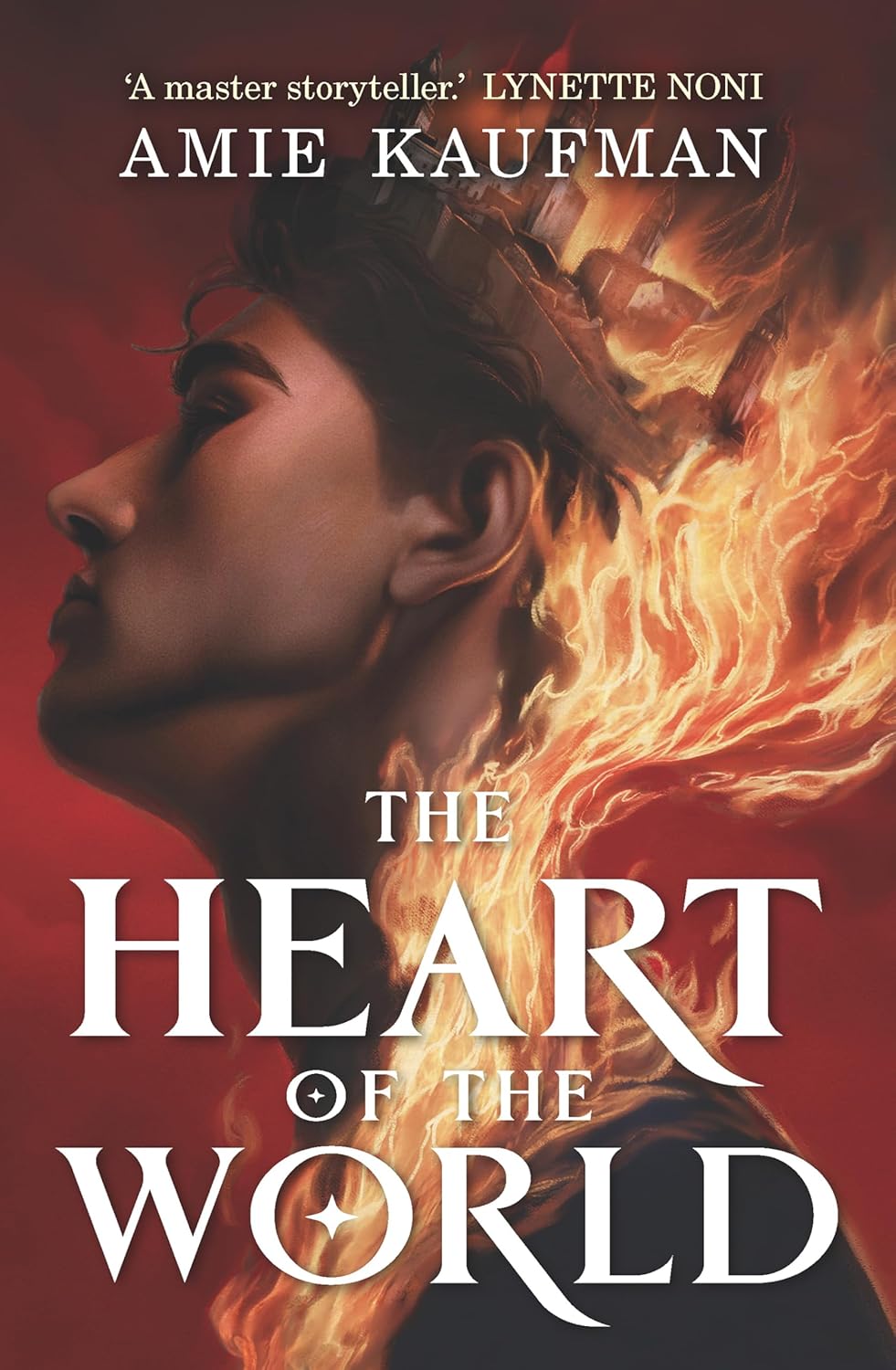
Quick Review – The Heart of the World by Amie Kaufman

Publisher: Allen & Unwin Australia (Trade Paperback – 27 August 2024)

Series: The Isles of the Gods duology – Book Two

Length: 424 pages

My Rating: 4.25 out of 5 stars

Amazon

One of Australia’s leading authors of young adult fiction, Amie Kaufman, presents a cool conclusion to The Isles of the Gods duology with the fun read, The Heart of the World.

Amie Kaufman is an impressive Australian author who has produced multiple entertaining and enjoyable series over the years, mostly in collaboration with other awesome authors.  For example, I best know Kaufman from the intriguing and addictive young adult science fiction trilogy she cowrote with Jay Kristoff, the Aurora Cycle trilogy, which proved to be particularly fun (see my reviews for Aurora Rising, Aurora Burning and Aurora’s End).  Kaufman’s latest body of work has been The Isles of the Gods duology, a great young adult fantasy series that follows several teenage protagonists who find themselves drawn into an ancient war between gods.  This series began last year with the first book, The Isles of the Gods, and has just come to an end with the compelling read, The Heart of the World.

Plot Synopsis:

Magic and sacrifice will collide as lovers and gods, enemies and allies vie for the fate of the world in this heart-pounding sequel to The Isles of the Gods, which Stephanie Garber called deliciously diabolical and full of heart.

When Selly and Leander began their treacherous voyage to the Isles of the Gods, the captain’s daughter and the playboy prince were strangers. But amid talk of war and a deadly attack on their ship, the unthinkable happened.

They fell in love.

Leander’s ritual at the island temple was meant to prevent a war between the gods. Instead, it nearly cost him his life, and drew the goddess Barrica back from exile. Now, as her Messenger, Leander is imbued with her deadly magic, and only Selly’s presence can stop it from consuming him.

But Barrica wasn’t the only immortal roused from sleep. The God of Risk, Macean, was awakened by an enemy all thought dead, and across the sea he’s calling for war.

The fight to save their world will take Selly and Leander from the gilded ballroom of the royal palace to the hallowed halls of an ancient library. Battle lines will be drawn, and bonds will break.

With the wrath of gods and the machinations of power-hungry rulers straining their loyalties, can their love withstand the trials that await them?

The Heart of the World was an exciting and moving book that did an excellent job wrapping up the storylines started in the first book.  Set immediately after the events of The Isles of the Gods, Kaufman presents an intense, character-driven narrative, as the teenage protagonists attempt to deal with the return of gods into their world.  Told from the perspective of five characters, you get some interesting storylines here, including Leander learning to control his power as his god’s Messenger while Selly tries to help him while also learning about the deadly politics of the realm.  Other character storylines of note include the scholar Keegan attempting to determine how to stop the oncoming chaos while also dealing with his many personal issues, the antagonistic Messenger of Macean, Laskia dealing with having power for the first time, and the conflicted Jude trying to determine where he stands in the world.

Kaufman does a great job blending these cool, character-driven storylines together into one compelling and exciting narrative with a very fast pace.  There is an excellent blend of politics, character growth and a deepening of personal relationships, as each of the protagonists react to the changes brought on by the events of the first book.  Things take a more urgent turn halfway through as the warring gods emerge and the characters find themselves desperately caught up trying to stop or control the destructive fight to come.  Featuring a countdown towards inevitable carnage, I liked how Kaufman kept the intensity and stakes of the second half of the book high without showing too much actual conflict and bloodshed, instead relying on compelling character moments thanks to a variety of unique interactions.  The protagonists are forced to overcome the consuming influence of their gods, both of whom want war, as they attempt to save their world, and I felt that the author came up with a well-written and cleverly set up solution to the entire plot.  The book ends on a satisfying and hopeful note, and I really had a fun time getting through this compelling story.

I really liked how The Heart of the World came together, and Kaufman ensures that it is accessible and enjoyable for a range of fantasy fans.  While I would recommend reading The Isles of the Gods first, new readers can probably dive into The Heart of the World straight away without too much prior context, as the author’s descriptive writing style and ability to effectively recap events really helps.  While some of the key fantasy elements from the last book aren’t as comprehensively covered in this sequel, such as spirit magic, Kaufman ensures that all the key features of this universe are well covered.  Indeed, there is a major religious focus throughout The Heart of the World, and it was fascinating to see various characters react to the direct influence and power of the two warring deities.

The resulting story moves at high speeds, and I honestly found myself powering through The Heart of the World every time I picked it up.  It helped that Kaufman made excellent use of quick and sharp perspective changes, and the jump from one short character-focused chapter to the next allowed for some quick plot progression.  As with the prior book in the duology, I felt that The Heart of the World was an excellent fantasy book that would appeal to a lot of readers, not just its intended young adult audience.  In particular, Kaufman sets up a lot of mature and intelligent themes and moments, most of the based around her complex protagonists, which I think will resonate with a teenage audience.  However, older fantasy readers can also enjoy The Heart of the World thanks to Kaufman’s clever writing and intriguing themes.

I also need to quickly highlight the excellent character work contained within The Heart of the World, which I felt helped to turn this sequel into something special.  Kaufman does an outstanding job continuing to explore her five damaged protagonists, and there is some great continuation to the complex character elements set up in the first book.  This includes a compelling look of the romance angle between Leander and Selly, who are forced to deal with major obstacles, including Leander’s sudden uncontrollable power, while Selly is forced out of her comfort zone on the waves and into the deadlier wilderness of court life.  I also loved the storyline of Laskia, who’s experience as her god’s Messenger went in a darker direction, as she struggles with finally having power and the ability to control her destiny after a lifetime of being manipulated by others.  All of the other protagonists have their own unique moments as well, and I really appreciated how all their respective family issues became even more apparent in this second book, as all five of them experience some form of betrayal or disappointment at the hands of their family which they must overcome.  Throw in a particularly entertaining new supporting character in Kiki, a bubbly and unstoppable force of social energy, and the cast of The Heart of the World was particularly strong and resulted in some moving moments.

Overall, The Heart of the World was an amazing new novel from Amie Kaufman that I was glad I checked out.  Providing a great ending to The Isles of the Gods duology, The Heart of the World had a brilliant, character-driven narrative, that is so easy to get lost in.  A fantastic and very fun novel that is worth checking out, especially if you enjoyed Kaufman’s previous work.

Amazon

Quick Review – Confessions of the Dead by James Patterson and J. D. Barker

Publisher: Century (Trade Paperback – 2 July 2024)

Series: Standalone

Length: 454 pages

My Rating: 4.25 out of 5 stars

Amazon

One of the weirder and more compelling thrillers of 2024 so far has to be the unique Confessions of the Dead by the superstar team of James Patterson and J. D. Barker.

2024 has been an excellent year for both Patterson and Barker, as both authors have produced some excellent books.  Barker wrote the engrossing and highly adult thriller, Behind a Closed Door, while Patterson has continued to release a raft of compelling thrillers cowritten with talented authors, including The No. 1 Lawyer with Nancy Allen and The Murder Inn with Candice Fox.  As such it is unsurprising that the two would come together again this year with another collaboration, this time with the intriguing novel, Confessions of the Dead.  Their last collaboration, Death of the Black Widow, was one of my favourite books of 2022, so I was very excited to read Confessions of the Dead, especially as it featured a particularly interesting plot.

Plot Synopsis:

The smallest towns hide the darkest secrets . . . Drawing elements from the horror genre, this eerie standalone suspense thriller is perfect for fans of Stephen King.

The dead tell no tales . . .

Hollows Bend is a picture-perfect New England town. The crime rate – zero – is a point of pride for Sheriff Ellie Pritchett.

The day the stranger shows up is when the trouble starts.

The sheriff and her deputy investigate the mysterious teenage girl. None of the locals can place her. She can’t – or won’t – answer any questions. She won’t even tell them her name.

While the girl is in protective custody, the officers are called to multiple crime scenes leading them closer and closer to a lake outside of town that doesn’t appear on any map . . .


Confessions of the Dead
proved to be an intense and captivating horror/thriller hybrid as Patterson and Barker make the full use of their inventive narrative to unleash death, destruction and horror onto a seemingly innocent small town.  Starting off with a rain of suicidal birds hitting main street, and only getting darker and weirder from there, Confessions of the Dead follows several intriguing characters as they witness their fellow townspeople descend into madness and begin to enact dark and violent acts against each other, all while a mysterious teenage girl silently witnesses their hatred and crimes.  Things get even weirder, when it becomes clear that their town has become fully isolated from the outside world, with shadowy soldiers holding watch from the outskirts of town.  The various storylines soon reveal the dark secrets of Hollows Bend and the young girl seemingly causing the chaos, and you will not be prepared for the full truth that is revealed, and the terrifying implications.

This proved to be a rather interesting and horror-laden story that takes the readers in some surprising directions.  The narrative within Confessions of the Dead is spooky, deeply personal, and occasionally outrageous, as dark deeds slowly begin to sweep the town, turning the innocent townspeople against each other.  Patterson and Barker do a really good job of building up the mystery in the first half of the book.  There are so many intriguing secrets and mysteries lurking in this first part of the book, which are well matched by scenes of horror and human violence.  The fast-paced chapter changes that are such a distinctive part of Patterson’s writing style work wonders in conveying the unusual situation, and I loved how well the plot switched between multiple unique characters, all of whom have some dark secret they are hiding, even if they don’t know what it is.  The authors also add in some intriguing wrinkles to the plot through the use of multiple well-placed interludes that show a point in the future where one of the book’s protagonists is being interviewed by a member of the mysterious organisation keeping the town.  These inclusions really helped to build up tension as they hinted at events to come, while the elaborate setup surrounding the interviews, gave some idea of how serious the situation really was.

Everything leads up to a very intense second half of the book, as Confessions of the Dead’s story gets darker and darker.  Indeed, the authors build together a real horror/thriller vibe for Confessions of the Dead, which I honestly enjoyed, and it was great to see a more unusual and inventive thriller come out of the Patterson production machine.  There is an interesting combination of storylines in the second half of the book, from vigilante townspeople, monstrous killers, and even a Stranger Things/Goonies inspired sideline following a group of the town’s younger residents as they try to investigate the chaos engulfing the lives of their parents.  The authors set up a big and intriguing conclusion to the story, that provides a particularly unique ending that will stick in the reader’s mind.  I did think that Patterson and Barker did perhaps make the ending a little too complicated and meta for its own good, and that certain aspects of the crazy conclusions impacted my overall enjoyment of the book.  Still, this was for the most part a great story, and I had fun getting through it.

Confessions of the Dead was a particularly fascinating and memorable 2024 thriller that I was glad I checked out.  Written by the brilliant team of James Patterson and J. D. Barker, Confessions of the Dead had a wonderfully dark and brutal plot behind it, that allowed for quite the outrageous read.  Grim, intense, and featuring some interesting concepts, Confessions of the Dead proved very hard to put down and it will be interesting to see where these two authors go the future.

Amazon

Quick Review – Outrider by Mark Wales

Publisher: Pan Macmillan Australia (Trade Paperback – 25 June 2024)

Series: Standalone/Book One

Length: 354 pages

My Rating: 4 out of 5 stars

Amazon

Former Australian soldier and current media personality Mark Wales presents a particularly exciting debut novel with the gripping thriller Outrider.  A gritty, intense, and absolutely action-packed dystopian thriller, Outrider is an awesome Australian novel readers will have a hard time getting away from.

Plot Synopsis:

Jack Dunne will do anything to save his son.

A violent civil war. An unstoppable enemy. One road to freedom.

In the wake of a global conflict, foreign forces occupy part of Australia, quashing all but a few pockets of local resistance. The tense stalemate ends in 2034, when Jack Dunne reignites the war.

Dunne is an Outrider, one of the last elite special operations soldiers in the Resistance. As the enemy prepare to eliminate the freedom fighters once and for all, he is tasked with his final mission.

If Dunne and his eleven-year-old son achieve the impossible, and survive, they’ll secure their future across the border in Free Australia.

But the road to victory will be bloody.

A cinematic action-thriller from bestselling author and veteran Mark Wales. Explosive and exhilarating, Outrider is a heartfelt father-and-son story of survival, resistance and hope.


Outrider
was an intriguing and complex novel that envisions a dark near future for Australian and sets loose a bold new action hero into the resulting carnage.  Set after a Chinese invasion of Australia, Outrider follows formidable resistance solider Jack Dunne and his son, Harry, as they attempt to save the lives of the last standing rebel fortress in Victoria from an upcoming war.  Given a mission to journey across occupied Australia to recover a military asset who can provide specialised assistance in the upcoming battle to come, Jack and his son will need to run a gauntlet of bandits, Chinese soldiers and members of the collaborating Victorian militia working for them.

This was an intense and exciting piece of Australian fiction, and Wales really dug deep to present an authentic tale of desperation and war.  Quickly and effectively introducing the 2034 dystopian setting, Wales takes the reader right into the action with a series of brutal early encounters that also set the rest of the narrative in motion.  From there, the story turns into an intense, Mad Max-style road trip as Jack and Harry embark on their journey to reach the required military asset and bring them back before it was too late.  This proves to be an excellent continued sequence, as the protagonists encounter obstacles and conflict, while also endearing themselves to the reader with a dive into their motivations and the history of events that drive Jack on.  The second half of Outrider proves to be even more epic and intense, as the protagonists desperately attempt to overcome the deadly forces coming for them.  This all leads up to the massive and impressive full on war sequence, with the fate of free Australia in the balance.  Wales does not disappoint when it comes to this final massive fight sequence, and readers will be blown away by how impressive the carnage gets.

Wales really dug deep here and produced an outstanding and fantastic debut novel that I just could not get enough of.  Making excellent use of his initial plot idea of a futuristic invaded Australia, Wales launches into a sharp and exciting narrative, that keeps grown in intensity as the book continues.  Unsurprisingly, considering the author’s background, the action sequences in Outrider are particularly well written, and Wales does an excellent job portraying the carnage of combat to the reader.  Each of these action sequences are well paced out and highly realistic (well, besides the highly advanced weapons), and the reader gets really drawn into them as a result as you can practically feel every shot or explosion.  While the main appeal of Outrider is the action and exciting story, I really appreciated that Wales took the time to set up several complex and compelling characters.  I felt that his protagonist, Jack Dunne, was an outstandingly damaged and angry main figure, whose loss of his wife is still raw for much of the book.  These intense emotions, as well as the bond he continues to form with his young son as they journey across Australia, adds a powerful edge to Wales’ narrative, and it helped Outrider be more than just an awesome action novel.

The final fantastic element I want to highlight about Outrider is the intriguing background setting of an invaded Australia.  Wales paints a haunting and disturbing picture of how this potential invasion would occur and in what form it would look like, and I liked the dark realism behind his ideas.  I particularly enjoyed how he portrayed the Chinese as only occupying key sections of Australia, rather than the whole continent, which honestly makes a lot of sense, and it allows the protagonist to slip between different parts of the country as a result.  The dive into collaborators and traitor militias continuing most of the fighting against the resistance, with China and the US playing proxy wars in the background, also had a tinge of realism behind it, even if we’d like to think differently.  Finally, the grim details surrounding the invasion add an urgent edge to the plot, and you find yourself pulling for the protagonists even more, especially after a powerful scene where they witness certain train carriages going by.  All of this proves to be an incredible background to a particularly exciting and engrossing read, and I loved seeing Wales’ intense look into the future.

Outrider by Mark Wales proved to be a particularly cool Australian thriller that I had an awesome time getting through.  An inventive and intense debut novel from Wales, Outrider comes highly recommended, especially for fans of Australian fiction with a ton of action, and it is really worth checking it.

Amazon

Quick Review – The Youngest Son by John Byrnes

Publisher: Pan Macmillan Australia (Trade Paperback – 30 July 2024)

Series: Standalone

Length: 386 pages

My Rating: 4.25 out of 5 stars

Amazon

Rising Australian author John Byrnes dives into a new genre with the fascinating and compelling historical fiction novel, The Youngest Son, which focuses an exciting and moving narrative around one damaged family.

Plot Synopsis:

On the unforgiving streets of 1920s Sydney, the Leach family have nothing but each other.

In a tale spanning decades, three children of the broken, working-class family find adventure, heartache and trouble as their lives drift apart.

John finds faith and love at a young age. The inevitable clash between the two leads him into a different kind of brotherhood as war clouds gather.

Maureen dreams of a life ‘just like the movies’ and waits to be swept off her feet. Yet at every crossroad, she makes the wrong choice.

Bob discovers a natural talent with his fists and an instinct for trouble. But with every win he earns the hard way, more enemies rise.

From police corruption and gambling dens to brothels and blood feuds, the Leach family toil in Sydney’s seedy underbelly and on battlefields far away. Against the backdrop of the Great Depression and the Second World War, The Youngest Son chronicles one family’s mesmerising fate in a grand saga and a masterclass in epic storytelling.

The Youngest Son was a fast-paced and addictive novel that cleverly followed the youngest members of a disadvantaged working class 1920s Sydney family through the highs and lows of early 20th century Australian history.  Byrnes, who really impressed me last year with his first novel, the gripping modern thriller Headland (one of my favourite debuts of 2023), did an outstanding job diving into the historical fiction genre, and I enjoyed the excellent and personal story that emerged.

The plot of The Youngest Son works very well, as Byrnes follows the varied lives of the three Leach children, John, Maureen and Bob, as well as a raft of other entertaining and complex characters.  Starting in the 1920s and continuing towards the end of World War II, The Youngest Son’s narrative splits between each of these primary characters and follows the highs and lows of their lives.  This includes the criminal activities of the youngest son, Bob, whose career fighting for Sydney’s criminal underbelly leads him into trouble time and time again.  The oldest son, John, attempts to live a good life and join the church, but misfortune and deceit instead lead him towards the horrors of war.  Finally, the daughter of the Leach family, Maureen, tries to find the excitement and glamour missing from her working-class life, but finds only heartbreak and bad decisions as she is constantly led along the wrong path in life.  Each of these characters experience conflict, betrayal, and tragedy as they attempt to find their way in life, and it helps produce one hell of a story.

I really enjoy historical fiction books that follow the lives of multiple characters as they follow their own path amid the backdrop of real-life history, and it is a format that has served many authors, such as Ken Follett, Jeffrey Archer and Peter Watt extremely well over the years.  Byrnes is another great author who perfectly utilised this story telling method, and I had a lot of fun getting to know the Leach family and their various friends and associates.  The author pulls together a great layered narrative, and I loved the mixture of story elements that emerged, including personal stories of self-discovery, a gritty war narrative, and a continued dive into the criminal underbelly of Sydney during the 1930s and 40s.  While all these major storylines are great in their own way, I personally found myself drawn more to Bob’s narrative, mainly because his dangerous dive into the world of underground boxing is full of excitement and action.

Each of the three main protagonists have intriguing journeys in their respective chapters, and I deeply enjoyed where each of their specific storylines go.  All their story arcs have a great mixture of success, tragedy and self-discovery, and you grow attached to all of them as a result.  The storylines also blend into a fantastic major narrative, and while for the most part they are kept separate from each other, they play off each other well, ensuring that readers get a good mixture of emotions and different experiences, as well as alternating character highs and lows.  Byrnes also makes excellent use of the 1930s and 40s background setting throughout The Youngest Son, and the author ensures each character’s story cleverly evolves to face the various changes occurring around Sydney.  The entire narrative goes in some interesting directions, and you willingly follow these characters wherever they end up, even if that leads you even deeper into tragedy.

While the three main characters are all entertaining in their own ways, I felt that the fourth perspective character Byrnes added in really helped to make The Youngest Son especially special.  This fourth character is the villainous Vince, a cowardly street thug who makes a big impact on the Leach family’s lives in different ways.  Vince proves to be a great recurring antagonist, and his slimy story of success blends in well with the alternating fortunes of the Leach children while also providing some real entertainment value.  You really cannot help but dislike Vince as he succeeds, but you really can’t look away as he succeeds, especially as his various dastardly and snivelling interactions with the other characters, primarily Bob and Maureen, prove to be excellent bridges between these protagonist’s respective storylines.  I really appreciate how Byrnes wove the story of Vince amongst the other major narrative threads of The Youngest Son, and the use of the excellent antagonist continuously moves the plot in the best direction, including with the big finale.

Overall, I felt that this was a great book from John Byrnes, who created an amazing and captivating novel with The Youngest Son.  A slick and easy-to-read novel with some real heart that makes excellent use of its impressive character-driven narrative, historical setting, and engaging protagonists, The Youngest Son is an awesome book to get lost in, and it was fantastic to see how Byrnes has grown as an author.

Amazon

Quick Review – The Death of Dora Black by Lainie Anderson

Publisher: Hachette Australia (Trade Paperback – 28 August 2024)

Series: Petticoat Police Mystery – Book One

Length: 312 pages

My Rating: 4.25 out of 5 stars

Amazon

Australian author Lainie Anderson presents a fun and compelling historical murder mystery that looks at a unique Australian historical figure with The Death of Dora Black.

Plot Synopsis:

Summer, Adelaide, 1917. The impeccably dressed Miss Kate Cocks might look more like a schoolmistress than a policewoman, but don’t let that fool you. She’s a household name, wrangling wayward husbands into repentance, seeing through deceptive clairvoyants, and rescuing young women (whether they like it or not) with the help of a five-foot cane and her sassy junior constable, Ethel Bromley.

When shop assistant Dora Black is found dead on a city beach, Miss Cocks and Ethel are ordered to stay out of the investigation and leave it to the men. But when Dora’s workmate goes missing soon after, the women suspect something sinister, and determine to take matters into their own hands. After all, who knows Adelaide better than the indomitable Miss Cocks?

*In 1915, Fanny Kate Boadicea Cocks became the first policewoman in the British Empire employed on the same salary as men. This novel is a rich exploration of that little-known chapter of Australian history.*


The Death of Dora Black
was a particularly interesting and entertaining read from Lainie Anderson, who has struck upon a fascinating figure to set her book around.  The first book in Anderson’s new Petticoat Policy Mystery series, The Death of Dora Black was a clever novel that blended the real-life history of the infamous Miss Kate Cocks with the author’s own crime fiction narrative.

Starting out in Adelaide, 1917, the book’s story sees formidable real-life police officer Miss Kate Cocks become embroiled in a deadly murder mystery when shop assistant Dora Black is found dead on the city’s beach.  What follows is an excellent story that blends the historical exploits of Cocks, which included helping the needy of Adelaide in her own unique way and attempting to save the morality of the young women of the city with her cane, with a gritty informal murder investigation.  This later investigation of course adds most of the meat to the story, as Cocks, and her junior constable Ethel Bromley, uncover a dark conspiracy of murder, drugs and kidnapping, with its roots deep in the heart of the city.

Anderson brings these disparate elements together into a fantastic overall read, and it was fascinating to see the more cozy and historical elements you would associate with Kate Cocks and her real-life actions blend with a darker murder plot.  I felt that Anderson’s main murder mystery was very well set out, and the resulting investigation by two underestimated women got quite thrilling and exciting.  There are some dark moments and intriguing twists featured throughout this plot, and Anderson produces a particularly powerful crime fiction narrative.  The entire murder mystery and the investigative arc came together extremely well, and I really enjoyed seeing Anderson’s unique protagonists trying to solve the case in their own unique way.  The background setting of Adelaide during World War I also added quite a lot to the narrative, and the author provided a complex and detailed recreation of the historical setting.

The real highlight of The Death of Dora Black was the intriguing main protagonists, Miss Kate Cocks and her junior constable Ethel Bromley.  The two protagonists play off each other extremely well throughout the course of the novel, and the blend of personalities, with the strict but caring Kate and the sassy and exceedingly keen Ethel, proved to be a winning combination.  Readers will particularly enjoy Anderson’s portrayal of Miss Kate Cocks in this book, especially as the author tried to capture all this unique figures’ quirks and historical reputation.  Anderson, who is a major expert on Kate Cocks, paints her as a particularly complex and conflicted figure driven by her religious principals but also willing to do the moral choice and help anyone in need.  It was fascinating to see Miss Cocks wander around historical Adeliade, distributing her moral judgement with her cane, while also solving problems no-one else can.  Anderson succeeded in capturing various aspects of her occasionally controversial history, and I really appreciated the way in which she converted her into a fearsome crime-fighting force, capable of hunting down murderers and drug smugglers.  The utilisation of this very distinctive figure helped to turn The Death of Dora Black into something very special, and I look forward to more exploits with Miss Kate Cocks in the future.

Overall, I felt that The Death of Dora Black was an amazing and highly entertaining novel from Lainie Anderson, who successfully brings her real-life historical protagonist to life and sets a wonderfully enjoyable crime fiction book around her.  Clever, fascinating, and with a lot of crossover appeal to many different readers, The Death of Dora Black was a great book, and I had a ton of fun getting through it.

Amazon

Quick Review – Eruption by Michael Crichton and James Patterson

Publisher: Century (Trade Paperback – 4 June 2024)

Series: Standalone

Length: 424 pages

My Rating: 3 out 5 stars

Amazon

If you’re in the mood for an easy-to-read, fast-paced thriller with cinematic scenes of destruction, then look no further than this year’s big blockbuster novel, EruptionEruption was a very interesting 2024 novel that caught my attention early in the year due to the eye-catching superstar writing team of Michael Crichton and James Patterson.  Apparently based on the notes of the late, great Crichton and then written by the world’s biggest thriller author, Eruption was a somewhat improbable creation that came to fruition this year in a big, explosive way that fans of crazy, over-the-top reads are bound to love.

Plot Synopsis:

Two of the bestselling storytellers of all time have created an unforgettable thriller.

A once-in-a-century volcanic eruption is about to destroy the Big Island of Hawaii.

But a decades-old military secret could turn the volcano into something even more terrifying…

Now it’s up to a handful of brave individuals to save the island – and the entire world.


Eruption
turned out to be a unique and memorable read, although not necessarily for all the right reasons.  The overall plot idea is exciting and easy to get into, with a massive volcanic eruption on the Big Island of Hawaii becoming a much more cataclysmic event when the predicted lava flow is expected to destroy a secret government vault containing decades of illegal radioactive waste material.  If the vault is breached, the resulting fallout from some of the vault’s more destructive contents would destroy all life on the planet.  To prevent this, a team of volcano experts from the observatory overlooking the volcano must work with the army and other skilled individuals to find a way to disrupt the lava flow and save the world.

On paper, this plot idea has a lot of potential, and the combination of Crichton’s vision and Patterson’s ability to create intense and exciting books should ensure that this is a pretty epic read.  Indeed, the reader does end up with a highly detailed volcano disaster novel that you could see Crichton imagining, brought to life with the quickfire storytelling and short-burst chapters that readers of Patterson would be familiar with.  However, despite all this, Eruption just doesn’t quite work, and a lot of people are going to come away from this book disappointed.

The main reason for this disappointment is that Eruption’sstory, while interesting in places, is very weak and just a little bit stupid.  While I don’t want to spend an entire review badmouthing every flaw with the story, there were several plot and writing issues that really bugged me which I must mention (SPOILER ALERT).  The first thing I couldn’t get past was the multiple weird and sudden jumps in the timeline that occurred throughout the book, which really throw me off from the story.  This was a minor structural issue in itself, but when combined with the other gaps and issues in the storytelling it’s very noticeable, and I hated it.  In addition, I felt that most of the characters acted like caricatures, and they routinely made stupid decisions again and again.  This includes a group of slightly ridiculous antagonists who, after nearly dying in a helicopter accident halfway through the book, decide to try the exact same thing several chapters later with results you can’t even call ironic, just dumb.  Another memorable issue involves the main protagonist’s major love interest dying in another country from an unrelated volcanic eruption (because why not?), only for the protagonist to mostly forget about them by the end of the book and instead start hitting on the other hot girl he works with.  To top this all off, they throw in a ridiculous ending which has the veneer of cleverness but literally makes all the protagonist’s actions in the book useless, and which kind reveals that none of the experts you’ve been following know that much about either volcanoes or geology.

Now, while I could completely trash Eruption for all its glaring storytelling issues, I’m a positive man, so I will also highlight bright points which will appeal to some readers.  For example, the authors have clearly done some research on volcanoes and volcanic eruptions, and they load up the book with the relevant science and history of volcanic occurrences in Hawaii.  Readers get a real crash course in volcanology, which proves highly fascinating at times, especially as the authors emphasise just how unpredictable and dangerous they can be, especially major volcanoes like those on Hawaii.  This deep understanding of volcanoes also translates into some amazing and thrilling sequences once the inevitable eruptions occur.  Massive and cinematic carnage unfolds before the readers eyes in the second half of the book, and the authors go out of their way to capture the intensity and deadly potential of a volcano, especially through a variety of gruesome deaths.  All these destructive scenes are really enhanced by the quickfire chapter changes featured throughout the book, and the authors do an excellent job of consistently building up tension as you count down to the potential destruction of the world.  All this ensures that, even with the issues I mentioned above, Eruption proves to be a hard book to put down, and you can really get lost in the insanity.

Overall, Eruption proves to be a mostly interesting and fun read, that will stick in the mind, especially as you witness the combined work of two legendary authors.  While there are a lot of obvious flaws, especially with the narrative, Eruption will still appeal to readers looking for a ton of action and over-the-top excitement.  I can honestly see Eruption being turned into a very cinematic action blockbuster at some point in the future, and if that appeals to you, you will have fun reading this cool book.  However, I do hope they fix up the storytelling holes in any eventual adaptation of Eruption.

Amazon