Star Trek Discovery: The Way To The Stars by Dr Una McCormack

Star Trek Discovery - The Way To The Stars Cover

Publisher: Gallery Books (Trade Paperback Format – 8 January 2019)

Series: Star Trek Discovery – Book 4

Length: 276 pages

My Rating: 3.75 out of 5 stars

Amazon     Book Depository

Get ready to dive into the extended Star Trek universe with The Way To The Stars, the latest tie-in novel to the franchise’s current show, Star Trek Discovery.

While most people would be familiar with the iconic Star Trek television shows and movies, some may be unaware that there is an extremely rich and extensive Star Trek universe across a variety of different media formats.  This is particularly true when it comes to the vast number of Star Trek novels which utilise the franchise’s massive universe.  Since 1967, during the run of the original Star Trek television series, a bevy of authors have contributed to this extended universe by creating a huge number of novels made up a range of different series and publishers.  There are now over 840 Star Trek novels, not only complementing the various Star Trek movies and television shows but also creating a series of new adventures.

With the announcement of the latest Star Trek television show, Star Trek Discovery, in late 2017, a new series of related novels was commissioned for release around the same time.  This new series focused on several of the characters featured within Star Trek Discovery, providing intriguing character history and a series of new, exciting adventures.  The first book in this series, Desperate Hours, was released in 2017, days after the premier episode of Star Trek Discovery.  These books have so far covered several of the show’s key characters, including Michael Burnham, Saru, Gabriel Lorca and Philippa Georgiou, while a fifth book out later this year will focus on Christopher Pyke and the original crew of the U.S.S. Enterprise.  I actually have a copy of the second book in this series, Drastic Measures, on my bookshelf at home, and I have been intending to read it for some time.  I will hopefully get to that, and the other books in the Star Trek Discovery book range, at some point in the future.

I have to admit that I am more of a casual Star Trek fan and I have more of a preference for Star Wars (and with that, I lose several Trekkies reading this review).  That being said, I have watched a number of the movies and I am really enjoying Star Trek Discovery at the moment.  This book is the first actual Star Trek novel that I have had the pleasure of reading, and there are several cool-sounding upcoming Star Trek novels that I am probably going to try and check out.

The Way To The Stars focuses on the character of Sylvia Tilly, the young, brilliant and awkward Starfleet cadet and essential member of the U.S.S. Discovery’s crew.  However, when she was 16, years before she joined Starfleet, her life was going down a different path.  The daughter of a high-ranking United Federation of Planets (the Federation) diplomat, Tilly finds herself under intense pressure to succeed.  Forced by her domineering mother to abandon her love of science and engineering to pursue a career as a diplomat, Tilly is shipped off to an elite off-world boarding school.

Forced out of her comfort zone, and continuously micromanaged by her mother, Tilly begins to crack under the pressure until, for the first time in her life, she rebels.  Escaping the school and embarking on a dangerous off-world trip, Tilly seeks her own path in life, which will eventually lead her join Starfleet and adventure out into the stars.

The Way To The Stars is the fourth entry in the Star Trek Discovery book series, and it is written by veteran science fiction and tie-in novel author, Dr Una McCormack.  Dr McCormack is an expert when it comes to the novelisation of popular science fiction television shows, having written a number of Doctor Who tie-in novels throughout her career.  Dr McCormack also has a large amount of experience when it comes to the Star Trek extended universe, having authored several novels that continue the adventures of The Next Generation and Deep Space Nine television series.

This book was a little different to what I anticipated it would be.  Rather than featuring an action-packed adventure with Starfleet like the previous books in the Star Trek Discovery series, The Way To The Stars mainly focused on Tilly’s school and family life.  While this was still a very interesting and enjoyable read, I kept expecting pirates, aliens or some sort of antagonist to drop in and take over the school, forcing Tilly to use the engineering skills that her mother and school friends were so dismissive of to save the day.  So it was a tad disappointing to find this book only contained a mostly school-based story, more concerned with Tilly’s studies, her overbearing mother and her problems making friends.  Do not get me wrong; there are a lot of fun and enjoyable elements to these parts of the story, and the later part of the book in which Tilly runs away from school and tries to make her own way in space are very interesting.  It was, however, somewhat lighter than what I was expecting from a Star Trek novel, and its tone and writing style reminded me more of a young adult school novel.

That said, this was still a very enjoyable novel as Dr McCormack does an amazing job of bringing one of Star Trek Discovery’s most entertaining characters to life while placing her in a fun and interesting coming of age story.  The author makes great use of the Star Trek elements to tell her story, and I found it fascinating to see the advanced interplanetary schooling (rich boarding schools are rich boarding schools no matter what planet they are on), as well as Tilly’s adventures on human planets and ships outside of Federation space.  The latter parts of the book set on the Starfleet ship were fun, and it was great to see the adventures of a scientific ship, as well as Tilly’s contributions to their voyage.  The resultant first contact that they make was interesting, and it was cool to see elements from the part of the story set in the school come into play during this bit.  Overall, I did have a lot of fun reading The Way To The Stars, and found it to be a very well-written story with a lot of intriguing elements to it.  I really got into the story and managed to read it in only a couple of days, so many people should have fun reading it.

One of the things that I did like about The Way To The Stars was the way the author brought the book’s main character, Tilly, to life.  Within Star Trek Discovery, Tilly, as portrayed by Mary Wiseman, is a fun, brilliant and neurotic character who serves as the show’s moral centre and heart.  Despite mostly being a kind and thoughtful person, Tilly is regularly able to take control of a situation and act in a command capacity, often with humorous results.  I felt that Dr McCormack’s portrayal of Tilly within this book did an excellent job of either showing that these were already existing qualities/personality traits or else examined the first time that Tilly ever showcased these traits.  It was really good to see where Tilly came from and the sort of influences she had in her life to turn her into the character that is so beloved in the show.  As a result, The Way To The Stars is an excellent coming of age story, and I really enjoyed the way that the author wrote the character within the book.

This book is strongly related to the Star Trek Discovery television show; however, I do not believe that too much pre-existing knowledge or fandom experience is required to enjoy The Way To The Stars.  Dr McCormack has an inclusive writing style and I believe that anyone with even a basic knowledge of Star Trek will be able to pick this book up and enjoy the fun story within.  It should go without saying, though, that those people who are fans of the Star Trek universe will get a lot more out of this story.  This is especially true for fans of Star Trek Discovery, who will appreciate this deeper dive into the protagonist’s backstory and the examination of her early life.  I believe that The Way To The Stars is considered to be a canon story within the Star Trek universe; however, I doubt that the events within will have any impact on the show.  Still, it is quite an interesting inclusion that will really interest those who have come to enjoy the characters of Star Trek Discovery.

Star Trek Discovery: The Way To The Stars is a fun and enjoyable tie-in novel that does an amazing job of examining the past of a key character of the show.  Dr McCormack creates an interesting coming-of-age story that will appeal to hardcore Trekkies and casual science fiction readers alike.  I quite enjoyed my first foray into the Star Trek extended universe, and I am planning to try and get some of other Star Trek books coming out later this year.  Stay tuned to see me go further beyond the final frontier.

Amazon     Book Depository

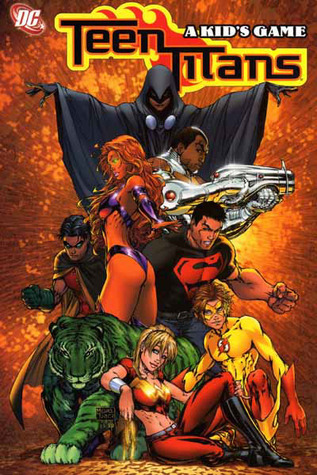
Throwback Thursday – Teen Titans Volume 1: A Kid’s Game

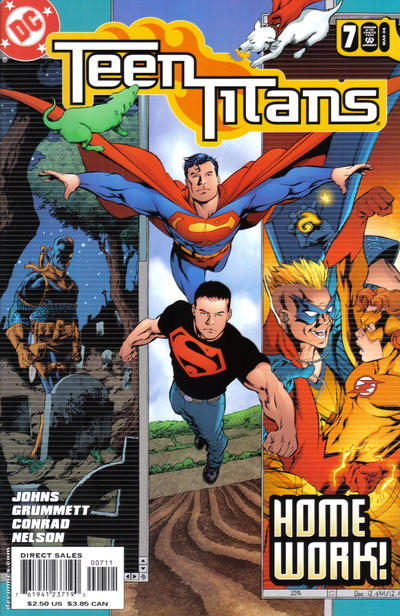
Teen Titans 1 Cover.jpg

Publisher: DC Comics (Paperback Edition – 1 April 2004)

Series: Teen Titans (2003)

My Rating: 5 out of 5 stars

Writer: Geoff Johns

 Artists:  Mike McKone

                Tom Grummett

                Marlo Alquiza

                Nelson

                Jeromy Cox

Amazon

Reviewed as part of my Throwback Thursday series, where I republish old reviews, review books I have read before or review older books I have only just had a chance to read.

Ever since I mentioned Geoff Johns’ 2003 Teen Titans series in one of my Top Ten lists last week, I have wanted to revisit the series.  I have always loved this run of Teen Titans the most.  Something about the combination of storylines, characters and this version of the artwork always spoke to me.  It was also one of the first comic series that I read and subsequently went out of my way to get every collected edition.  Even years later I still love dusting this series off, so I figured this would be a good time to go back and have a try at reviewing parts of this series.  That is why for this Throwback Thursday I will be looking at the first collected volume of the series, Teen Titans: A Kid’s Game.

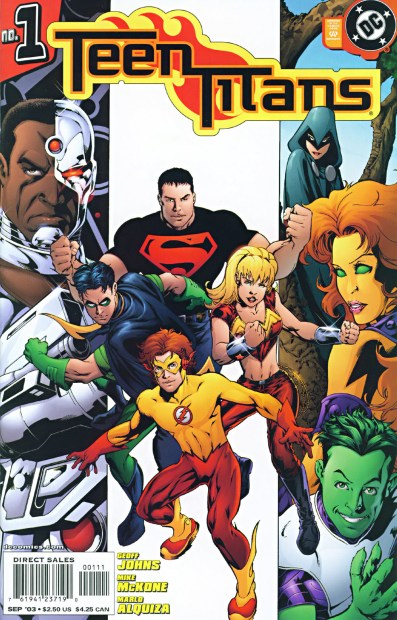
Teen_Titans_v.3_1.jpg

The Teen Titans are a team of teenaged heroes in the DC universe, usually the sidekicks of the universe’s adult heroes, but also featuring several characters without mentors.  The first formation of the Teen Titans occurred in 1964 and featured the original Kid Flash (Wally West), Robin (Dick Grayson) and Aqualad (Garth).  After a short while the original Wonder Girl (Donna Troy) joined their ranks and the team started calling itself the Teen Titans before it was given its own series.  Teen Titans was DC’s attempt to appeal to the younger generation of comic book fans, and it proved to be an extremely successful series, featuring a number of DC’s younger characters, including Green Arrow’s sidekick, the original Speedy (Roy Harper), who is considered a founding member of the team.  Teen Titans went through a number of different relaunches, with probably their most famous one occurring in 1980 with the launch of the New Teen Titans series, which brought back most of the original Titans, revamped Changeling to Beast Boy and introduced a number of iconic characters, including Cyborg, Starfire and Raven.  It also introduced several of the team’s most famous villains, including Deathstroke and Trigon.  The Teen Titans are one of DC’s most iconic superhero teams and have been featured in a number of media platforms, including the amazing Teen Titans animated show, Teen Titans Go (the less said the better), the dark and surprisingly good live action Titans and a number of key story and character elements have been included in the awesome Young Justice animated show.

Teen Titans went through a number of relaunches throughout the 1980s and 1990s, but the one most relevant to the 2003 Teen Titans comic series is the 1999 Titans comic series, which followed the adventures of adult versions of the original Teen Titans, most of whom had new superhero personas.  At the same time, DC launched the Young Justice comic book series (which I have talked about before) incorporating the younger generation of sidekicks (for example a new and younger Robin and Wonder Girl).  Both these series ended after the 2003 crossover limited series, Titans/Young Justice: Graduation DayGraduation Day featured a number of important events, including the sudden death of longstanding Titans member Omen; however, the most significant event was the death of the original Wonder Girl, Donna Troy.  The resultant despair and guilt following the death of this significant character led to both the Titans and Young Justice dissolving in what was to be conclusion of both these series.

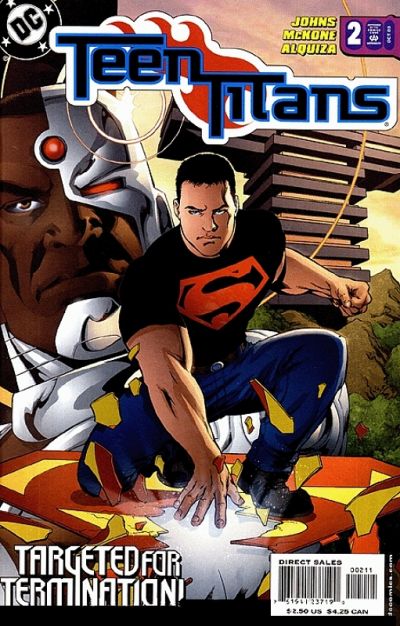
Teen_Titans_v.3_2

However, shortly after this, Geoff Johns started this specific run on Teen Titans, which combined elements of the cancelled Young Justice and Titans series, with the main four characters from Young Justice teaming up with some of the classic Teen Titans.  Another new series of Outsiders started around the same time and was heavily linked to this run of Teen Titans and featured Dick Grayson and Roy Harper.  This specific run of Teen Titans lasted until 2011, when DC initiated their New 52 relaunch (which I may or may not have some issues with).  Geoff Johns was the principle writer of this series until the 2005-06 Infinite Crisis limited series, which was a significant story point for all of DC’s titles at that point.  Due to the fact that Johns was the principle writer of the Infinite Crisis series, several of the younger Teen Titans (Superboy and Wonder Girl in particular) played a key part in this big crossover event, and several storylines from the 2003 Teen Titans turned out to be heavily linked to the crossover event.

Following the tragic events of Graduation Day, the young heroes that made up the superhero team Young Justice are lost.  Tim Drake (Robin), Conner Kent (Superboy) Bart Allen (Impulse) and Cassandra Sandermark (Wonder Girl) dissolved the team in their grief over losing the original Wonder Girl, Donna Troy, and have been avoiding each other since her funeral.  They may be the sidekicks of the greatest heroes in the world, but they are all missing their friends.  Despite their reluctance to team up again, each of them accepts an invitation from Victor Stone (Cyborg) to form a new version of the Teen Titans.  With a new base in San Francisco and other veteran Titans members Starfire and Beast Boy to help as mentors, Cyborg wants to bring these young heroes together again and forge an effective team.

Teen_Titans_v.3_3.jpg

However, before Cyborg can attempt to work with the four new Titans and convince them to stay on the team, a massive explosion rips through Alcatraz, endangering tourist lives.  As the Teen Titans mount a rescue, one of them is ambushed by the team’s oldest and most dangerous adversary, the world’s best assassin, Deathstroke the Terminator.  Deathstroke has long had a complicated relationship with the Teen Titans, but this time it looks like he wants to put the team down for good.  Claiming that kids should not wear costumes, he attempts to take out each member of the team, but what is the real reason behind his attack?  Can this new version of the Teen Titans survive the ruthless assassin?  What role will recently reborn Titan Raven play? Moreover, what will happen when the Justice League arrives to shut them down?

As I mentioned above, I am a huge fan in general of this entire run of Teen Titans, but this has to be one of the best instalments in the entire series.  Geoff Johns and his creative team came out of the gate swinging with this one and started the series off with a bang.  Not only does A Kid’s Game feature a fantastic storyline and contain some excellent character work, but it also serves as an outstanding first instalment of what turned out to be one of DC’s most consistent and captivating comic book series between 2003 and 2011.  The A Kids Games collected edition is made up of Teen Titans (2003) #1 – 7 and also features parts from Teen Titans/Outsiders Secret Files 2003, which can be useful for those readers unfamiliar with the characters, or at least that incarnation of them.

Teen_Titans_v.3_4.jpg

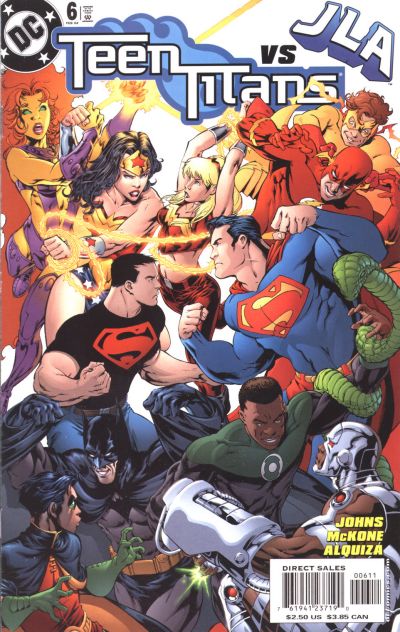
The storyline contained within A Kid’s Game has a lot of fantastic elements to enjoy within it.  The initial formation of the team is handled very well, as each of them is shown to be lonely or unsatisfied with their lives without their friends, and despite their misgivings decide to join up.  The follow-up battle between the team and Deathstroke is really good, and the team learning how to fight together while uncovering their antagonist’s motivations is very exciting.  Deathstroke has a hell of an entrance in this volume when he kneecaps Impulse at the end of the second issue in what is a pretty shocking and memorable moment.  I personally loved the storyline that occurred right after this in Teen Titans 2003 #6, when the Justice League, including the mentors of each of the younger Teen Titans’ members, show up and try to meddle with how the team is run.  This results in some chaotic action and a huge amount of amazing comic book drama, as the sidekicks fight and vent their well-justified frustrations to their mentors while also coming to terms with the guilt they feel over Donna Troy’s death.  I really cannot speak highly enough about this part of the volume, and I think this was what made me initially fall in love with the series.  The final storyline shows each of the characters during the school week, when it really helps to highlight the issues that being a part of the Teen Titans is helping them face.

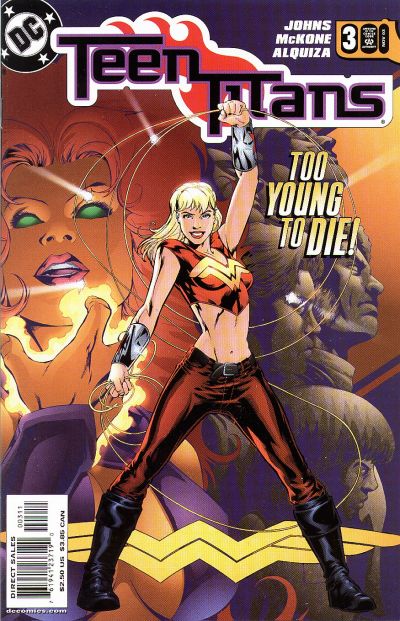
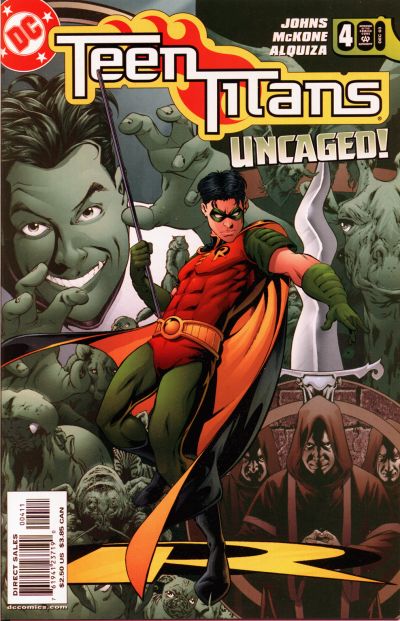
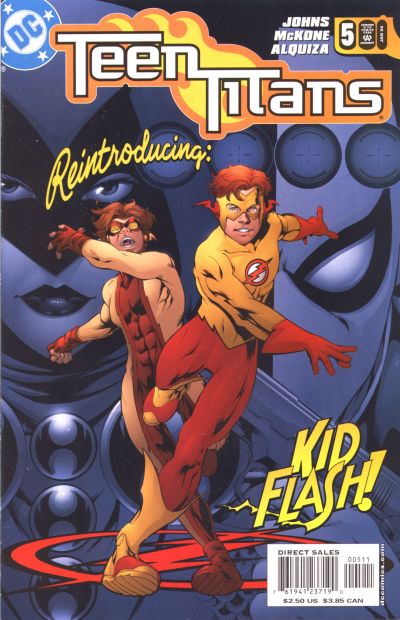
One of the things that I really like about this volume is that each issue contains a shocking reveal at the end.  I know that some comics overuse this, but I felt that Johns and his team were pretty justified in doing this, as they were trying to up the stakes during these first comics in their new series.  A lot of significant and surprising things are revealed during each of these issues, many of which would have ground-shaking impacts not just for the Teen Titan, but for the DC universe as a whole (Spoilers ahead).  This happens right in the first issue, with the reveal that half of Superboy’s DNA comes from Lex Luthor.  Other big events occurring at the end of each issue are the kneecapping of Impulse, the revelation that Jericho was still alive inside Deathstroke, Bart’s first appearance as Kid Flash, Wonder Woman showing up to start the brawl between the League and the team and the reveal that Lex Luthor is the person leaking information about Superboy’s genetics to Robin.  Even the quiet, final issue of this volume has a big reveal at the end, with the revelation that Rose Wilson is now working with her father Deathstroke.

Teen_Titans_v.3_5.jpg

The creative team behind this original run obviously had a great appreciation for some of the preceding Teen Titans series, as they utilise a number of key characters from these earlier series.  I personally thought that the issues contained with A Kid’s Game did a fantastic job of blending these old school Teen Titans storylines and character together with the former Young Justice characters, creating an excellent new dichotomy for the team.  This blend of the old and new helped create an excellent new series and was one of the best features of John’s run, and I also enjoyed the respect he showed towards the old Young Justice series.  I was also really impressed in hindsight with how well Johns and his team set up or hinted at a number of future storylines or character developments in these initial issues.  Many of these storylines (such as Superboy being a mixture of Superman and Lex Luthor’s DNA, Wonder Girl being related to Ares, Rose Wilson joining with Deathstroke, the resurrection of Raven and Jericho and the new Brother Blood) would have impacts for years to come and some are even utilised in comic series, television shows and animated movies to this day.  The creators of A Kid’s Game did an incredible job including them this early in the series, and they were really good introductions.

One of the best things about the entire 2003 run of Teen Titans is the focus on the characters and their development throughout the series.  While other volumes of this series feature some great character moments, nowhere is this more prevalent than within the issues that make up A Kid’s Game.  Most of the focus within this book is on the four characters, Robin, Superboy, Impulse and Wonder Girl, who are moving over from Young Justice to the Teen Titans.  The creators take a significant look at each of them and really work to develop each of them as substantial characters and develop them deeper than what they were within Young Justice.  With this impressive focus on developing and utilising these characters to their full potential, it is no wonder that they were utilised as such major characters during the Infinite Crisis storyline and beyond.  I also like how the older members of the team had to step up and assume a leadership role that readers had not seen before.  As a result, Cyborg and Starfire attempted to fill these leadership roles, while the slightly younger and less mature Beast Boy acts as the bridge between the two generations.  I thought that these new roles were really clever and added some new dynamics to the team.  I was also really impressed with how the creators focused on the trauma that all of the team members were feeling in the wake of Donna Troy’s death.  Each of them was racked with guilt after they were unable to help stop her death, and the anger and grief that each of them was feeling was extremely evident throughout the volume.

Teen_Titans_v.3_6.jpg

Another incredible part of this initial volume was the strong look at the relationship between the sidekicks and their mentors.  Despite the high regard each of their mentors holds in the superhero world, each of these sidekicks has issues that stem from how they perceive or are treated by their mentor.  The creative team really go out of their way to highlight these issues, and many are quite clever.  For example, Superboy, who is living as Conner Kent, appears to be frustrated at living a quiet life in Smallville, but as the story progresses it becomes clear that he is having trouble living up to the legacy of not only Superman but Clark Kent as well.  Robin is stuck wondering what his future holds and it soon becomes clear that he is reluctant to become like Batman, despite the fact that his is more like him than any of the Robins that came before him.  Wonder Girl is extremely angry and rebellious throughout this volume and is beginning to doubt her mentor Wonder Woman.  This is revealed to be a side effect of her trauma at the death of Donna Troy, and it soon becomes clear that she is one most impacted by the former Wonder Girl’s death.  Finally, Bart is sick of being considered not good enough to be part of the Flash legacy, as his own mentor does not think he is responsible enough to bear the Flash name (which is ironic, considering he is the only one of these young heroes whoever takes up their mentor’s mantle).  As a result, he acts like he does not care, while deep down he craves approval and Flash’s respect.  Bart easily shows the most growth within this volume, as he takes the Kid Flash mantle for himself, dedicates himself to learning all he needs to be a hero and vows to leave the Flash in his shadow.  All of these character issues come to a head perfectly when the Justice League arrives unannounced at Titan’s Tower and they try to meddle with their sidekicks lives and there are some amazing and cathartic moments between the younger heroes and their mentors.  His is comic book character work at its very best.

I have to note the great job the artistic team does throughout these first seven issues.  There are some great new character designs, such as Superboy’s iconic new look of jeans and a superman t-shirt, something that is still utilised within the Young Justice television show.  I also liked the way that Bart looked in the Kid Flash outfit.  The artwork on the action sequences is also pretty awesome, and there are a huge number of eyepopping scenes throughout this volume.  That shot of Kid Flash getting kneecapped is very impressive and really sticks with you.  Overall, there is some fantastic artwork, which works really well with the outstanding story and character work to create an excellent first volume.

Teen_Titans_v.3_7

Teen Titans: A Kid’s Game is an amazing first volume in the 2003 Teen Titans series.  I cannot speak highly enough about the storylines and the way that the creative team handle the complex young heroes.  A spectacular start to an incredible run one of DC’s most iconic series.  I fully intend to review some other volumes in this Teen Titans in the future so stay tuned for them.

Amazon

Waiting on Wednesday – Firefly: The Magnificent Nine by James Lovegrove

Welcome to my weekly segment, Waiting on Wednesday, where I look at upcoming books that I am planning to order and review in the next few months and which I think I will really enjoy.  Stay tuned to see reviews of these books when I get a copy of them.
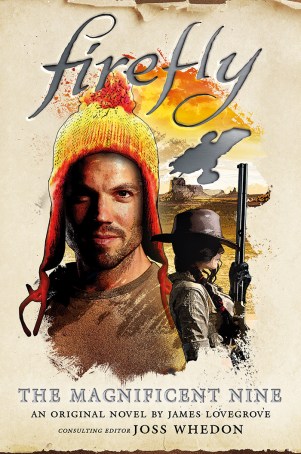
Firefly The Magnificent Nine Cover.jpg

After my recent review of the first book in the new Firefly series, Big Damn Hero, for this week’s Waiting on Wednesday I will be looking at the second book in the series, The Magnificent Nine.  I am massive Firefly fan, so I am extremely eager to read any new instalments in the Firefly series.  After James Lovegrove’s strong first entry with this series, I am very keen to check out his follow-up book, especially as it has an extremely intriguing-sounding plot.

Goodreads Synopsis:

The second original novel tying into the critically acclaimed and much-missed Firefly series from creator Joss Whedon.

An old flame of Jayne Cobb’s, Temperance McCloud, sends a message to Serenity, begging him for help. She lives on the arid, far-flung world of Tethys, and bandits are trying to overrun her town to gain control of their water supply: the only thing standing between its people and dustbowl ruin. Jayne tries to persuade the Serenity crew to join the fight, but it is only when he offers Vera, his favourite gun, as collateral that Mal realises he’s serious.

When the Serenity crew land at a hardscrabble desert outpost called Coogan’s Bluff, they discover two things: an outlaw gang with an almost fanatical devotion to their leader who will stop at nothing to get what they want, and that Temperance is singlehandedly raising a teenage daughter, born less than a year after Temperance and Jayne broke up. A daughter by the name of Jane McCloud…

One of the most amusing episodes from the original Firefly series was the seventh episode, Jaynestown, which focused on Serenity’s morally deficient mercenary and framed him in a vaguely good light for the first time in the series.  This plot synopsis sounds a bit like this episode, and I am very keen to see more of Jayne’s past, as well as some characters that can bring out the character’s better side.  The whole bandit situation is also reminiscent of the series’ 13th episode, Heart of Gold, which saw Serenity’s crew defend a settlement against a band of attackers.  The combination of both of these plots could result in some story magic, and I am looking forward to what is sure to be an action-packed bag of fun.  I am also very curious to see if the child, Jane McCloud, is actually Jayne’s daughter.  Personally, I think it could go either way.

The Firefly shows, comics and books have always been a fantastic combination of the science fiction and western genres, so I am quite excited about the name of this latest book, The Magnificent Nine.  Obviously, this is a reference to the famous western movie, The Magnificent Seven (or the movie it was based, the Japanese film Seven Samurai), which featured a band of highly skilled adventurers defending a village from a group of bandits.  So I am looking forward to seeing several scenes where the eclectic Serenity crew trains the villagers to defend themselves, before leading them into battle against the bandits, and I am sure this book will be a fun homage to this classic western movie.

The Magnificent Nine is set to be released in about a month, and I cannot wait to get a copy of it.  I did want to combine this review with a Waiting on Wednesday for the third book in this series, Generations, but only the very bare-bones synopsis of the plot has been released so far.  That being said, I am already in love with it and keen to check it out.  Bring on the next instalment of the Firefly universe!!!

Firefly: Big Damn Hero by James Lovegrove and Nancy Holder

Firefly Big Damn Hero Cover.png

Publisher: Titan Books (Hardcover edition – 20 November 2018)

Series: Firefly

Length: 334 pages

My Rating: 4.25 out of 5 stars

Amazon     Book Depository

Ready for something shiny? Serenity flies again in this fantastic new Firefly tie-in novel that takes the reader back to the original television series and reunites the crew of your favourite spaceship for another amazing adventure.

Firefly, for those people unfamiliar with it, was a science fiction television show that ran for one season back in 2002-03.  Created by Joss Whedon of Buffy the Vampire Slayer, Angel and The Avengers movie fame, Firefly is widely regarded as one of the best science fiction television shows of all time.  Featuring a fun group of main characters all played by amazing actors, this western-themed epic in space had some extremely clever and well-written storylines and an outstanding core concept.  Unfortunately, the show was cancelled after only one season (clearly the evillest thing that anyone at Fox has ever done), although it gained cult status after it was released on DVD.  Its post-airing popularity allowed Whedon to create the movie, Serenity, which closed one of the show’s major storylines, while also taking out a couple of major characters (I am still upset about one of those, he was a leaf on the wind, god damn it).  Following the movie, the Firefly universe has mostly continued in the form of several different comic books, usually created with Whedon’s direct input as either a writer or producer.  Do not be surprised if I review several of these Firefly/Serenity comics in the future, either as part of my Throwback Thursday series or when I review the collected edition of the current ongoing Firefly series.

If my notations above did not give it away, I am a huge fan of the Firefly franchise (and generally anything written/created by Joss Whedon), so I was always going to love this novel.  However, all prior biases aside, I found that Big Damn Hero was an excellent tie-in novel, and I powered through this book in extremely short order.

Big Damn Hero is written by James Lovegrove with bestselling author Nancy Holder (author of nearly 20 Buffy the Vampire Slayer tie-in books) credited as coming up with the original story concept.  Joss Whedon is also acknowledged as the original creator of the Firefly universe and is credited as a consulting editor.  Lovegrove is a veteran writer who has published a number of books since his 1990 debut, The Hope.  Readers may be familiar with his long-running Pantheon series, his recent work on the 2011 Sherlock Holmes series or the three books he has currently written for his The Cthulhu Casebooks series, which also features Sherlock Holmes.  Big Damn Hero is the first novel in a new Firefly tie-in trilogy from Titan Books which brings fans a completely new set of Firefly adventures.  Two additional books are set to be released later this year, with The Magnificent Nine coming out in March and Generations being published in October.

The Firefly franchise is set approximately in the year 2517, where humanity has expanded out into a new star system and terraformed a number of planets and moons.  The central planets were fully terraformed and heavily populated, while the outer planets and moons are more rugged, desert-like and with smaller populations.  The television series is set six years after the end of a brutal war between the Union of Allied Planets (the Alliance) and the Independents (also known as the Browncoats, a name also given to the fans of the franchise), which saw the Alliance gain complete control of the star system.

The show and associated media follow the adventures of the crew of the Firefly-class spaceship Serenity as they travel across the system participating in a variety of illegal or barely legal jobs.  The ship is captained by Malcom “Mal” Reynolds, a former sergeant in the Independent army who named the Serenity after the bloodiest battle in the entire war.  Joining him are former Independent army corporal and second in command of the ship Zoe; Zoe’s husband and Serenity’s pilot Wash; mercenary Jayne; ship’s mechanic Kayle; companion Inara; Shepherd Book; and the fugitive siblings Simon and River Tam.  Most of the crew’s adventures in the show followed their various jobs, personal stories and a particular focus on the events surrounding the Tam siblings becoming fugitives.

Big Damn Hero is set a few weeks after the events of the television show’s 12th episode, The Message, and starts the same way most Firefly adventures start, with the crew taking on a new job.  Initially contracted to transport volatile explosives off Persephone for their regular booker, crime lord Badger, the crew decide to take on some additional cargo from a mysterious new contact.  However, the meet turns out to be a trap and Mal is kidnapped and taken off-world.

With the explosives nearing a point of instability, the rest of Serenity’s crew is forced to leave Persephone to continue their original contract.  With only limited leads and the Alliance on their tail, the crew split up in order to locate their captain and maintain the safety of the ship.  Meanwhile, Mal awakens to find that he has been kidnapped by a squad of former Browncoats who are fanatically hunting down former members of the Independent army who they deem responsible for the Independents’ defeat in the war.  Mal has been named a traitor and a coward by old friend from before the war and must now defend himself in an impromptu trial.  As secrets from Mal’s past are brought to the surface, he finds himself at the mercy of a frenzied mob of former friends and comrades demanding his blood.  Can the crew of the Serenity save him, or will Mal pay for his past sins?

Perhaps the best praise I could heap on this book is that I very easily saw this story as a new episode of the show.  Like several of Firefly’s episodes, Big Damn Hero contains a compelling story that is split between the current adventures while also examining the past of one of its characters, in this case Mal.  This exploration into the past then comes into play for the main adventure, as it not only shows the reader events that were formative in Mal’s current character but also explains the actions of the book’s antagonists.  I felt that the plot of Big Damn Hero was a bit of an homage to the show’s fifth episode, Safe, as there were a number of similarities.  Safe was also interspersed with character flashbacks and the main plot of that episode features members of Serenity’s crew being kidnapped and subsequently imperilled while the rest of the crew are forced to take Serenity away from the area for an urgent plot reason.  Safe also featured the crew of Serenity arriving to save the day at the last minute in order to be the “big damn heroes”, a term the crew coined in Safe.  I also felt that the author tapped into elements of the lasting impacts of the war that were featured in episodes such as The Message or in the movie Serenity.  Throughout this book, various characters are shown to be negatively impacted by the war, whether this has made them cold and determined or raging bags of revenge.  Overall, I felt that the author captured the heart of these episodes quite well and helped turn them into a fantastic new addition to the Firefly franchise.

While this is mainly a book about Mal and his past coming back to haunt him, Lovegrove does spend a bit of time focusing on the other members of Serenity’s crew.  As a result, nearly all of the other crew members have at least one chapter told from their point of view.  This allows the reader, especially those who are unfamiliar with the television series, to get a good idea of who the characters are and what their general personality or motivation is.  Aside from Mal, Zoe gets the most focus out of all the other characters, as she not only attempts to find her missing captain but must also take command of Serenity to ensure its safety from other threats encroaching on it.  Zoe is pretty awesome in these chapters, and I felt that the author captured her determination, badassery and extreme loyalty to Mal after serving with him during the war.  Shepherd Book also gets a few entertaining chapters throughout the book, as he leads the investigation into Serenity’s missing captain.  Lovegrove continues to expand on Book’s mysterious past, as the supposedly humble shepherd has high-level military contacts, investigative skills and tactical abilities (those curious to find out Book’s past should check out the comic book Serenity: The Shepherd’s Tale).  Most of the rest of the characters also get their moments to shine: Jayne is his usual over-the-top violent self, Inara uses her position and companion training to manipulate several opponents, and River does River things, such as making fun of Badger’s accent or taking out armed goons surprisingly easily.  This focus on the whole crew of Serenity was very reminiscent of the show, and it is obvious that Lovegrove has a great appreciation for franchise’s characters.

In addition to looking at the main characters, Lovegrove also features a number of characters or references from the television show and movie that are likely to be extremely attractive to the franchises fans.  Lovegrove has included a huge range of stuff, from fan favourite side character Badger to Jayne’s fabulous knitted hat and a number of other call-backs to previous episodes and antagonists.  It is possible the author might have gone a bit overboard in places with these inclusions.  When the Hands of Blue are mentioned and it is implied that they could be nearby, that really got my hopes up and I was disappointed when they did not show up in any way.  However, I personally loved all the call-backs and references and it really played to my well-defined sense of nostalgia.

One of the inclusions I really enjoyed in Big Damn Hero was the new insight into main character Malcolm Reynolds’s backstory.  While the show and movie did provide some insights into his actions during the war against the Alliance, not a lot else about his past was ever shown.  Big Damn Hero, however, provides the reader with several chapters that delve into his past and show Mal as a rambunctious teenager on his home world of Shadow.  It is quite amusing to see several of Mal’s personality traits imposed on a younger version of the character, and fans will have fun getting this insight into the early days of this character.  I quite liked these flashback scenes, especially as they show some of Mal’s early tragedies and the events that led up to him joining the Independent army.  This is a fantastic addition to the plot, and I really appreciated this deeper look into one of my favourite characters.

Big Damn Hero is a superb new addition to the Firefly franchise that sees the crew of Serenity go on another dangerous adventure.  Not only does the author dive into the past of one of one of the show’s main characters but he presents a compelling and moving story of the harsh life at the edge of the verse while expertly utilising each of the show’s major characters.  The result is a fantastic tie-in novel that does a great job of capturing the Firefly universe and continuing one of my favourite science fiction series.  I had a lot of fun reading Big Damn Hero, although I am aware that a lot of that is due to my love of the show and movie.  People who are unfamiliar with the Firefly franchise will probably have a harder time following this novel, although I felt that Lovegrove did a good job setting this up as a book any science fiction fan could enjoy.  I am giving this book a rating of 4.25, although some of this rating is due to my nostalgia and love of the series as a whole.  I am very much looking forward to the next two Firefly tie-in novels that Titan Books are releasing later this year, and 2019 is going to be a great year for fans of the Firefly franchise.

Amazon     Book Depository

Throwback Thursday – Star Wars: Death Troopers by Joe Schreiber

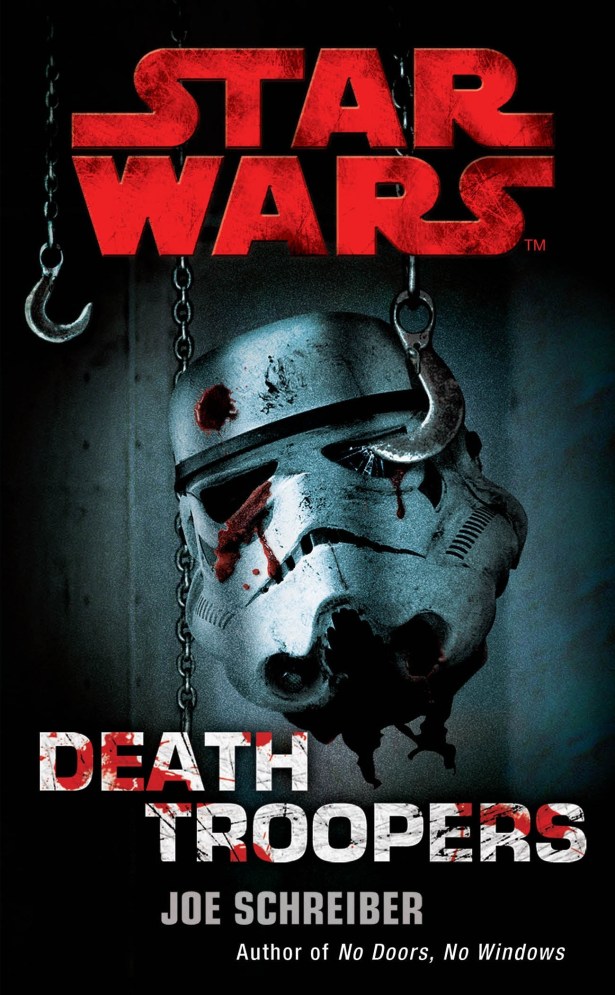
Death Troopers Cover.jpg

Publisher: Random House Audio (Audiobook Edition 13 October 2009)

Series: Star Wars Legends

Length: 6 hours 42 minutes

My Rating: 4.25 out of 5 stars

Amazon

Reviewed as part of my Throwback Thursday series, where I republish old reviews, review books I have read before or review older books I have only just had a chance to read.

In this week’s Throwback Thursday, I look at an entertaining blend of horror and Star Wars with Death Troopers, a book from the Star Wars Legends collection which I listened to in its audiobook format.

Death Troopers is set a short time before the events of Star Wars: Episode IV – A New Hope.  The Imperial prison barge Purge is the temporary home of the galaxy’s worst criminals, rebels and murderers.  Carrying over 500 prisoners, as well as guards, stormtroopers and other personnel, the ship is a floating hive of scum and villainy, where the guards are just as bad as the inmates.  En route to a permanent prison facility, the engines fail, stranding the Purge in an uninhabited area of space.  Rescue appears to be weeks away, unless the crew can fix the engines.  The discovery of an apparently deserted Star Destroyer offers hope to the Purge’s crew, but the ghost ship contains a dark secret.

A boarding party sent to scavenge parts for the Purge inadvertently brings back something lethal: a virus that spreads incredibly fast and soon infects everyone aboard the ship.  Within hours, only a few survivors are left alive: the ship’s compassionate doctor, the sadistic captain of the guards, two young teenage brothers and a certain pair of smugglers.  However, these survivors soon discover that the sudden and bloody death of everyone on the ship is the least of their problems.  Shortly after dying the bodies of the Purge’s crew and passengers violently reanimate.  These creatures are driven, unstoppable and have a hunger for the flesh of the living.  As the survivors attempt to flee the Purge, they soon find that the Star Destroyer above is not as abandoned as they had believed.  The dead have risen, and their greatest desire is to infect the entire Star Wars universe.

Zombies!  In a Star Wars book!  How can I possibly resist that?  No seriously, tell me how it is even possible not to check out a book with that sort of premise.

Death Troopers is a 2009 release from horror, thriller and tie-in novel author Joe Schreiber, who wrote several fun-sounding books between 2006 and 2015.  These novels include two additional Star Wars novels, all of which fall in the Star Wars Legends line of novels.  Indeed, his third Star Wars novel, 2014’s Maul: Lockdown, was actually the last novel released in the Star Wars Legends series of books.  His other Star Wars novel, 2011’s Red Harvest, is a prequel to Death Trooper, and is set in the Old Republic, thousands of years before the events of Death Troopers.

The Star Wars Legends series of books is the current incarnation of the old Star Wars expanded universe, which, in addition to the six Star Wars movies that George Lucas produced, included all the books, comics, video games and television series that were endorsed by Lucasfilm.  All of these entries were considered canon, so at one point there were actually proper zombies in the Star Wars canon.  While the original expanded universe did have a dedicated fan base, it did not survive the Disney buyout of Lucasfilm intact.  In order to allow for the new movies, Disney declared that, with the exception of the films and The Clone Wars television show, everything created before 25 April 2014 would no longer be considered canon.  However, rather than disavow all of these previous Star Wars media items, Disney rebranded this original expanded universe as the Star Wars Legends collection and kept it as a deep pool of ideas and characters for any future writers of the franchise.

It’s no secret that I am a bit of a Star Wars fan, having reviewed several tie-in books and comics in the last year.  While my current interest mostly lies within Disney’s expanded universe, I did grow up with a number of books and games in what is now the Star Wars Legends range.  Star Wars books and comics are going to form a significant part of my upcoming Throwback Thursday entries, but I had not intended to dive back into the Star Wars Legends range until I had gotten through all the books in the Disney expanded universe, as I wanted to stick with what is currently canon.  However, I happened to come across the cover and plot synopsis for Death Troopers the other day, and the moment I saw it I knew that I had to read it.  I immediately grabbed an audiobook copy, narrated by Sean Kenin, and started listening to it.

While I loved the plot synopsis, I was worried that Death Troopers was going to be a Star Wars novel first that featured some light zombie elements and minimal gore.  However, what I was not expecting was an extremely terrifying and well-written zombie novel that makes full use of its Star Wars setting to create a dark, gruesome and somewhat scary story.  I was very impressed with Schrieber’s ability to craft an amazing zombie novel.  His creations are pretty darn terrifying, especially as the author paints some detailed and horrifying descriptions to go along with his story.  The introduction of the zombies is done perfectly, in my opinion, as Schreiber goes for a slow burn approach.  Following the introduction of the virus, the book’s survivors slowly explore the ship, searching for a way to escape.  The author slowly builds up the tension by having things move around out of the characters’ sight, the bodies slowly disappear, bloody handprints appear in places and the characters hear all sorts of noises.  The characters of course have no idea what is happening, and blame their imagination or paranoia, but the reader knows full well what is happening.  Even when the first zombie is actually seen, panic and realisation still does not immediately set in for the rest of the characters, much to the reader’s frustration.  It is not until well after halfway through Death Troopers that the zombies are revealed in all their horror, and from there the pace of the book picks up, as the characters must find a way to quickly get away from the creatures hunting them.  This slow introduction of the zombies was a fantastic part of the book and represents some outstanding horror writing from Schreiber.

Despite this being a Star Wars novel, Schreiber does not dial back on the blood, gore or horror, and there are quite a few dark scenes throughout the book.  I was on the edge of my seat for quite a lot of it and felt that this was a great piece of horror fiction.  There are quite a few dark scenes, such as cannibalism, jaunts in rooms full of body parts and some fairly gross surgical scenes, all of which Schreiber describes in shocking detail.  I did find the story to be a bit predictable in places, and it was pretty easy to predict which of the characters would live or die.  There were also quite a few unanswered questions (what the hell was the lung room for?), although they may be answered in the prequel book Schreiber wrote a couple of years later.  I also thought that the way Schreiber ended the plot line about the zombies attempting to escape the Star Destroyer and infect the rest of the universe was a bit of an anti-climax, but overall this was a pretty fun story that I quite enjoyed.

I felt that Schreiber was quite clever in his use of the Star Wars elements throughout Death Troopers.  It is quite obvious that Schreiber is a fan of the franchise and he has a wonderful understanding of the history, technology and characters that have appeared in other Star Wars works.  As a result, he is able to craft an excellent Star Wars setting for this story that presents the reader a good idea of how this book appears in relation to the rest of the franchise.  However, what I really liked was how Schreiber did not overuse the Star Wars elements, and the reader’s focus was never taken away from the zombie part of the book.  I also felt that several of the Star Wars elements really helped to enhance the horror aspects of the book.  Having the familiar turn into something different can often be quite scary for people, and to see the often-ridiculed Imperial Stormtrooper turned into a ravenous, mutilated zombie was quite something.  The inclusion of fan favourite characters Han Solo and Chewbacca was also a nice touch.  Not only do you have some familiar characters for the readers to enjoy but you also raise the stakes of the story when both of these beloved characters come close to being eaten by zombies.

Another benefit of combining Star Wars and zombie fiction is that for once characters are completely justified in not knowing what a zombie is.  There are quite a few other major zombie movies or television shows set in fictional worlds that are supposed to mirror ours, and yet the protagonists have no idea what zombies are, despite how much they are used in fiction.  This always frustrates me, and while it was a minor thing, I was very happy to read a book where the character’s lack of understanding about zombies is completely understandable.  Overall, I really liked how the author presented the Star Wars elements within the book, and I was impressed by the way he used it to make the zombie elements even scarier.

If you are tempted to check this book out, I would highly recommend that you listen to the book in its audiobook format.  At just over six and a half hours, this did not take me a long time to get through, but I was absolutely amazed at how much the audiobook format enhanced the story.  This is mainly down to the fantastic sound effects that were scattered throughout the story.  The producers of this book did a superb job inserting a range of zombie sound effects throughout the background of the book’s narration.  This includes sounds such as screams, disturbing eating sounds, moans and other assorted sounds of horror, with the continued screams being particularly off-putting.  None of these sounds overwhelm or totally distract from the narration, but I found hearing them when the narrator describes a horror scene really enhanced the tension and dread I experienced.  I also thought that the disconnected, whispered and screamed echoes of the chapter names was a very nice touch and it really added to the overall atmosphere of the book. In addition to these horror based sound effects, there are quite a few classic Star Wars sound effects for the reader to enjoy and get nostalgic about, including some of the classic music from the movies.

Sean Kenin’s narration was also extremely well done, as the narrator was able to create a series of fun and distinctive voices.  I thought that Kenin’s Han Solo was very convincing, and it sounded a lot like the movie version of the character.  I also found that having this horror story narrated to me helped bring me into the centre of the action and really experience the horror and dread that was present there.  The narration of the descriptions can be a bit disturbing at times, and I would recommend not eating during one or two scenes; trust me on that.  As a result, I would highly recommend that people wanting to check out Death Troopers should definitely use the audiobook version of it, as in my opinion it does an amazing job enhancing this already fun story.

I am happy to say that I was not disappointed by this entertaining combination of zombie literature and the iconic Star Wars universe.  This was a pretty dark story, which also includes some familiar elements from a franchise that I truly love.  Because of this I had an outstanding time reading Death Troopers and felt that it was a great example of both a zombie novel and a piece of Star Wars fiction.  In my mind the book itself is four stars out of five, but I had so much fun with its audiobook format that I am raising it up to four and a quarter stars.  An overall fantastic and unique read, Death Troopers is really worth checking out for fans of either zombies or Star Wars and is perfect for those who love both.  I am very curious to check out Schreiber’s other Star Wars books in the future, as both of them sound like a lot of fun.

Amazon

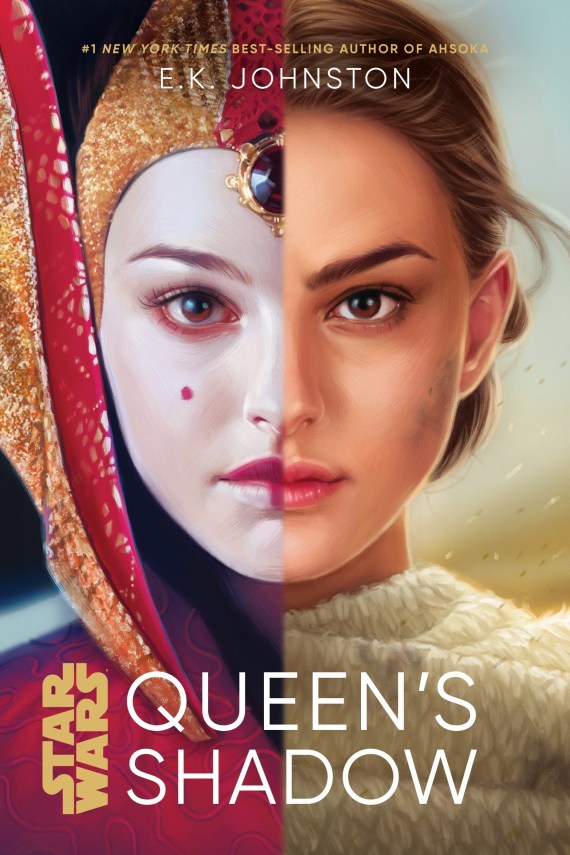
Waiting on Wednesday – Queen’s Shadow and Superman: Dawnbreaker

Welcome to my weekly segment, Waiting on Wednesday, where I look at upcoming books that I am planning to order and review in the next few months and which I think I will really enjoy.  Stay tuned to see reviews of these books when I get a copy of them.

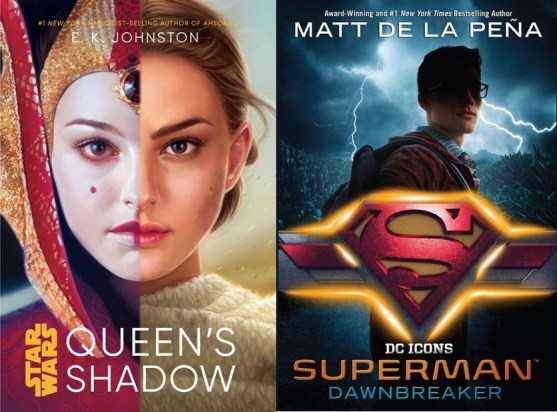
waiting on wednesday 9 jan 2019 picture

I have never made any secret about the fact that I love novels that tie-in to movies, televisions shows, video games and comic books, with multiple examples featured on my blog and Goodreads page.  Therefore, it should come as no surprise that a huge number of tie-in novels are going to appear on my must-read list for the future.  This week I am taking a look at two intriguing young adult tie-in novels that are going to be released in early March 2019: the latest Star Wars novel, Queen’s Shadow, by E. K. Johnston and the fourth book in the DC Icons series, Superman: Dawnbreaker, by Matt de le Pena.

I am a massive fan of both the Star Wars and DC Comics universes, and generally go out of my way to watch, read or play anything associated with these franchises and extended universe.  Honestly, I am going to get both of these books no matter what, but I may as well try and discuss what about these books I am most excited about.

Both of these books have some pretty awesome-sounding story premises.  Queen’s Shadow will apparently follow a young Padmé Amidala immediately after the events of The Phantom Menace, as she transitions from Naboo’s queen to its representative in the Galactic Senate.  I think it is a story with some potential, as this book is likely to become a bit of a political thriller/espionage hybrid, and will explore the politics of the Republic leading up to the Clone Wars.  No doubt Padmé will see some forms of corruption and intrigue, as well as the future Emperor’s devious plots.  I am also looking forward to Padmé getting a story to herself.  While Padmé started off as a badass ruler in the movies, most of her appearances were overshadowed by that frankly terrible romance with Anakin (he’s an angry, stalking man-child who attempted to hit on her by talking about sand, and the whole age gap is pretty darn creepy).  Therefore I will be extremely happy to get a story which will hopefully have no appearances from Anakin, and which will allow the character of Padmé to live up to her own potential (although I will not be surprised if creeper teenage Darth Vader makes some sort of appearance in this book).

While Queen’s Shadow has an interesting-sound story premise, I am actually a bit more intrigued about the proposed story in Dawnbreaker.  It sounds like it will focus on a young Clark Kent still living in Smallville as he learns to control his powers and find his calling as a hero.  Clark will find some dark secrets in the heart of his small town and be forced to investigate.  I have no doubt that this will be an intriguing re-imagination of Superman’s origin, and I am eager to see what sort of mystery or villain will be behind these terrible events.  Just from the synopsis alone, I think this book has potential, and I am looking forward to uncovering all of the story’s hidden secrets.

Another reason why I am hoping to get copies of both of these books is due to my previous experiences with these authors or franchises.  I have been in a real Star Wars expanded universe mood for the last few years now, but I am also excited to get another entry from E. K. Jackson.  I previously read her last entry in the Star Wars universe, Ahsoka, and I was struck by the author’s understanding of the character and the intriguing young adult storyline she was able to create.  As a result, I am eager to see this author’s treatment of another strong female Star Wars character, and I hope she will craft another great story.  I have not previously read anything from Dawnbreaker author Matt de le Pena before, but I have read some of the previous books in the DC Icons series before, such as the last book, Catwoman: Soulstealer.  I really enjoyed the unique ways the author of that book was able to alter the established origin story of Catwoman, so I am very eager to see the new and different story DC will allow in Dawnbreaker.

While I will be very happy with physical copies of both these books, there is a very strong chance that I will seek out audiobook copies.  Both Queen’s Shadow and Dawnbreaker will have their audiobook formats released at the same time as their paperback formats, and neither audiobook sounds like it will be too long, with Dawnbreaker apparently clocking in at around eight hours, while Queen’s Shadow is only a little longer, at 10 hours.  After listening to the audiobook version of the previous DC Icons book, Catwoman: Soulstealer, I know that they will do a good job with it and produce an enjoyable and easy-to-listen-to book.  I am really excited about the audiobook version of Queen’s Shadow.  Not only is it likely to have the same high-quality production value, music and sound effects that the previous Star Wars audiobooks have all featured, but it will also be narrated by Catherine Taber, the voice of Padmé in the Star Wars: The Clone Wars animated movie and television series.  With Natalie Portman extremely unlikely to narrate an audiobook, Taber is the perfect voice to get for this book.  Not only does she have a perfect Padmé voice, but fans of extended Star Wars universe cartoon shows will love to see her jump back into the character, especially as she is likely to voice the character again in the recently announced new season of The Clone Wars television show.  With the producers going all out for Queen’s Shadow’s audiobook format, it will be a hard target for me to miss and will no doubt be an incredible way to enjoy this book.

These two books will be among the first two tie-in books of 2019 that I seek out, so I am really hoping that I will enjoy them.  I think both of them have intriguing sounding stories, and I have had some great experiences with their respective franchises and their specific authors or series.  I am very likely to get the audiobook version of Queen’s Shadow, but I will have to see how I go with Dawnbreaker.  I have no doubt that I will really love both of these books, and I am definitely going to get copies of both.

Mass Effect: Annihilation by Catherynne M. Valente

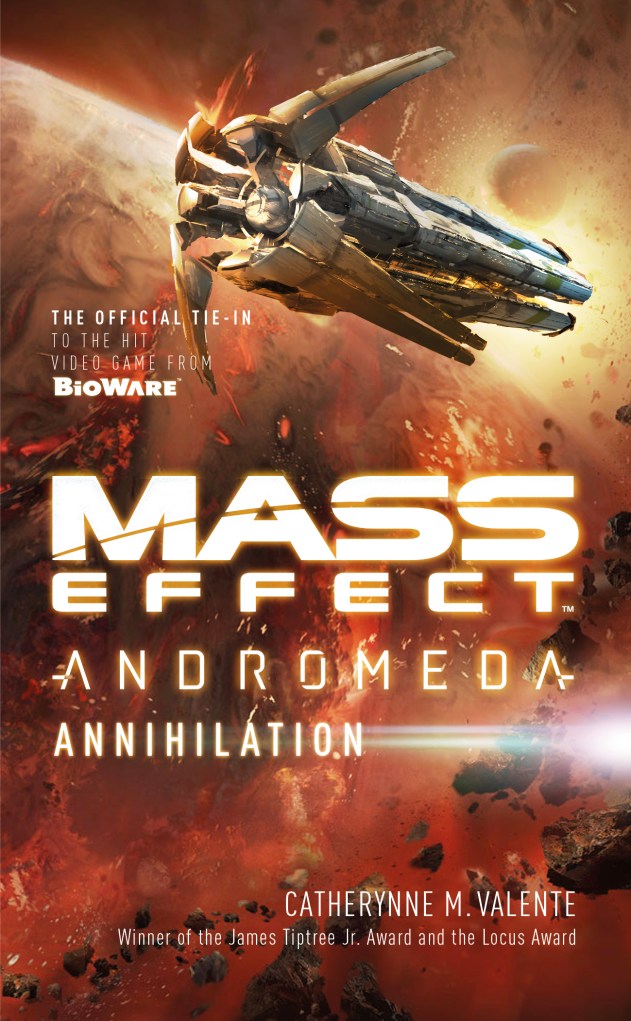
Mass Effect Annihilation Cover

Publishers: Titan Books

                        Blackstone Audio

Publication Date – 6 November 2018

Amazon     Book Depository

A new galaxy, a ship full of disparate alien species, what could possibly go wrong?  Veteran author Catherynne M. Valente brings to life a new adventure in the Mass Effect universe with Mass Effect: Annihilation, the third official tie-in novel to the 2017 video game, Mass Effect: Andromeda.

This was a really good piece of science fiction that expertly built on the intricate extended universe that has been created around the Mass Effect video game franchise.  I should preface this review by mentioning that I am a huge fan of this video game series, and one of the best things about it is the great universe and intriguing storylines that have been produced as a result.  While I know that many people had some valid criticisms about the latest game in the series, Andromeda, I actually really enjoyed the new addition to the series’ story and lore and had a lot of fun playing it and exploring all the additional plot that is hidden outside of the main missions.  One of the many mysteries that I hoped to get an answer about was the fate of Quarian ark, so I was very eager to read this book when I first heard about what it was going to focus on.

For those unfamiliar with the Mass Effect franchise, the first game was released in 2007 and is set in a universe where humanity has gained spaceflight and by 2183 has expanded throughout the Milky Way galaxy.  Once they were outside of our solar systems, humans met with several alien races which governed large portions of the galaxy.  The three main species, the Asari, the Salarians and the Turians, formed a ruling council on the ancient alien space station, the Citadel, which served as a capital city for these races and several other allied species.  The game series followed the human protagonist, Commander Shepard, as he (or she, depending on your settings), investigates the resurgence of the Reapers: ancient, sentient space ships who appear every 50,000 years to destroy all sentient organic life.  While Shepard is able to delay the appearance of the Reapers in the first two games, they launch a full-scale attack in Mass Effect 3, leading to significant, galaxy-changing events.

The game Mass Effect: Annihilation is based on, Mass Effect Andromeda, is the fourth Mass Effect game released and a loose sequel to the original series.  Andromeda is set over 600 years after the events of Mass Effect 3, and follows a group of explorers and colonists from the Milky Way galaxy as they travel to the Andromeda galaxy in an epic one-way trip to find new planets to settle on.  This was a result of the Andromeda Initiative, a joint exercise from a number of Citadel species in order to settle in the new galaxy.  The Initiative launched their ships to Andromeda in the period between Mass Effect 2 and 3.  Each of the main Citadel races, humans, Asari, Salarians and Turians sent an ark ship to Andromeda, each filled with 20,000 cryogenically frozen members of their respective species.  These four arks were launched at the same time, and the plan was for them to dock in the Nexus, a miniature version of the Milky Way Citadel sent in advance of the arks, which was to be used as a staging ground while the Pathfinders found and explored new planets for their races to settle on.  During the events of Mass Effect: Andromeda, mention was made of a fifth ark, built by the Quarians and filled with several other alien races, that was supposed to launch soon after the initial four arks.  However, this fifth ark made no appearance during Andromeda, and was one of the game’s unsolved mysteries, perhaps destined to never be solved, as there is currently no plans to continue the Mass Effect game franchise (although it is too big a franchise for them not to do something else with it in the future).

The Mass Effect games have inspired a number of additional media releases over the years.  Four Mass Effect books were written between 2007 and 2012 to correspond with the original game trilogy, as well as a number of comic book series.  Following the release of Mass Effect: Andromeda in 2017, a new trilogy of books was commissioned which further explored key events or characters mentioned in the fourth game.  Annihilation is the third and final book in the Mass Effect: Andromeda book trilogy.

As the Reaper fleet begins to appear in the Milky Way galaxy, a fifth ark is launched by the Andromeda Initiative to bring another 20,000 settlers to the Andromeda galaxy.  Built by the planetless Quarians, the ark Keelah Si’yah is the only ark to hold colonists from a number of different races, including Quarians, Drell, Elcor, Batarians, Volus and Hanar.  Despite having different outlooks, opinions, biological requirements and reasons to leave the Milky Way, these races are united in their decision to reach the new galaxy and find new planets to settle on.

As the ship reaches the end of its 600-year long journey, problems are soon identified aboard the ship.  One of the ark’s Sleepwalker teams, a small team of individuals tasked with checking on the status of the ark as it flies through space, is suddenly awoken years before the Keelah Si’yah is scheduled to dock with the Nexus.  The ship’s virtual intelligence has identified certain discrepancies in the readings of several Drell cryopods.  Investigating the pods, the Sleepwalker team find that their inhabitants have died from a disease, something that is supposed to be impossible while frozen.  Even worse, the ships systems are all reporting that everything is fine, and that the inhabitants of the pods are still alive.

The Sleepwalker team quickly discover that the dead colonists have all been infected by a virulent disease, one that seems capable of jumping across to the vastly different alien species.  The team are desperate to find out the cause of the disease, but their investigation is severely hampered by a number of system failures across the ark, while the ship’s computers continue to insist that everything is all right.  As the failing systems start to randomly unfreeze more and more colonists, the disease quickly spreads across the ark.  It soon becomes apparent that the disease has been artificially created, and that someone is launching a deliberate attack against the Keelah Si’yah and its crew.  As the various colonists turn on each other in fear and confusion, can the Sleepwalker team find a cure and uncover who is behind the attack, or will everyone on the ark die before reaching Andromeda?

The author of this book, Catherynne M. Valente is not an author I was very familiar with before listening to Annihilation, but she appears to have produced a wide range of different novels, some of which are quite quirky in content.  I do remember seeing and trying to get a copy of her 2018 release, Space Opera, earlier this year, mainly because it sounded like such a fun read, what with it essentially being Eurovision in space.  Luckily, I was able to obtain a copy of Annihilation a week ago and powered through its audiobook format, narrated by Tom Taylorson.

Mass Effect: Annihilation has an exciting and intriguing story that expands on the established lore of the Mass Effect universe while also providing the reader with a compelling science fiction mystery.  The story is broken up into three main parts: the characters attempting to identify and cure the disease, the attempts to fix the ship’s broken system and an investigation into who or what initiated the attack on the ark and its inhabitants.  As a result, there is a good combination of medical, technical and investigative scenes that come together into a rather intriguing overall narrative.  There is not a lot of action, but the focus on the various problems around the ship is very interesting.  The link between the various parts of the book and the final solution to who is behind them was also quite clever and the reasons behind it were quite interesting.  There are some certain dark moments, especially when it comes to the reveal of who was behind it.  Annihilation is obviously going to appeal a lot more to readers who are familiar with the games and who enjoy the backstory of this series, but this is a great story with plenty for other readers to enjoy, and I felt that Valente makes this story accessible for outside readers.

One of the most interesting parts about Annihilation is the fact that the book focuses on the less prominent alien races in the Mass Effect universe.  Aside from one prologue that follows a human, every single character is a member of six less common races in the lore and games, the Quarians, Drell, Volus, Batarians, Hana and Elcor.  This is unique, as the games and the previous novels tend to mostly focus on human characters, or feature a significant number of characters from the games more prominent races, such as the token sexy alien species, the Asari, or the gigantic and war loving Krogan.  The other main council races, the Turians and the Salarians, are also extremely prominent compared to the six races featured within this book, with great Turian and Salarian characters appearing frequently in the games or the books (I am the very model of a scientist Salarian).  In pretty much all of the games, the protagonist can choose members of the above aliens to be a part of the team.  However, Annihilation completely changes this around, as four of the six races that the book focuses on have never had usable characters in any of the games and are mostly minor side characters.  Of the other two races, the Quarians do get a good examination within the games, with one of their members quite a key character.  The Drell are explored to a much lesser degree, although badass Drell assassin Thane Krios as a useable teammate in the second game.

I was pleasantly surprised to read a book where these six less commonly featured races were so prominent.  Valente has a great understanding of these races and spends a significant part of the book exploring each race’s various quirks, important parts of their biology, culture, society or lifestyle, as well as certain parts of their history.  The author does a fantastic job expressing all these racial traits throughout the book, and even new readers to the franchise can quickly gain an understanding of what these species are and what is key to all of them.  For example, Valente is able to expertly capture the various speech characteristics of each of the races featured in Annihilation.  This includes the heavy breathing of the Volus, the lack of personal pronouns in the Hanar’s dialogue, the rolling stream of Drell memories that they say aloud when flashing back to important memories, and even the Elcor habit of prefacing their sentences with their emotional state.  These are all done incredibly consistently throughout the book and really add a lot of authenticity to the story.  These vocal patterns can also be particularly entertaining, especially when it comes to the Elcors, as nothing is more amusing than having an angry Elcor calmly telling everyone how enraged he is.  The various alien species did have the potential to make the investigation into the virus hard to understand, but the author cleverly got around this by having the characters compare the disease, cures and other relevant aspects to common and recognisable human disease.  Overall, these alien inclusions are fantastic, and it was great to see these more obscure fictional species finally get the limelight in a Mass Effect story.

While the alien races as a whole are great inclusions in Annihilation, Valente has also created some amazing characters to make up the Sleepwalker team investigating the issues plaguing the ark.  These characters include the team’s leader, Quarian Senna’Nir vas Keelah Si’yah, Drell detective Anax Therion, Elcor doctor Yorrik, former Batarian crime lord Borbala Ferank, Volus tailor Irit Non and a religiously fanatic Hanar apothecary.  Each of these characters is pretty fun, and all of them have demons in their past that are explored throughout the book.  For example, Senna’Nir is obsessed by computer intelligences, something that is forbidden by the other Quarians following a terrible event in their history.  As a result, Senna’Nir spends large portions of the book coming to terms with his secret obsession, and it is quite an interesting subplot which also allows the introduction of one of the best side characters, a sassy Quarian grandmother virtual intelligence.  Each of the characters’ backstories is fairly compelling and each add a lot to the story.  Borbal Ferank’s crime lord persona is also a lot of fun throughout the book, as she casually mentions her previous crimes and familiar betrayals that are quite common for Batarians.  There are also the mysteries around Anax, as the ultimate infiltrator gives several versions of her past throughout the book to various characters to get the answers and stories she requires.

Easily the best character in Annihilation is Yorrik, the Shakespeare-obsessed Elcor doctor who spends the entire book trying to cure the virus infecting the ark.  He was extremely amusing throughout the entire book, as he spend significant parts of the book dropping jokes in his emotionless tone, or attempting to engage his companions in discussion about his extremely long Elcor adaptions of Hamlet or Macbeth.  Yorrik is a fantastic character throughout the entire book, and he is definitely the person the reader gets the most attached to.  Never have Shakespearian quotes been more appropriate for the fate of an alien.  I also really loved the unique partnership between Anax and Borbala.  The detective and criminal make a great team, and the two have a lot of fun investigating the attack on the ship, and it was great seeing the two of them get closer to each other through the course of the book.  Valente has done an incredible job with the characters in this book, and their histories, relationships and unique viewpoints really make this novel awesome.

I listened to the audiobook version of Annihilation, which I found to be an amazing way to enjoy this book.  At just under nine hours long, this is an easy audiobook to get through, but it is one I had a lot of fun with.  One of the best things about the audiobook version was the fact that they got Tom Taylorson, the voice of the male protagonist in Mass Effect: Andromeda, to narrate this audiobook, which is just awesome for those people who have played the game.  Taylorson does an excellent job portraying each of the characters in this book and I loved all the voices he came up with.  He also managed to get all of the unique voice patterns and vocal particularities of the various alien species down perfectly, and each alien species sounded exactly as they did in the games.  This is an outstanding piece of audiobook narration, which really added a lot to how much I enjoyed this book.

Overall, I am going to give Mass Effect: Annihilation a rating of four and a half stars.  I will admit that one of the main reasons I am giving it such a high rating is because of my love of all things Mass Effect and because of how much I love the franchises lore and expanded fictional history.  I am aware that people who are not as familiar with Mass Effect may not enjoy it as much, but I hope that most readers will appreciate the great characters, interesting story and excellent audiobook adaption.  This is great piece of science fiction and an excellent tie-in novel that is a perfect read for fans of the Mass Effect franchise.

My Rating:

Four and a half stars

Amazon     Book Depository

Waiting on Wednesday – Alien: Echo by Mira Grant

Welcome to my weekly segment, Waiting on Wednesday, where I look at upcoming books that I am planning to order and review in the next few months and which I think I will really enjoy.  Stay tuned to see reviews of these books when I get a copy of them.

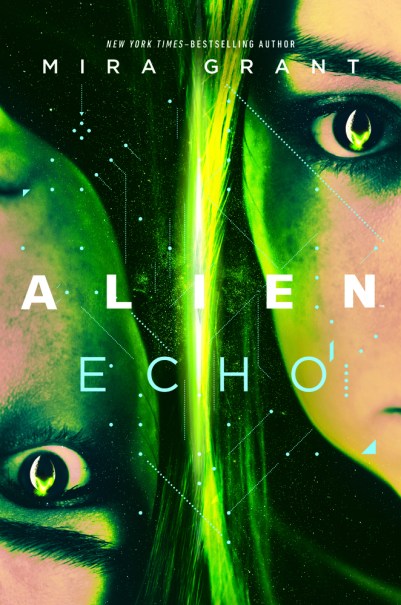
Alien Echo Cover

For this week’s Waiting on Wednesday review, I will be looking at one of the more interesting looking movie tie-in books of early 2019, Alien: Echo by Mira Grant. If you look back at some of the books I have reviewed in the past, it is pretty clear that I love novels that tie in to movies, television shows, video games and comic book series.  Therefore, when I saw this tie-in to the classic Alien movies, I knew that I would have to read it, especially as it’s being written by skilled horror author Mira Grant.

Horror is not my favourite genre in the world; however, I have read a couple in the last year, and one of my favourites has got to be Into the Drowning Deep by Mira Grant.  So far this is the only Mira Grant book I have read, except for a short story in a Night of the Living Dead zombie short story book, but I have been intending to check out some of her other series, such as her Newsflesh or Parasitology series.  However, if Grant can make mermaids bloody terrifying like she did in Into the Drowning Deep, I can not wait to see what she does with one of film’s most iconic horror creatures.

Here is what the plot is sounding like at the moment:

An original young adult novel of the Alien universe

Olivia and her twin sister Viola have been dragged around the universe for as long as they can remember. Their parents, both xenobiologists, are always in high demand for their research into obscure alien biology.

Just settled on a new colony world, they discover an alien threat unlike anything they’ve ever seen. And suddenly the sisters’ world is ripped apart.

On the run from terrifying aliens, Olivia’s knowledge of xenobiology and determination to protect her sister are her only weapons as the colony collapses into chaos. But then a shocking family secret bursts open—one that’s as horrifying to Olivia as the aliens surrounding them.

The creatures infiltrate the rich wildlife on this virgin colony world—and quickly start adapting. Olivia’s going to have to adapt, too, if she’s going to survive…

As you can see, this book has a pretty cool synopsis, and I like the sound of two young people fleeing through a strange new planet, being pursued by an entire planet of aliens. I am also loving the cover of this book, especially the alien eggs appearing in both of the young women’s eyes.  Early prediction based off the synopsis: the girls are either clones, part alien, androids or some variation of the three.

Alien: Echo is apparently going to be an original young adult novel, and I will be interested to see how writing it for a young adult audience will affect the horror elements of the Alien franchise.  This book is coming out in early April 2019, and I will probably get it in its audiobook format, which will apparently be narrated by Kate Marcin.  I have not heard anything narrated by Marcin before, but I am hoping that the audiobook format will bring the reader right into the middle of the horror.  Plus, at around eight hours, it should allow me to breeze through this book fairly quickly and get out a review ASAP.

I am really looking forward to this one, and do not be surprised if this kick-starts me into reading a few more Mira Grant books in 2019.

Catwoman: Soulstealer by Sarah J. Maas

Catwoman Soulstealer Cover.jpg

Publishers: Penguin Random House

                        Penguin Random House Audio

Publication Date – 7 August 2018

Amazon

One of DC Comics’ most iconic and badass female antiheroes is re-imagined in this bold new novel from young adult fiction bestseller Sarah J. Maas.

Selina Kyle is a rough street kid growing up in the slums of Gotham City.  She looks after her sister while scraping a living as a gang member and pit fighter.  When her luck finally runs out, her potential is seen by the mysterious Talia al Ghul who saves her and recruited into the League of Assassins.

Two years later, Selina has returned to Gotham City with a plan to turn the city on its head as Catwoman, the master thief and criminal mastermind.  Using the alias of the spoiled socialite Holly Vanderhees, Selina has returned at an ideal time; Batman is not in the city, away on a vital mission, and he has left his protégé Batwing behind to safeguard the city.  Initiating a series of high-profile thefts, Selina soon has the attention of Batwing and GCPD, especially when she starts teaming up with her new BFFs Poison Ivy and Harley Quinn to wreak havoc around the city.

While Batwing searches the city for this mysterious new villain, his alter ego, Luke Fox, encounters his mysterious new neighbour, Holly, and the two find themselves drawn to each other as their alter-egos battle in the night.  While Selina is able to outfox Batwing, a far more destructive force is about to be unleased upon Gotham.  Catwoman stole something from the League of Assassins and now a cadre of their most lethal assassins are descending on the city.  Will Selina be able to survive their deadly attentions, what is Catwoman’s plan, and who will be left standing in the aftermath?

This is the third book in the DC Icons series, a series of young adult books that provide re-imagined origin stories for younger versions of DC’s most iconic characters outside of the other established DC universes.  Featuring a range of different authors, the first book in the series, Wonder Woman: Warbringer, focused on Wonder Woman before she left Themyscira to become a hero, while the second book, Batman: Nightwalker, followed a teenage Bruce Wayne as he attempts to stop a series of murders in Gotham City.  A fourth book in the DC Icons series, Superman: Dawnbreaker, is currently set to be released in March 2019 and will follow a young Clark Kent as he investigates strange happenings in Smallville.

Soulstealer is the first of these DC Icons books that I have read, and I was quite impressed with the new and unique Catwoman story that it contained, as well as the cool new versions of several DC characters, including Poison Ivy, Harley Quinn and Batwing.  I listened to this book in its audiobook format, read by Julia Whelan.  I quite enjoyed having the story narrated to me, especially as it only took around 10 hours to get through.  While I initially had misgivings about whether I would like this series, after reading and loving Soulstealer I will definitely be getting a copy of Dawnbreaker when it is released next year, and Warbringer and Nightwalker will both be appearing future versions of my Throwback Thursdays reviews.

The author of Soulstealer, Sarah J. Maas, is one of the biggest names in modern young adult fiction, having written two best-selling young adult series in the last six years.  Her long-running Throne of Glass series finished earlier this year, and she has also created the A Court of Thorns and Roses series.  Soulstealer is the first Sarah J. Maas book that I have had the pleasure of reading, but after really enjoying the intricate story and fantastic characters within the novel I am keen to see what her fantasy books are like.  As a result, her Throne of Glass series is high on my list of books to check out in the future, especially after seeing just how awesome the artwork is on some of those covers and collected box sets.

Maas has installed a fantastic and clever story into her debut DC novel, and I really enjoyed how she re-imagined the origins of prominent comic book character.  Soulstealer contains a younger version of Catwoman, introducing her as a teenager gang member and focusing on her initial life of crime.  After the introductory paragraph, the story jumps ahead two years to Selina’s return to Gotham and her initial adventures as Catwoman, while also featuring several flashbacks to her training with the League of Assassins.  This main story is then told from two separate point-of-view characters, Selena and Batwing, and shows the characters in both their costumed adventures and as the people behind the masks in their civilian identities.  Soulstealer has a tight and intricate storyline that contains the perfect balance of comic book action, relationships, backstory, references and variations to comic lore, as well as a number of heists and intricate plots.  I loved Catwoman’s overall plan, as she engages in a play to take over Gotham while really nursing an ulterior motive that pits her against the League of Assassins.  I loved the slow reveal of this complex and insane plan, as well as the lengths she goes to bring her plan to pass, including making some dangerous partnerships.

One of the most interesting and significant changes that Maas makes to Catwoman’s origin story in this novel is the fact that she never meets or associates with Batman.  In nearly every previous iteration of Catwoman, her story has always been intertwined with Batman’s, as the two were usually each other’s main love interest, either as Batman and Catwoman or Bruce Wayne and Selina Kyle.  However, in Soulstealer, Catwoman is substantially younger than Batman, who starts his crusade years before she is trained by the League of Assassins.  In addition, Batman is not present in Gotham when she returns to the city and throughout the book the two characters have no interactions at all.  Instead, Catwoman’s main love interest is the Luke Fox version of Batwing, who has been defending Gotham in Batman’s absence.  This results in a similar romance plot to some of the classic Batman and Catwoman storylines, where the two characters meet and start to fall in love with each other in both of their personas, despite their apparently different personalities.  This is a fun little romance that does get serious at times, as the two characters are mirrored by their personal traumas and backstories, such as a Selina’s life on the streets and with the League, versus Luke’s PTSD as a result of his time as a marine.  There are also some great moments when the two characters face off against each other, and some of the book’s best laugh-out-loud moments came when Catwoman messes with either Batwing or Luke, sometimes at the same time.  To my mind, the funniest scene in the book had to be when Batwing, after getting injured and rescued by Catwoman, awakens half-naked in a darkened room, only to find out that he is actually in Commissioner Gordon’s spare bedroom.  The moment Luke walks out to find Gordon and his family staring at them was pretty darn funny, especially when Batwing attempted to play it off nonchalantly while silently cursing Catwoman.

One of the elements of Soulstealer that I really appreciated was the references and re-imagined versions of several DC comics characters that appeared throughout the novel.  A huge range of DC characters, many tied into the Batman comics, appear throughout the book in a number of different capacities.  The characters that appear range from the iconic to the obscure and are enough to delight both hardcore comic fans and those with a more casual knowledge of these comics.  Several major Batman characters appear throughout the story; I will refrain from mentioning the full roster of characters to cut down on spoilers, although there is one appearance that was particularly awesome.  While a number of these characters have key or interesting differences between their mainstream comic book counterparts, it is clear that Maas has a real understanding and appreciation for the lore behind these characters.  It is also incredibly fascinating to see how Maas changes these characters for the purposes of her story, and the subtle tweaks that are made to accommodate this different universe.

Of all these additional characters, two of the best and significant inclusions are fellow supervillains Poison Ivy and Harley Quinn, who team up with Catwoman to bring a little chaos to Gotham.  In the comic universe, these three supervillains occasionally form a team known as the Gotham City Sirens, and it was great to see them together in this book.  Like Catwoman, both Poison Ivy and Harley Quinn are quite young and have slightly altered origin stories which somewhat mirror the new origin story of Catwoman.  However, some of the key elements that made these characters so great in their comic book origins remain alive in these book adaptations of the characters and which work extremely well with Maas’s fantastic Soulstealer storyline.  For example, in this story, Harley is still obsessed with the Joker, no matter how much it impacts her relationship with the others, and there are a lot of discussions between Catwoman and Ivy about the roots of her obsession and insanity.  There is also a very clear and acknowledged romantic connection between Ivy and Harley that adds a really interesting element to the story, especially as Harley’s insanity stands in the way of the more serious relationship Ivy desires.  The inclusion of these characters adds in a defining friendship for a main character who has never had the option of friends before, and it’s also a lot of fun seeing these three characters work together, especially as they have such diverse skill sets and range of attitudes.  Overall, I really loved the fact that Maas included Poison Ivy and Harley Quinn as key characters in her novel, and it was a lot of fun to see her version of these young villains banding together for the first time and forming an outstanding partnership.

Rather than read a physical copy of this book, I grabbed the audiobook copy of Soulstealer and listened to that instead.  The audiobook is narrated by Julia Whelan, who does an amazing job capturing the essence of the book’s main character, Catwoman/Selina Kyle.  When focused on Catwoman’s point of view, the listener gets a real sense of the character’s emotions and attitude, and the voices that Whelan assigns to the other main female characters, Ivy, Harley and Talia, are fairly distinctive and fit well with the character.  I thought that the voice that the narrator used for the book’s other point-of-view character, Batwing/Luke Fox, was very serviceable and conveyed the character well enough.  However, I was a tad disappointed that the narrator did not do too much with several of the other iconic Batman characters in the story, such as Alfred, Batman or Commissioner Gordon, especially as these major characters have all been portrayed by amazing actors or voice actors in the past.  Still, the audiobook version is a great way to enjoy this story and it certainly helped me power through this novel quickly without forcing me to skip over any of its important elements.

Catwoman: Soulstealer is an excellent young adult superhero novel from acclaimed author Sarah J. Maas.  This book is a fantastic standalone novel that re-imagines an iconic DC comic book character.  No great previous insight into Catwoman or the DC universe is required, and those with even a glancing knowledge of the comic book characters will be able to enjoy this novel to its full potential.  This serves as a very good young adult novel that will hopefully draw in a younger generation of readers into this established universe, and I appreciated Maas’s casual inclusions of a number of LGBT+ elements.  Soulstealer comes highly recommended and it has certainly sparked my interest in checking out all the other books in the DC Icons range.

My Rating:

Four and a half stars

Amazon

Young Justice – Book Three by Peter David and Todd Nauck

Young Justice 3.jpg

Publisher: DC Comics

Publication Date – 4 December 2018

Amazon

Before the third season of the Young Justice television show debuts after its long hiatus, go back to the comic book series that inspired it all, with the third volume of DC Comics’ reprint of the 1990s Young Justice comic book series, which includes the full collection of the Sins of Youth crossover event from 2000.

Young Justice is an interesting comic series.  Most people would probably be familiar with the 2010 television series of the same name.  The original comic book series started in the 1990s and was created in a unique period of DC Comics.  Many of the traditional sidekicks had grown up in recent years and taken on different identities to distinguish themselves from their mentors.  For example, the first Robin, Dick Grayson, had has own identity as Nightwing; the original Kid Flash, Wally West, had succeeded his mentor as the Flash; the original Wonder Girl, Donna Troy, had become Troia; while the original Speedy and Aqualad had taken on the identities of Arsenal and Tempest respectfully.  In order to fill the void, DC Comics creators in the 1990s created several new young sidekicks for their key heroes.  At the same time, with most of the former sidekicks in their early 20s, DC needed a new group of young heroes to appeal to their younger readers.  With the former sidekicks already formed up as the Titans, these younger heroes were placed into their own team, Young Justice.

Starting in 1998, this series ran alongside DC’s Titans series before both were cancelled in 2003 following the Graduation Day crossover event.  Young Justice was a successful way to launch several of its featured character outside their mentors’ orbit, much like the original Teen Titans series did for the first round of sidekicks, and many of its key characters are still used in DC Comics to this day.  Despite this, the series is probably best known for having the same name of one DC’s most popular animated shows, the Young Justice television show.  The show, which started in 2010, features a team based more on the Teen Titans comics rather than the Young Justice comics, with only one member of the original comic run of Young Justice, Superboy, appearing in the first season, although other members of the team did appear in the second season.  It did, however, make use of a number of storylines and villains from the original series, many of which were adapted into first-rate episodes.  The show received high ratings, but was cancelled after only two seasons.  However, continued petitioning from its dedicated fanbase has seen a revival of the show, with a third season airing in January 2019.  A new comic book reboot of the Young Justice comic series is also planned for 2019 and will see several of the original characters reunite for the first time in years.  Starting in 2017, DC started reprinting the original Young Justice comic run into a new set of collected editions, and this review is focused on the third volume of this reprinting.

Before this new reprinting of the original series I had not had much of a chance to read Young Justice, but it has always been high on my list of must-read comics.  This is mainly because I am such a big fan of Geoff John’s 2003 run on Teen Titans, which followed several characters from Young Justice after their team was disbanded.  This run on Teen Titans has to be one of my all-time favourite series and I was always very curious to see what happened to the characters during their Young Justice years.  So I was very happy when DC decided to reprint this original run and I have been having fun seeing these younger versions of some of my favourite characters before they got more mature and serious after the events of Graduation Day.

They are the next generation of superheroes, but being the second round of sidekicks to the leading members of the Justice League is tough, and sometimes having your own group of friends is what you need.  So Young Justice was formed: part superhero team, part friendship group.  Originally made up Robin (Tim Drake), Superboy (Kon-El/Conner Kent), Impulse (Bart Allen) and Wonder Girl (Cassandra Sandsmark), the team was later joined by new heroes Arrowette and Secret, while also being monitored by veteran hero Red Tornado.

Recent events have rocked the group and exposed them to negative attention.  The team have continuously been drawn into destructive fights and been forced to partially destroy Mount Rushmore, and Arrowette has been forced to retire after nearly killing a suspect.  At the same time, a new superhero team, Old Justice, made up of the aging sidekicks of the Golden Age of heroism, have been calling out the actions of their younger counterparts.  Railroaded by the press, politicians and even their mentors in the Justice League, the situation keeps going from bad to worse for the young heroes when they lose their base to an attack from a new superpowered group, the Point Men.

Attempting to regain public opinion, Young Justice and a supporting group of heroes attempt to hold a rally in support of young heroes, but a villainous presence wants to stop the young heroes from developing to their full potential.  A mysterious organisation, Agenda, headed by Lex Luthor’s ex-wife Contessa Erica Alexandra Del Portenza, wants to discredit all superheroes and believes that Young Justice is their weakest link.  Agenda uses the magical agent, Klarion the Witch-Boy, to cause havoc at the event, and Klarion’s magic leads to some accidental side effects.

The members of Young Justice have all been aged into adults, while their contemporaries, the members of the Justice League of America and the Justice Society of America, have all been turned into children or teenagers.  Worse, these de-aged heroes now have the emotional maturity of their age, while the members of Young Justice have the patience and wisdom of their mentors.  Forced to switch roles with the world’s greatest heroes, the members of Young Justice must find a way to not only stop the sinister machinations of Agenda but also find a way to reverse the effects of the spell.  Can Young Justice grow up to be the heroes they were always meant to be, or is the future of the DC universe a whole lot darker than anticipated?

This third volume of the reprint is another fantastic collection of a great original storyline.  I have been really enjoying this reprinting of Young Justice, and it was great to see this full collection of one of their most iconic storylines in full.  Not only does this new volume contain issues #18-19 of the original series but it also contains a huge number of tie-in storylines that feature most of the other heroes of that period of the DC universe, following their adventures as they have been de-aged or aged up.  As a result, this volume contains input from a gigantic range of DC creative talent, as the writers and artists of these other connected series do a one-shot version of the series they were working on at the time.

There is quite a lot going on in this volume and it definitely takes a while to get through.  There are a also a lot of technical and obscure comic book characters and teams that become the focus of the various stories within Young Justice Volume 3, so it might become a bit confusing for some people.  The volume is broken up by a couple of Young Justice storylines that introduce and finalise the story, while also providing the explanation for how this event unfolds and the villains responsible for it.  Once this is established, the volume goes into a series of different short stories that focus not only on the members of Young Justice but on some of the other superheros that have been caught up in the events of this crossover.  Each of these storylines show how the various heroes deal with being de-aged or turned into adults, and then follows up with an adventure, often with that particular team or hero working to find a solution to the curse afflicting them.  The four best storylines deal with the aged-up sidekick members of Young Justice (Robin, Wonder Girl, Superboy and Impulse) as they are forced to team up with teenage versions of their mentors.  There are some good jokes in this as the characters reverse roles and the younger heroes are forced to act as the mature anchors for their biggest heroes in the DC Universe.  These jokes range from Bruce Wayne being forced to pretend to be a moody Robin while his sidekick takes on the role of Batman for the first time, to Wonder Girl being forced to reign in a destructive Wonder Woman while making several snide comments about the practicality of her uniform, to a very young Flash attempting to hit on his fully grown wife.  There are also some quite heartfelt moments as the mentors are finally placed in their misunderstood sidekicks’ shoes and find a way to emphasise with them in a way they haven’t managed before.

In addition to these stories around the Young Justice sidekicks and their well-established mentors, there are a number of other interesting stories splashed through this volume.  I particularly enjoyed the short one that featured a teenage Aquaman teaming up with an adult Lagoon Boy to stop a crisis under the water.  This one is not only fun, as the teenage Aquaman is a bit of a bold ladies man, but it also shows how he was a hero even as a teenager, as he sacrifices a potential solution to his problem to restore a devastated city.  There is also a story that focuses on the Titans, which brings its founding members back to their Teen Titans days, with a storyline that reminds the readers of their classic adventures.  I was less of a fan of the storyline that focused completely on a teenage version of the Justice League, and I really disliked the storyline that contained an all-child version of the Justice Society going on an adventure.  Overall though, this huge collection of stories comes together in a fun and cohesive narrative that not only presents a massive, whole DC Universe event, but one that focuses on the core team at the heart of the adventure.

A major feature of this volume is the examination of the negative perceptions that older people have for the world’s youth.  Even 20 years later this is still incredibly relevant, as most older people these days are quite dismissive of today’s youth culture (those darn millennials).  Young Justice goes out of its way to show a group of teenagers who try to do the right thing but are constantly dismissed by adults as nuisances who do not try to see their side of the story.  After being hounded for a good part of this and the previous volume, Wonder Girl gives an impassioned speech to the media that gets the worlds attention, divides some of the older heroes and rallies several other prominent young heroes to their cause.  The creative team follows this up by putting its young heroes in the position of responsibility and showing that they can act in a mature and responsible way when given the chance, while their established mentors act irresponsibly when turned back into teenagers.  All of this is a great examination of how young people are perceived by their elders and how they can surprise you when given a chance.  This is still a great storyline to enjoy to this day and one that will resonate with the modern youth culture.

While I have been having quite a lot of fun with this re-print run of Young Justice, it may prove a little harder to get into for people who are not as familiar with some of the other 1990s DC Comics storylines which were happening at the time.  That being said, it is a series well worth getting into, especially for fans of any of the Teen Titan runs that followed the cancellation of Young Justice, as many of the members of these teams were originally featured in this series.  Fans of the Young Justice television show will probably also get a lot out of this series, as several of the show’s best storylines and villains originated in this original comic series.  Overall, Young Justice is a fantastic series that will appeal to both younger readers and well-established comic book fans.  This third volume features a full and fantastic collection of one of this series’ most iconic story events, which provides an intriguing examination of youth culture perception and a great examination of the additional hazards of being a young hero.  Extremely entertaining and a lot of fun to read, I am really glad that DC decided to do this re-print of Young Justice.

My Rating:

Four and a half stars

Amazon