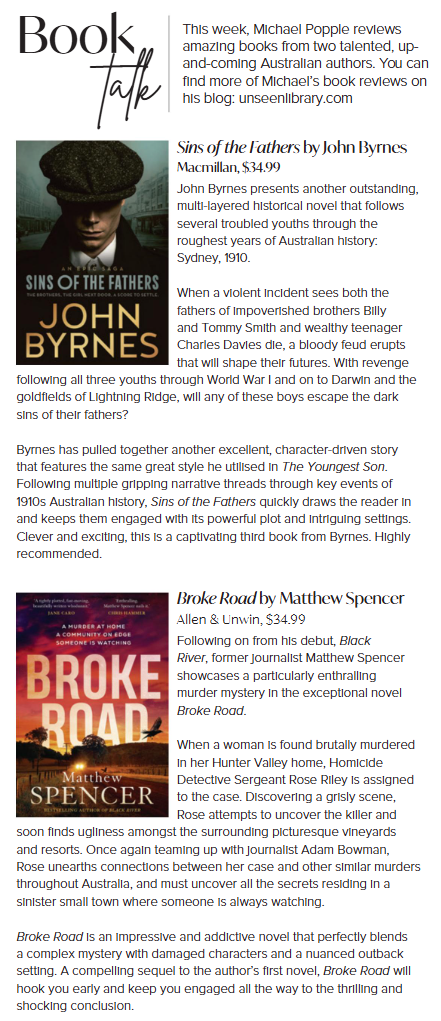
Originally published in the Canberra Weekly on 3 July 2025.
Make sure to check out my extended reviews of Sins of the Fathers and Broke Road.
Expert reviews of the latest and the best in Fantasy, Historical Fiction, Science Fiction and Crime Fiction from an Australian reviewer.

Originally published in the Canberra Weekly on 3 July 2025.
Make sure to check out my extended reviews of Sins of the Fathers and Broke Road.
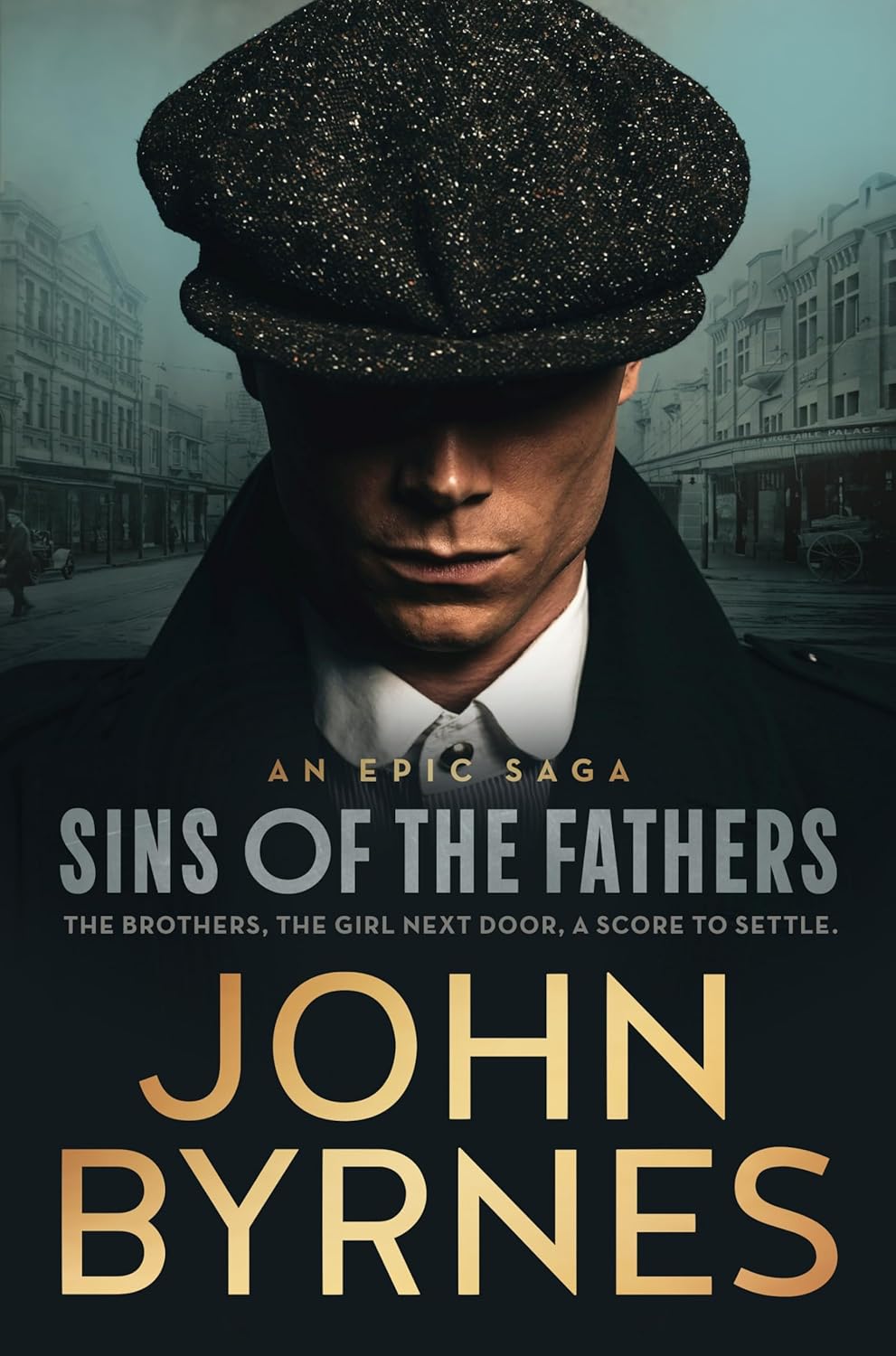
Publisher: Macmillan (Trade Paperback – 1 July 2025)
Series: Standalone
Length: 399 pages
My Rating: 4.5 out of 5 stars
A rising author in the field of Australian drama and historical fiction, John Byrnes, had a very interesting book back in 2025 that I have been meaning to review for a while, Sins of the Fathers.
Byrnes is a relatively new Australian author whose work I have been rather enjoying in recent years. Byrnes career started back in 2023 with his cool thriller Headland, a compelling modern crime fiction novel with some interesting dramatic twists around it. Headland ended up being one of my favourite debuts of 2023, and I made sure to read his next novel, the historical saga The Youngest Son (one of my favourite Australian novels of 2024). It looks like Byrnes intends to continue his focus on Australian historical epics going forward, as his third book was the intriguing and exciting novel from last year, Sins of the Fathers, which followed several compelling characters through several major events of the 1910s.
Plot Synopsis:
In 1910s Australia, the sins of the fathers leave behind a bloody legacy in this historical epic saga, perfect for fans of Peaky Blinders.
Two fathers, their sons and the feud that binds them.
In the early years of the twentieth century, Billy and Tommy Smith are growing up on the mean streets of Sydney’s Millers Point. It’s a hungry, hard-scrabble life, made even worse when their violent father returns home from a long stint in prison.
In the wealthy eastern suburbs, Charles Davies is living an entirely different life, the beneficiary of his father’s business acumen and insatiable, unyielding greed. Charles wants for nothing – except perhaps his father’s approval.
When an incident on The Point leads to the deaths of both Charles’ and the Smith boys’ fathers, a hatred is born that will follow the three men through their lives. In an epic saga taking them from Sydney to Gallipoli and the killing fields of France in World War I, to the melting pot of Darwin and the opal fields at Lightning Ridge, the men’s paths all lead to one final revenge.
But in the end, what price must be paid for the sins of the fathers?
Sins of the Fathers was a very good historical fiction read that thrusts several damaged youths into the grinder of early 20th century Australian history. Starting off strong, the book primarily begins in early 1910, when violent father of Billy and Tommy Smith is released from prison back into their already hard lives. As the Smith children attempt to survive in harsh poverty, their lives take a dangerous spin when their father is murdered, and the evidence points to crooked businessman Arthur Davies, who soon also dies. This leads to a life-long, mostly one-sided feud between the Smiths and the spoiled son of Davies, Charles, who is determined to get revenge for the slights against him. This revenge plot also extends to the Smith’s young neighbour Angeline, who serves as a love interest to Tommy throughout the book.
After these early chapters, the plot of Sins of the Fathers keeps jumping ahead every couple of years, with the protagonists examining some key historical events that impacted Sydney in the early 1910s. Naturally, this leads to the three male characters of the book getting enlisted in the Australian Army for World War I, with the Smiths and Charles Davies eventually ending up on the same battlefield, with disastrous results for all involved. At the same time, Angeline remains in Sydney and serves as an interesting fourth point-of-view character, as she uses her business acumen to survive and gain status. Back in Europe, the three male characters are eventually separated and start making their own way in the world in their own standalone adventures. The exception is Davies, who continues to attempt to get revenge and gain money by attacking his apparent rivals. Byres explores some interesting different historical locales and periods throughout the second half of Sins of the Fathers, with some intense and exciting adventures befalling the cast. Everything eventually leads up to all the characters reuniting towards the end of the book, as the protagonists attempt to overcome one last plot from Davies. The end result is a very compelling and intense standalone narrative, that drags you in with its fun characters and cool historical content.
At this point Byrnes has settled well into the historical fiction groove, producing a complex and layered narrative across several entertaining characters. Making good use of a split between four key characters, Byrnes did an excellent job exploring the turbulent 1910s in Sins of the Fathers, with some great dives into key elements of early Australia and World War I. This exploration of this crucial decade served as a captivating backdrop to the personal narratives of the four main characters, and the mixture of personalities and their separate struggles allows for a highly enjoyable read.
The resulting narrative is loaded with action, adventure and some excellent examples of personal determination, which allows for a very fast-paced read. I also loved the thrilling intrigue that surrounds the book’s antagonist, Charles Davies, who is a devious and entertaining brat incapable of taking responsibility for his actions. Byrnes did such a good job creating another repellent villain here with Davies, and watching his various schemes against the protagonists and others really amps up the stakes of the book as the reader is eager to see him fail. I frankly had the most fun with Davies’s various chapters, and it was an entertaining foil to perspectives of the more likeable protagonists. Throw in some interesting twists about the death of the Smith’s father and the resulting rivalry between them and Davies, and the entirety of Sins of the Fathers plot really comes together into a clever and deeply personal historical journey.
Overall, I was quite impressed with John Byrnes’s second dive into the historical fiction genre, and Sins of the Fathers proved to be a strong and highly exciting piece of Australian fiction that you could really sink your teeth into. An addictive epic that expertly showcased some key Australian moments and locations in the 1910s, Sins of the Fathers was a great read, and I am excited for whatever historical adventure Byrnes comes up with next.
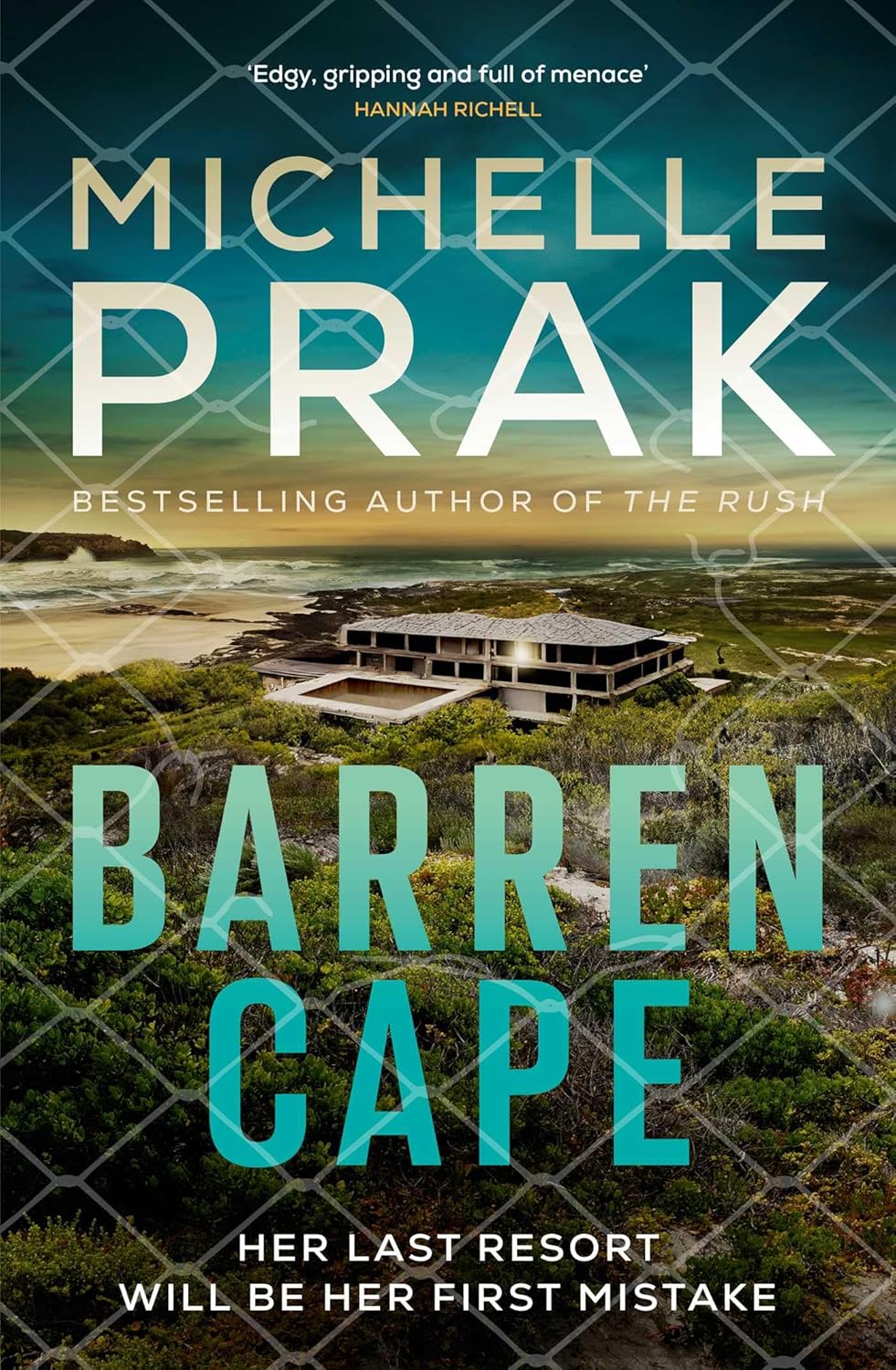
Publisher: Simon & Schuster Australia (ebook – 2 April 2025)
Series: Standalone
Length: 352 pages
My Rating: 4 out of 5 stars
Australian author Michelle Prak takes aim at a serious issue in Australian society, with her intriguing standalone thriller, Barren Cape, a great book I had the pleasure of reading in early 2025.
Plot Synopsis:
An abandoned resort seems the perfect place to hide, but is Barren Cape a refuge or a trap?
Former housemates Mac and Erika are homeless.
Well, Erika is fine, she just has to live with her parents until she can find another rental. Mac’s situation is much worse – family isn’t an option and she’s surfing the couches of her increasingly exasperated friends.
Driving around one lonely afternoon, Mac discovers Barren Cape. Once destined to be a luxury escape, now it’s just wire fence and grey cement. It’s stark, but quiet. There’s no harm in staying here a little while …
From the bestselling author of The Rush, this is the chilling result of people pushed to the fringes of society and forced to make unthinkable choices.
Barren Cape was a very compelling read from Prak that combines a cool thriller narrative with an interesting look at the current dire housing situation in Australia. Set around the city of Adelaide, Barren Cape follows three separate protagonists, including roommates Mac and Erika who find themselves homeless after losing their rental, and young teen Brex, whose family life forces her to leave home and try to find alternate accommodation.
All three point-of-view characters are eventually drawn towards the abandoned building development of Barren Cape, whose cement rooms appear to be the perfect place to hang out while the protagonists try to find their separate ways in life. However, the interactions between the three protagonists leads to a great layer of drama within the plot, which is thrown into overdrive when another resident of Barren Cape is discovered. This leads to a dark, conflict laden second half of Barren Cape, which only gets worse with every single mistake and bad decision the protagonists make. Prak constantly twists the story around, ensuring that you don’t know what’s going to happen next, and resulting in a complicated ending, where the characters try to move on to better things after experiencing some trauma.
I felt that Barren Cape came together extremely well, especially when it came to the author’s compelling examination of Australia’s housing crisis and its impacts. Showcasing various levels of the struggle in one city, Prak paints a pretty desperate picture around the lack of accommodation for vulnerable people, enough so that camping out an isolated and abandoned building site seems like a reasonable option. I really appreciated how Prak explored the characters’ desperation around this key issue, and the lengths they will go to maintain even this level of housing security. The drama that flows from this desperation, which includes some characters even overlooking murder, is intense, and its connection to a real issue ensures that all the character’s struggles are quite relatable.
One issue I had with Barren Cape was that parts of this narrative weren’t as exciting as I had hoped, with the plot mostly resolving around interactions between relatively normal characters. However, I think that this perceived lack of excitement was more on me as I was expecting a horror/slasher story, with some dangerous figures stalking the protagonists. It did feel that Prak was setting that up at times, especially with a scene around a dangerous group on the beach and a stalker for one of the characters, two story elements that never really went anywhere. One scene where a female character, who spends most of the book bodybuilding at the gym, was wrestled down by children, also took me out of the plot a little, although it led to some interesting follow-up moments. Still, the rest of the book with its complex interactions and clever take on a major modern issue helped to balance these issues out, and I ended up having a good time with this compelling novel.
Overall, Barren Cape was an excellent Australian novel from Michelle Prak, who produced an interesting and thought-provoking read. Moving, intense and diving into something that is causing a lot of concern in modern Australia, Barren Cape is well worth a read, and I’ll be curious to see what Prak writes next.
 The Unseen Library